Revista de la Facultad de Ciencias
Agrarias. Universidad Nacional de Cuyo. Tomo 54(2). ISSN (en línea) 1853-8665.
Año 2022.
Original article
Sequential
application of herbicide options for controlling Conyza sumatrensis in
soybean pre-sowing
Aplicación secuencial de opciones de herbicidas para el
control de Conyza sumatrensis en presiembra de soja
Leandro Paiola Albrecht 1
Alfredo Junior Paiola Albrecht
1
Romulo Augusto Ramos 3
Karine Yone Rodrigues da Costa
1
Gabriel Viana de Araújo 1
Tamara Thaís Mundt 1
Corina Colombari 1
1 Federal University of Paraná. R. Pioneiro. 2153. Jardim Dallas. 85950-000.
Palotina. PR. Brazil.
2 Crop Science Ltda. Linha Bem-ti-vi. mailbox 01, 85955-000. Maripá. PR. Brazil.
3
Basf S.A. Estrada Municipal
Jose Lopes. 13833-612. Santo
Antônio de Posse. SP.
Brazil.
Abstract
The aim of this
study was to evaluate the efficacy of sequentially applied herbicides to
control Conyza sumatrensis, one of the most widely distributed weeds
worldwide, in soybean pre-sowing burndown. The study was conducted under field
conditions in the state of Paraná, Brazil, at 2018-2019 growing season. The
experiment consisted of a randomized block design with four replicates, with 12
treatments consisting of different herbicide mixtures applied before sowing.
Control of C. sumatrensis, injury to soybean plants, and variables
related to agronomic performance were evaluated. The control levels were high
for all treatments, except for the one that was free of saflufenacil in either
of the two applications. These results highlight the importance of saflufenacil
in the control of C. sumatrensis and show promise for the use of
saflufenacil/imazethapyr when considering the system and other weeds. All
studied treatments were selective to soybean, which showed higher injury values
in the presence of diclosulam; however, this did not compromise the agronomic
performance of soybean.
Keywords: ALS inhibitors; Glycine max; PROTOX
inhibitors; Sumatran fleabane; Weeds.
Resumen
El objetivo de este estudio fue evaluar la eficacia de los herbicidas
aplicados secuencialmente para controlar Conyza sumatrensis, una de las
malezas más ampliamente distribuidas en todo el mundo, en la pre siembra de
soja. El estudio se realizó en condiciones de campo en el estado de Paraná,
Brasil, en la campaña 2018-2019. El experimento consistió en un diseño de
bloques al azar con cuatro repeticiones, con 12 tratamientos compuestos por
diferentes mezclas de herbicidas aplicados antes de la siembra. Se evaluó el
control de C. sumatrensis, daño a plantas de soya y variables
relacionadas con el comportamiento agronómico. Los niveles de control fueron
altos para todos los tratamientos, excepto para el que estaba libre de
saflufenacil en cualquiera de las dos aplicaciones. Estos resultados resaltan
la importancia de saflufenacil en el control de C. sumatrensis y
son prometedores para el uso de saflufenacil/imazethapyr cuando se
considera el sistema y otras malezas. Todos los tratamientos estudiados fueron
selectivos a la soja, que mostró mayores valores de daño en presencia de diclosulam;
sin embargo, esto no comprometió el comportamiento agronómico de la soja.
Palabras
clave: Inhibidores de la ALS; Glycine max; Inhibidores
de la PROTOX; Rama negra; Malezas.
Originales: Recepción: 04/05/2022
Aceptación:
12/09/2022
Introduction
The hairy
fleabane (Conyza bonariensis), horseweed (Conyza canadensis), and
the Sumatran fleabane (Conyza sumatrensis) are among the most dominant
weeds found worldwide. C. sumatrensis is believed to have originated in
subtropical South America and subsequently dispersed to Europe, America, and Asia
(11). It is an
herbaceous plant with an annual life cycle and high seed production (9, 14), and it is found in various agricultural
environments, such as grain crop fields (18). Conyza spp. disperses exclusively
through seeds present in the achene. The number of seeds produced by a single
plant varies from 100,000 to 200,000 (9). For C. sumatrensis, this number can
be as high as 350,000 seeds produced during the plant cycle These
seeds are positively photoblastic, and thus germinate only in the presence of
light, a feature favored by direct sowing in straw, at temperatures below
28-30°C. The seeds germinate mainly from fall to early spring (33) in the off-season, before the sowing of soybeans.
A study by Trezzi et al. (2015) indicated that C.
bonariensis can reduce soybean yield by 50% at a plant density of just 2.7
plants m-2. Therefore, the
adoption of control measures -most of which involve chemical control- is
essential to prevent losses in crop yield. The three species of Conyza have
105 reported cases of biotypes resistant to herbicides, such as glyphosate,
paraquat, and ALS inhibitors (12). In Brazil, the three species have been
reported to be glyphosate resistant, with C. sumatrensis having seven
records of resistance to herbicides, the largest number accounted for in the
country. Moreover, there are reports of multiple resistance to glyphosate and
chlorimuron (28), to paraquat (1), and to 2,4-D (27), among others. In this sense, an initial
application of systemic herbicides, with sequential application of burndown
and/or pre-emergent herbicides has proved to be effective and necessary,
especially for large plants with a history of herbicide resistance (8, 12). Herbicides such as PROTOX or ALS-inhibiting
herbicides can be used in sequential applications (12, 26,
34).
Considering
the aggressiveness of C. sumatrensis and the increasing number of
reports of biotypes resistant to glyphosate and other herbicides, the need for
proactive management is apparent. The combination and rotation of systemic
herbicides, with pre-emergence and/ or burndown action during sequential
application, are effective in controlling this weed species. In this context,
the objective of this study was to evaluate the efficacy of different
herbicides by analyzing the sequential application of saflufenacil/imazethapyr
in soybean pre-sowing.
Material
and Methods
Experiments
1 and 2 of the study were conducted in the field during the 2018-2019 growing
season in the municipalities of Assis Chateaubriand (24°28’28.0” S 53°51’39.8”
W) and Alto Piquiri, state of Paraná (PR), Brazil (24°06’27.01”S 53°45’35.07”
W), respectively. According to the Köppen classification, the climate of the
region is Cfa, and the weather conditions during the experimental period are
illustrated in Figures 1 and
2.
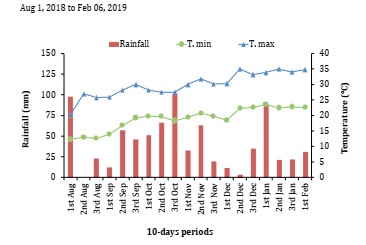
Figure 1: Rainfall and
minimum and maximum temperatures for the experimental site Assis Chateaubriand
(Experiment 1), 2018-19 growing season.
Figura 1: Representación de la lluvia, temperatura
mínima y máxima para el sitio. Campaña 2018-19, Assis Chateaubriand (Experimento 1).
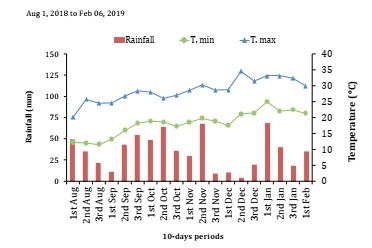
Figure 2: Representation of rainfall and minimum and maximum temperature for
the test site Alto Piquiri (Experiment 2), 2018-19 growing season.
Figura 2: Representación de la lluvia, temperatura
mínima y máxima para el sitio. Campaña 2018-19, Alto Piquiri (Experimento 2).
For experiment
1, the soil was classified as clayey (66.25% clay, 18.75% silt, and 15% sand),
with the following chemical properties in the 0-20 cm layer: pH (CaCl2) of 4.8, 2.23% organic
matter (OM), and 11.85 cmolc dm-3 of cation exchange capacity
(CEC). For experiment 2, the soil was classified as having a sandy loam texture
(12.5% clay, 10% silt, and 77.5% sand), with a pH (CaCl2)
of 7.7, 1.39% OM, and 6.64 cmolc dm-3 of CEC.
Experimental
site 1 was infested with C. sumatrensis, with a density of 6 plants m-2
(> 15 cm) and 11 plants m-2 (<15 cm), and approximately
55% of the C. sumatrensis population was resistant to paraquat. In
experimental site 2, density was 8 plants m-2 (> 15 cm) and 2 plants m-2
(<15 cm), with approximately 10% of the C. sumatrensis population
being resistant to paraquat. To determine the frequency of C. sumatrensis indicative
of resistance to this herbicide, we applied paraquat (Gramoxone®
200) on tracks at label rate (400 g ai ha-1)
14 days before the start of the experiment. Before and after application, the number
of uncontrolled plants (≤20% control) with 6-10 leaves (4-8 cm in height) was
evaluated and compared to the track where paraquat was not applied. Seven days
after the application of paraquat, a second application was performed to
determine the frequencies of resistance.
Previously,
these areas had been cultivated with maize. Soybeans were sown under no-till,
with 0.45 cm spacing between rows. Soybean cultivar Monsoy®
5917 IPRO (Monsanto Co. Brazil, São Paulo, SP, Brazil) was used
in Experiment, 1 and Monsoy® 6410
IPRO (Monsanto Co. Brazil, São Paulo, SP, Brazil) in Experiment 2. The
experiment was a randomized block design with four replicates. The treatments
are presented in Table 1.
Table 1: Treatments consisting of herbicide mixtures for controlling Conyza
sumatrensis (2018-19 growing season).
Tabla 1: Tratamientos compuestos por mezclas de
herbicidas para el control de C. sumatrensis. Campaña 2018-19.
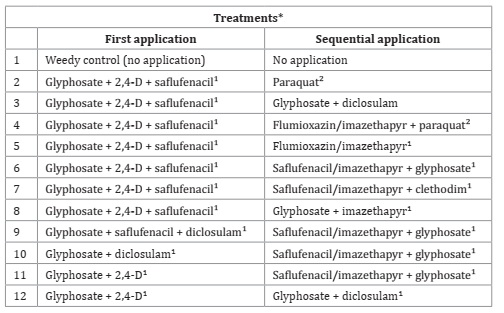
* Glyphosate (Zapp® QI 620 - 1,500 g ae ha-1);
2,4-D (DMA® 806 BR - 670 g ae ha-1); saflufenacil
(Heat® - 35 g ai ha-1);
diclosulam (Spider® 840 WG - 25.2 g ai ha-1); paraquat (Gramoxone®
200-400
g ai ha-1);
flumioxazin/imazethapyr (Zethamaxx® - 100/50 g ai/ae ha-1);
saflufenacil/imazethapyr
(Optill® - 35.6/100.4 g ai/ae ha-1);
clethodim (Poquer® - 144 g ai ha-1); imazethapyr (Vezir® 100-100 g
ae ha-1).
¹Adjuvant
Agral® (250 mL ha-1) used. ²Adjuvant Mees® (500 mL ha-1)
used.
* glyphosate (Zapp® QI 620 - 1,500 g ea ha-1);
2,4-D (DMA® 806 BR - 670 g ea ha-1); saflufenacil (Heat® - 35 g ia ha-1); diclosulam
(Spider® 840 WG - 25.2 g ia ha-1);
paraquat (Gramoxone® 200 - 400 g ia ha-1);
flumioxazin/imazethapyr
(Zethamaxx® - 100/50 g ia/ea ha-1);
saflufenacil/imazethapyr (Optill® - 35.6/100.4 g ia/ea ha-1);
clethodim
(Poquer® - 144 g ia ha-1); imazethapyr (Vezir® 100 - 100 g ea ha-1).
¹ Uso de adyuvante Agral® (250 mL ha-1). ² Uso de adyuvante
Mees® (500 mL ha-1)
The dates of application,
sowing, and environmental conditions during application are listed in Table 2.
Table 2: Dates and weather conditions during herbicide applications.
Tabla 2: Fechas y condiciones climáticas durante la
aplicación de herbicidas.
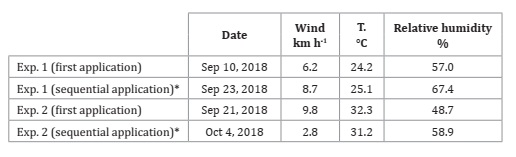
* Day of sowing. / * Realizado el mismo día de la
siembra.
All
applications were performed with a pressurized CO2 backpack sprayer, equipped
with six AIXR 110.015 nozzles, at a pressure of 2.5 kg * cm-2 and a speed of 3.6 km * h-1, providing an
application volume of 150 L * ha-1.
The control of C.
sumatrensis was evaluated at soybean sowing and 7, 21, and 35 days after
the second application (DAA) of herbicides. Importantly, after the last control
evaluation, all treatment plots were weeded except for the control. Injury to
soybean plants was evaluated 14, 28, and 35 days after sowing (DAS), which was
also performed in maize crops grown in succession areas. These evaluations were
conducted through visual analysis at each experimental unit (0 for no injury,
up to 100% for plant death), considering significantly visible symptoms in the
plants according to their development (32).
Upon harvest,
plant height and yield were evaluated. To evaluate the stand, the number of
plants per meter was counted with four measurements per plot. Plant height was
measured using a wooden ruler (10 plants per plot). For yield, the two central
rows were harvested (4 m in length), moisture was corrected to 13%, and the
results were extrapolated to kg ha-1.
Analyses were
performed using the statistical software Sisvar 5.6 (10). In addition, an analysis of variance
(ANOVA) and an F-test (P ≤ 0.05) were performed following Pimentel-Gomes and Garcia (2002), and mean treatment
values were grouped using the Scott and Knott (1974)
test (P ≤ 0.05).
Results
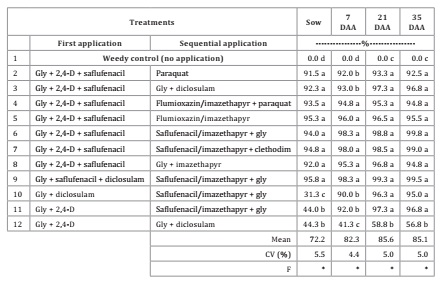
For control
evaluation at sowing, values of at least 91.5% were observed in Experiment 1
for the application of glyphosate + 2,4-D + saflufenacil and glyphosate +
saflufenacil + diclosulam, The first evaluation was conducted 13 days after the
first application, and the following evaluations included the effects of the
two herbicides. In subsequent evaluations, all herbicide treatments resulted in
the control of at least 90% of C. sumatrensis, with the exception of
treatment 12. This treatment consisted of the first application of glyphosate +
2,4-D and the sequential application of glyphosate +
diclosulam, and control at 35 DAA was only 56.8% (Table 3).
Table 3: Conyza sumatrensis control
(%) after herbicide application. 2018-19 growing season, Assis Chateaubriand (Experiment 1).
Tabla 3: Control (%) de C. sumatrensis después
de la aplicación de herbicidas. Campaña 2018-19, Assis Chateaubriand (Experimento 1).
Sow: sowing; DAA: day after sequential application; Gly:
glyphosate. * Means followed by different letters in the same column are
significantly different according to the Scott and Knott’s (1974) test, P ≤
0.05.
Sow: siembra. DAA: día después de la aplicación secuencial. gly: glyphosate. * Las medias seguidas de la misma
letra en la columna no difieren entre sí por Scott y Knott (1974), P ≤
0,05.
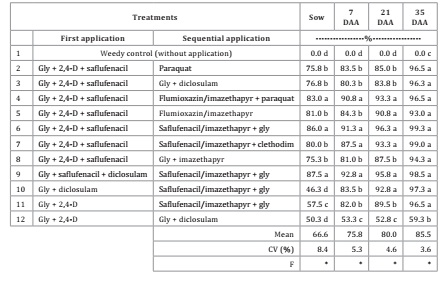
The control
results for C. sumatrensis in Experiment 2 were similar to those
observed in Experiment 1. The highest percentages at soybean sowing were
obtained for glyphosate + 2,4-D + saflufenacil and
glyphosate + saflufenacil + diclosulam, with 75.3-87.5% of C. sumatrensis controlled.
For the following evaluations, C. sumatrensis control of at least 80.3%
(at 7 DAA) was recorded. At 35 DAA, with C. sumatrensis control between
93% and 99% in all evaluations, the only satisfactory control was found for
treatment 12, which was 59.3% (Table 4).
Table 4: Conyza sumatrensis control (%)
after herbicide application. 2018-19 growing season, Alto Piquiri
(Experiment 2).
Tabla 4: Control (%) de C. sumatrensis después
de la aplicación de herbicidas. Campaña 2018-19, Alto Piquiri (Experimento 2).
Sow: sowing. DAA: day after sequential application. gly: glyphosate. * Means followed by different letters in
the same column are significantly different according to the Scott and Knott’s
(1974) test, P ≤ 0.05.
Sow: siembra. DAA: día después de la aplicación
secuencial. gly: glyphosate. * Las medias
seguidas de la misma letra en la columna no difieren entre sí por Scott y Knott
(1974), P ≤ 0,05.
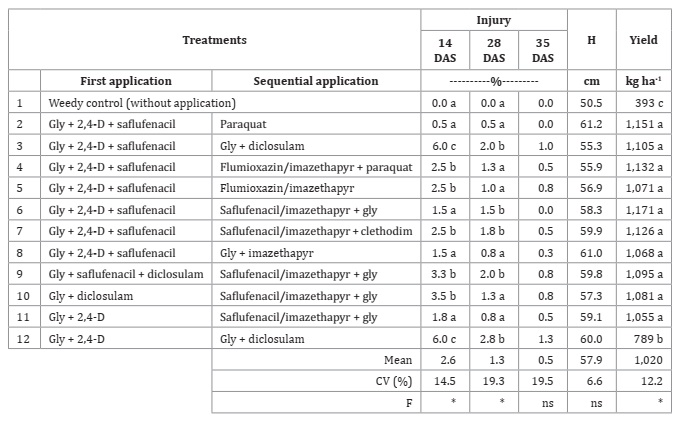
In
Experiment 1, injury of up to 6% at 7 DAS was observed for treatments 3
(glyphosate + 2,4-D + saflufenacil sequential [seq.]
glyphosate + diclosulam) and 12 (glyphosate + 2,4-D seq. glyphosate +
diclosulam). However, a reduction in symptoms was observed in subsequent
evaluations, even without any differences between treatments in the last
evaluation at 35 DAS. Moreover, in the area of both experiments, maize was
grown in the second crop (sowing in January 2019), and no crop injury was
detected at 14, 28, and 35 DAS.
In addition, no
differences were found between treatments for plant height in Experiment 1.
There was also a reduction in yield for the control, as well as for treatment
12, which resulted in the lowest control of C. sumatrensis and lowest
soybean yield among all herbicide treatments. This may be because we used an
earlier cycle cultivar and due to a water deficit in the first and second
10-day periods in December, with only 17 mm of rainfall and maximum average
temperatures of 30.3°C and 35.1°C being observed during this time. For the
control and treatment 12, in addition to weather conditions, competition with C.
sumatrensis plants further reduced yield (Table 5).
Table 5: Percentage of plant injury, height, and yield of soybean plants
after herbicide application for control of Conyza sumatrensis. 2018-19
growing season, Assis Chateaubriand (Experiment 1).
Tabla 5: Daño al cultivo, altura y rendimiento de las
plantas de soya después de la aplicación del herbicida, para el control de C.
sumatrensis. Campaña
2018-19, Assis Chateaubriand (Experimento 1).
DAS:
days after sowing; Gly: glyphosate; H: height. * Means followed by different
letters in the same column are significantly different
according to the Scott and Knott’s
(1974) test, P ≤ 0.05. ns:
non-significant, or means do not differ from each other according to the F-test
(P > 0.05).
DAS: días después de la siembra. gly: glyphosate. H: altura. * Las medias
seguidas de la misma letra en la columna no difieren entre sí por Scott y Knott
(1974), P ≤ 0,05. ns: no significativo,
los medios no difieren entre sí por la prueba F (P > 0,05).
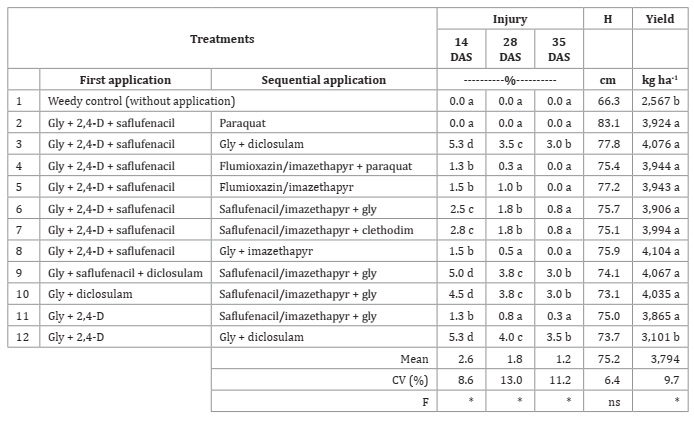
In
Experiment 2, differences were detected between treatments in the three
evaluations of injury to plants, with stronger symptoms (up to 5.3%) at 14 DAS
and symptom reduction in the subsequent evaluations. At 35 DAS, the strongest
symptoms were observed for treatments 3 and 12, as in Experiment 1, and for
treatments 9 (glyphosate + saflufenacil + diclosulam seq.
saflufenacil/imazethapyr + glyphosate) and 10 (glyphosate + diclosulam seq.
saflufenacil/imazethapyr + glyphosate), with values of 3-3.5% injury. No
differences were observed between treatments with respect to plant height.
Differences in yield were observed, whereas in Experiment 1, reductions were
observed in the control and treatment 12 due to competition with C.
sumatrensis plants. The other herbicide treatments were superior to these
two, but showed no significant differences from each other, with values of up
to 4,104 kg ha-1 (Table 6).
Table 6: Percentage of plant injury, height, and yield of soybean plants
after herbicide application for the control of Conyza sumatrensis. 2018-19
growing season, Alto Piquiri (Experiment 2).
Tabla 6: Daño al cultivo, altura y rendimiento de las
plantas de soja después de la aplicación del herbicida, para el control de C.
sumatrensis. Campaña
2018-19, Alto Piquiri (Experimento 2).
DAS:
days after sowing; Gly: glyphosate; H: height. * Means followed by different
letters in the same column are significantly different according to the Scott
and Knott’s (1974) test, P
≤ 0.05. ns: non-significant, or means do not differ from each other
according to the F-test (P
>
0.05).
DAS: días después de la siembra. gly:
glyphosate. H: altura. * Las medias seguidas de la misma letra en la
columna no difieren entre sí por Scott y Knott (1974), P ≤ 0,05. ns: no significativo, los medios no difieren entre sí por la
prueba F (P > 0,05).
Discussion
In both
experiments, treatments with sequential application of saflufenacil/
imazethapyr and flumioxazin/imazethapyr were among the most effective in
controlling C. sumatrensis. According to Hedges et
al. (2019), the pre-sowing application of dicamba/ glyphosate (1,800 g
ae ha-1) + saflufenacil
(25 g ai ha-1)
or saflufenacil/imazethapyr (100 g ae ha-1)
was effective in controlling C. canadensis, with results of ≥91% (12
weeks after application). Similarly, Cantu et al. (2021)
reported the effectiveness of dicamba, in combination with other herbicides, in
the control of C. sumatrensis. Moreover, Hedges et
al. (2019) observed up to 10% soybean injury with the application of
saflufenacil in different chemical management programs; however, the symptoms
did not result in reduced soybean yield, thus demonstrating that the
application of saflufenacil is effective in different management programs to
control Conyza spp. (4, 7, 15, 16, 17,
34). Other studies also
demonstrated, as in the present study, the efficacy of flumioxazin in different
combinations for the control of Conyza spp. (20, 23,
26, 34).
In this
study, the application of treatment 12 (glyphosate + 2,4-D seq.
glyphosate + diclosulam) was not satisfactorily effective in controlling C.
sumatrensis in both experiments; rather, it was the most phytotoxic
treatment to soybean plants, with up to 6% at 14 DAA, as observed in Experiment
1. From a control point of view, an additional post-emergence application is
necessary for soybean. Neto et al. (2009)
observed an injury of 2.2% in soybean plants treated with glyphosate (960 g ae
ha-1) + diclosulam
(35 g ai ha-1)
at the V1 stage. These symptoms did not affect soybean yield, indicating the
selectivity of the combination.
Furthermore,
soil and climate conditions interfere with the effects of diclosulam and other
pre-emergents on soybean; for example, high rainfall after application can
increase soybean injury (8), which may explain what was observed in the
present study. According to Pereira et al. (2000)
and Osipe et al. (2014), the application of
diclosulam to soybean was selective, alone or in combination with glyphosate,
although some symptoms of injury were observed.
The results
presented herein demonstrate the importance of herbicide application before
soybean sowing for the effective control of C. sumatrensis. The use of
systemic herbicides in the first application, as well as the sequential
application of burndown herbicides, is essential for the control of large
plants (>15 cm height), notably saflufenacil and flumioxazin (PROTOX
inhibitors), in addition to imazethapyr (ALS inhibitor) herbicides. These
herbicides are also effective in controlling other weeds, especially broadleaf
weeds such as Amaranthus spp., Ipomoea spp., and Commelina spp.,
and imazethapyr has been shown to act on Digitaria insularis, D.
horizontalis, and other monocotyledons. Furthermore, our results indicate
the effectiveness of the sequential application of these herbicides in
controlling C. sumatrensis, which is relevant as they might contribute
to supporting the ban on paraquat in Brazil.
Finally,
control of Conyza spp. and other weeds cannot be left solely to
glyphosate, as this genus has 66 cases of glyphosate-resistant biotypes
worldwide. For instance, in Brazil, Lolium perenne ssp. multiflorum,
C. bonariensis, C. sumatrensis, C. canadensis, D. insularis,
Chloris elata, Amaranthus palmeri, Eleusine indica, and Amaranthus
hybridus have glyphosate-resistant biotypes (12). Thus, the use of other herbicides, such as
ALS inhibitors, auxinics, and glufosinate, should be considered. This is
especially true for combinations and weed management during the off-season, as
studies have highlighted the efficacy of pre-emergence herbicides along with
pre-sowing burndown for weed management in grain crops (2, 3,
5, 21, 31).
Conclusion
Control levels
were high for all the herbicide treatments, except for the one that was free of
saflufenacil in both applications. These results highlight the importance of
saflufenacil in controlling C. sumatrensis and show promise for
saflufenacil/imazethapyr considering the system and other weeds. Finally, all
studied treatments were selective to soybean, which showed higher injury values
in the presence of diclosulam; however, this did not compromise soybean
agronomic performance.
Acknowledgements
This study
was financed in part by the Coordenação de Aperfeiçoamento de Pessoal de Nível
Superior - Brasil (CAPES) - Finance Code 001
1. Albrecht, A. J. P.; Pereira, V. G. C.; Souza, C. N. Z.;
Zobiole, L. H. S.; Albrecht, L. P.; Adegas, F. S. 2020. Multiple resistance of Conyza sumatrensis to three mechanisms
of action of herbicides. Acta Sci. Agron. 42: e42485.
DOI: 10.4025/actasciagron.v42i1.42485
2. Belfry, K. D.; Soltani, N.; Brown, L. R.; Sikkema, P. H. 2015.
Tolerance of identity preserved soybean cultivars to preemergence herbicides.
Can. J. Plant Sci. 95(4): 719-726. DOI: 10.4141/cjps-2014-351
3. Braz, G. B.; Oliveira Junior, R. S.; Zobiole, L. H. S.; Rubin,
R. S.; Voglewede, C.; Constantin, J.; Takano H. K. 2017. Sumatran
fleabane (Conyza sumatrensis) control in no-tillage soybean with
diclosulam plus halauxifen-methyl. Weed Technol. 31(2): 184-192. DOI:
10.1017/wet.2016.28
4. Budd, C. M.; Soltani, N.; Robinson, D. E.; Hooker, D. C.;
Miller, R. T.; Sikkema, P. H. 2016. Glyphosate-resistant
horseweed (Conyza canadensis) dose response to saflufenacil,
saflufenacil plus glyphosate, and metribuzin plus saflufenacil plus glyphosate
in soybean. Weed Sci. 64(4): 727-734. DOI: 10.1614/WS-D-15-00211.1
5. Byker, H. P.; Soltani, N.; Robinson, D. E.; Tardif, F. J.;
Lawton, M. B.; Sikkema, P. H. 2013. Control of glyphosate-resistant Canada
fleabane [Conyza canadensis (L.)
Cronq.] with preplant herbicide tankmixes in
soybean [Glycine max (L). Merr.].
Can. J. Plant Sci. 93(4): 659-667. DOI: 10.4141/cjps2012-320
6. Cantu, R. M.; Albrecht, L. P.; Albrecht, A. J. P.; Silva, A. F.
M.; Danilussi, M. T. Y.; Lorenzetti, J. B. 2021. Herbicide
alternative for Conyza sumatrensis control in pre-planting in no-till
soybeans. Adv. Weed Sci. 39: e2021000025. DOI:
10.51694/AdvWeedSci/2021;39:000012
7. Cesco, V. J. S.; Nardi, R.; Krenchinski, F. H.; Albrecht, A. J.
P.; Rodrigues, D. M.; Albrecht, L. P. 2019. Management of
resistant Conyza spp. during soybean pre-sowing. Planta Daninha.
37: e019181064. DOI: 10.1590/s0100-83582019370100039
8. Dalazen, G.; Kaspary, T. E.; Markus, C.; Pisoni, A.; Merotto
Junior, A. 2020. Soybean tolerance to sulfentrazone and
diclosulam in sandy soil. Planta Daninha 38: e020225717. DOI:
10.1590/S0100-83582020380100081
9. Dauer, J. T.; Mortensen, D. A.; Vangessel, M. J. 2007. Temporal
and spatial dynamics of long‐distance Conyza
canadensis seed dispersal. J. Appl. Ecol. 44(1): 105-114. DOI:
10.1111/j.1365-2664.2006.01256.x
10. Ferreira, D. F. 2011. Sisvar: a computer statistical analysis
system. Cienc. Agrotecnol.
35(6): 1039-1042. DOI: 10.1590/S1413-70542011000600001
11. Hao, J. H.; Qiang, S.; Liu, Q. Q.; Cao, F. 2009. Reproductive
traits associated with invasiveness in Conyza sumatrensis. J. Syst.
Evol. 47(3): 245-254. DOI: 10.1111/j.1759-6831.2009.00019.x
12. Heap, I. M. 2022. International survey of
herbicide resistant weeds. http://www.weedscience.org (Accessed May 2022).
13. Hedges, B. K.; Soltani, N.; Robinson, D. E.; Hooker, D. C.;
Sikkema, P. H. 2019. Control of glyphosate-resistant Canada
fleabane in Ontario with multiple effective modes-of-action in glyphosate/
dicamba-resistant soybean. Can. J. Plant Sci. 99(1): 78-83. DOI:
10.1139/cjps-2018-0067
14. Lorenzi, H. 2014. Manual de identificação
e controle de plantas daninhas: plantio direto e convencional. 7th. ed. Nova Odessa. Instituto Plantarum.
15. Mahoney, K. J.; McNaughton, K. E.; Sikkema, P. H. 2016. Herbicide tank mixtures to control co-existing glyphosate-resistant
Canada fleabane and giant ragweed in soybean. Can. J. Plant Sci. 96(4):
657-661. DOI: 10.1139/cjps-2015-0344
16. Mellendorf, T. G.; Young, J. M.; Matthews, J. L.; Young, B. G.
2013. Influence of plant height and glyphosate on saflufenacil efficacy on glyphosate-resistant
horseweed (Conyza canadensis). Weed Technol. 27(3): 463-467. DOI:
10.1614/WT-D-13-00004.1
17. Montgomery, G. B.; Treadway, J. A.; Reeves, J. L.; Steckel, L.
E. 2017. Effect of time of day of application of 2,4-D,
dicamba, glufosinate, paraquat, and saflufenacil on horseweed (Conyza
canadensis) control. Weed Technol. 31(4): 550-556. DOI: 10.1017/wet.2017.34
18. Moreira, H. J. C.; Bragança, H. N. P. 2011. Manual de identificação de plantas infestantes: cultivos de verão. Campinas. FMC Agricultural Products.
19. Neto, M. E. F.; Pitelli, R. A.; Basile, E.; Timossi, P. C.
2009. Selectivity of post-emergence herbicides applied on genetically modified
soybeans. Planta Daninha. 27(2): 345-352. DOI: 10.1590/S0100-83582009000200018
20. Norsworthy, J. K.; McClelland, M.; Griffith, G. M. 2009. Conyza canadensis (L.) Cronquist
response to pre-plant application of residual herbicides in cotton (Gossypium
hirsutum L.). Crop Prot. 28: 62-67. DOI:
10.1016/j.cropro.2008.08.012
21. Nunes, A. L.; Lorenset, J.; Gubiani, J. E.; Santos, F. M.
2018. A multy-year study reveals the importance of residual herbicides on weed
control in glyphosate-resistant soybean. Planta Daninha. 36: e018176135. DOI:
10.1590/s0100-83582018360100039
22. Osipe, J. B.; Oliveira Junior, R. S.; Constantin, J.; Biffe,
D. F.; Rios, F. A.; Franchini, L. H. M.; Gheno, E. A.; Raimondi, M. A. 2014. Selectivity of combined applications of herbicides in pre and
post-emergence for the glyphosate tolerant soybean. Biosci.
J. 30(3): 623-631.
23. Owen, L. N.; Steckel, L. E.; Koger, C. H.; Main, C. L.;
Mueller, T. C. 2009. Evaluation of spring and fall burndown
application timings on control of glyphosate-resistant horseweed (Conyza
canadensis) in no-till cotton. Weed Technol. 23 (3): 335-339. DOI:
10.1614/WT-08-170.1
24. Pereira, F. D. A. R.; Alvarenga, S. L. A.; Otubo, S.; Morceli,
A.; Bazoni R. 2000. Seletividade de sulfentrazone em cultivares
de soja e efeitos residuais sobre culturas sucessivas, em solos de cerrado. Rev. Bras. Herb. 1(3): 219-224. DOI: 10.7824/rbh.v1i3.338
25. Pimentel-Gomes, F.; Garcia, C. H. 2002. Estatística
aplicada a experimentos agronômicos e florestais: exposição com exemplos e
orientações para uso de aplicativos. Piracicaba. Fealq.
26. Pittman, K. B.; Barney, J. N.; Flessner, M. L. 2019. Horseweed (Conyza canadensis) suppression from cover crop
mixtures and fall-applied residual herbicides. Weed Technol. 33(2):
303-311. DOI: 10.1017/wet.2018.111.
27. Queiroz, A. R.; Delatorre, C. A.; Lucio, F. R.; Rossi, C. V.
S.; Zobiole, L. H. S.; Merotto Junior, A. 2020. Rapid necrosis: a novel plant
resistance mechanism to 2,4-D. Weed Sci. 68 (1): 6-18.
DOI: 10.1017/wsc.2019.65
28. Santos, G.; Oliveira Junior, R. S.; Constantin, J.;
Francischini, A. C.; Osipe, J. B. 2014. Multiple resistance
of Conyza sumatrensis to chlorimuron-ethyl and to glyphosate. Planta
Daninha. 32(2): 409-416. DOI: 10.1590/S0100-83582014000200019
29. Scott, A. J.; Knott, M. 1974. A cluster analysis method for
grouping means in the analysis of variance. Biometrics.
30: 507-512. DOI: 10.2307/2529204
30. Trezzi, M. M.; Vidal, R. A.; Patel, F.; Miotto Junior, E.;
Debastiani, F.; Balbinot Junior, A. A.; Mosquen, R. 2015. Impact
of Conyza bonariensis density and establishment period on soyabean grain
yield, yield components and economic threshold. Weed Res. 55(1): 34-41.
DOI: 10.1111/wre.12125
31. Underwood, M. G.; Soltani, N.; Robinson, D. E.; Hooker, D. C.;
Swanton, C. J.; Vink, J. P.; Sikkema, P. H. 2017. Weed control, environmental
impact, and net revenue of two-pass weed management strategies in
dicamba-resistant soybean. Can. J. Plant Sci. 98(2): 370-379. DOI:
10.1139/cjps-2017-0147
32. Velini, D. E.; Osipe, R.; Gazziero, D. L. P. 1995. Procedimentos para instalação, avaliação e análise de experimentos com
herbicidas. Londrina. SBCPD.
33. Wu, H.; Walker, S.; Rollin, M. J.; Tan, D. K. Y.; Robinson,
G.; Werth, J. 2007. Germination, persistence, and emergence of flaxleaf
fleabane (Conyza bonariensis [L.]
Cronquist). Weed Biol. Manag. 7(3): 192-199. DOI:
10.1111/j.1445-6664.2007.00256.x
34. Zimmer, M.; Young, B. G.; Johnson, W. G. 2018. Herbicide
programs utilizing halauxifen-methyl for glyphosate-resistant horseweed (Conyza
canadensis) control in soybean. Weed Technol. 32(6): 659-664. DOI: 10.1017/wet.2018.60