Revista de la Facultad de Ciencias
Agrarias. Universidad Nacional de Cuyo. Tomo 54(2). ISSN (en línea) 1853-8665.
Año 2022.
Original article
Responses of Panicum
and Brachiaria to irrigation during winter in the Goiás’
Cerrado-Brazil
Respuestas de Panicum y Brachiaria al riego durante el invierno en
el Cerrado de Goiás-Brazil
Dyb Youssef Bittar 1
Wilian Henrique Diniz Buso
2
1 Mestre em Irrigação no Cerrado. Instituto Federal Goiano. Campus Ceres. Rod. GO 154, km 03. Zona Rural. Ceres-GO. 76.300-000. Brazil.
2
Instituto Federal Goiano. Campus
Ceres. Rod. GO 154, km 03, Zona Rural. Ceres-GO. 76.300-000. Brazil.
*cleiton.sousa@ifgoiano.edu.br
Abstract
Forage
production in the Cerrado is based on well-defined seasons: a rainy summer, and
a dry winter. To define strategies that minimize the seasonality of forage
production, responses in growth and biomass accumulation of five irrigated
forages were evaluated during winter. The experimental design was randomized
blocks, in a split plot arrangement, with five replicates, five forages in the
plots (three of Panicum maximum - Mombasa, Tanzania, and Masai; two of Brachiaria
brizantha - piatã and MG5), and five cuts in the subplots made from July to
October 2016. Forages were cultivated with centre-pivot irrigation and the
water level was defined according to the reference evapotranspiration
determined through a Class A pan evaporation method, 0.8 kc, and two-day
irrigation shifts. The number of shoots, leaves/tiller, leaves/plant, fresh
leaf and stem biomass, dry leaf and stem biomass, fresh leaf mass/fresh stem
mass ratio, dry leaf mass/dry stem mass ratio, and biomass accumulated in the
five cuts were calculated. Irrigated forage during winter in the Goiás’ Cerrado
showed satisfactory growth, reaching a lower plant height between cuts than
those reported in the literature. Among the Panicum grasses, Mombasa
grass stood out, and MG was superior to piatã grass.
Keywords: Forage; Fresh weight; Dry weight; Tillering; Supplementary
irrigation.
Resumen
La producción de forrajes en el Cerrado presenta estacionalidad debido a
estaciones bien definidas, una lluviosa, con altas temperaturas y días largos,
y la otra, estación seca, con temperaturas más bajas y días más cortos. Con el
fin de definir estrategias para minimizar la estacionalidad en la producción
de forrajes, se evaluaron las respuestas de crecimiento y acumulación de
biomasa en cinco forrajes regados durante el invierno en Cerrado Goiano. El
diseño experimental utilizado fue en bloques al azar, en un arreglo de parcelas
divididas, con cinco repeticiones, cinco forrajes en las parcelas (tres del
género Panicum maximum - mombaça, tanzânia y massai; dos del género Brachiaria
brizantha - piatã y MG5) y cinco cortes en las subparcelas. Los cortes se
realizaron entre julio y octubre de 2016. Los forrajes se cultivaron en un área
irrigada con pivote y la lámina de agua se definió según la evapotranspiración
de referencia (ETo), estimada por el tanque clase A, 0.8 kc y riego con un
intervalo de dos días. Se evaluó el número de macollos, hojas por labranza,
hojas por planta, biomasa de hojas y tallos frescos, biomasa seca de hojas y
tallos, relación masa de hojas frescas x masa fresca, relación masa de hojas
secas x masa seca de los cinco cortes. Los forrajes regados durante el invierno
en el Cerrado Goiano mostraron un crecimiento satisfactorio, alcanzando altura
de planta con intervalos de corte más cortos que los encontrados en la
literatura. Mombaça se destacó entre el Panicum y MG fue superior al piatã.
Palabras
clave: Forraje; Materia fresca; Materia seca; Macollamiento; Riego complementario.
Originales: Recepción: 28/04/2021
Aceptación:06/12/2022
Introduction
The Goiás’
Cerrado has a seasonal tropical climate with rainy summers and dry winters. The
temperature can reach 40°C in summer and 10°C in winter. The average annual
rainfall is approximately 1500 mm, and is distributed between October and
April. In winter, the days are shorter, whereas in summer, they are longer.
It is estimated
that the Cerrado has 50 million ha of cultivated pastures (24). In the pastures in the Goiás’ Cerrado,
grasses of the genus Brachiaria are predominantly grown (5, 18); however, the areas cultivated with Panicum
have been significantly increasing. These plants have a C4 carbon fixation
metabolism and generally exhibit better growth and biomass accumulation at
temperatures between 30 and 40°C and high luminosity.
The areas of
pastures cultivated with Brachiaria species in Brazil are probably
unequalled by other forages in any other country with a tropical climate,
especially at the national level with Brachiaria brizantha cv. MG-5 (7). On the other hand, Panicum maximum is
one of the main forage species cultivated worldwide, and is highly valued for
its dry matter production and forage quality (23).
In tropical
regions, rain is the main factor that limits the growth and accumulation of
forage mass, and it has been verified that the seasonality of rainfall
influences the increase in biomass of Pennisetum purpureum cv. Roxo (16). The seasonality of Brachiaria brizantha cv.
Marandu production, even with fertigation, had higher values in spring and
summer and lower values during the autumn-winter season (22).
Nevertheless,
the seasonality in the growth and accumulation of biomass depends on the
interaction of the plants with edaphoclimatic conditions, and in some cases,
the water supply does not provide the maximum forage yield. In these cases, the
low yields in autumn-winter were compensated for by the better quality of
forage crude protein and neutral detergent fiber (22).
The use
of irrigation in pastures in the Cerrado still predominates based on the
empirical experience of producers and is still not based on academic research.
The authors found that dry matter production of Mombasa grass during spring was
higher than that during winter, with an increase in the production of dry
matter with an increase in the minimum temperature. They also defined minimum
air temperature and water availability in the soil as the main factors
responsible for the mass production of Mombasa grass.
Higher air
temperatures, with high luminosity and moisture, stimulate the growth of C4
plants throughout the year, providing high productive potential. However, low
temperatures can reduce or even prevent plant growth. Little or no growth is
expected for tropical grasses when temperatures are below 15°C (17). Thus, even
with irrigation, the plant did not produce good yields under these conditions (20).
Accordingly,
the objective of this study was to evaluate the responses of growth and biomass
accumulation of five forage plants grown under irrigation in the Goiás’
Cerrado.
Material
and methods
The experiment
was conducted at the Federal Institute Goiano - Campus Ceres, Ceres - GO, in a
center-pivot irrigated plot, with the following Cartesian Coordinates:
15°18′49” S, 49°36´12” W, located at an approximate altitude of 570 m a. s. l.
According to
Koeppen’s classification, the climate of the site is Aw, which is a tropical
climate with a dry season in winter. Average minimum temperature in the coldest
months was below 15°C, and in the hottest months, the average maximum
temperature exceeded 35°C. The average annual rainfall is approximately 1575
mm.
The soil of the
experimental area is a typical eutrophic Red Latosol with a very frank clayey
texture. The chemical and physical properties of the soil in the experimental
area are: 48.2% sand, 4.0% silt, 47.8% clay, pH (in water) = 5.62, organic
matter (OM) = 22 g dm-3 (colorimetric), P = 50.0 mg dm-3, K = 0.56 cmolc dm-3, Ca = 3.85 cmolc dm-3, Mg = 1.94 cmolc dm-3
(KCl mol.l-1),
H+Al = 3.80 cmolc
dm-3
(SMP buffer at pH 7.5), and V = 62.57%. The methodology used for
the soil analysis followed the recommendations of Embrapa
(2011).
The average,
maximum, and minimum temperatures, and evapotranspiration (Figure 1) were
determined using the Class A pan evaporation method during the experimental
period.
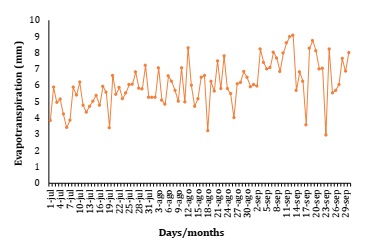
Figure 1: Evapotranspiration
monitored by Class A pan evaporation method during the experimental period.
Figura 1: Evapotranspiración monitoreada por el método
de evaporación, tanque Clase A, durante el período experimental.
During
the experiment, the following rainfall was recorded: 16/08/2016 - 42 mm,
21/08/2016 - 1 mm, 25/08/2016 - 1 mm, 01/09/2016 - 20 mm, 02/09/2016 - 2 mm,
16/09/2016 - 10 mm, 17/09/2016 - 1 mm, 25/09/2016 - 25 mm, 01/10/2016 - 18 mm,
03/10/2016 - 1 mm, 04/10/2016 - 15 mm, 05/10/2016 - 12 mm, and 06/10/2016 - 6
mm.
The
experimental design was a completely random block split plots arrangement with
five replicates, five forages in the plots (three of the species Panicum
maximum - Mombasa, Tanzania, and Masai, two of the species Brachiaria
brizantha (cultivar piatã and MG5), and five cuts in the sub-plots.
The soil was
prepared in a conventional manner with one plowing and two harrowings. The
deployment of forage occurred on December 29, 2015, with a distribution of 20
kg of seeds per ha, with a crop value of 50% for Brachiaria and 32% for Panicum.
Seventy days
after emergence, the plants were cropped to standardize the plots, and the
residues were removed, followed by application of the treatments.
The area was
irrigated with a central pivot, and the water level was calculated according to
the reference evapotranspiration (ET0) from a class A pan, crop coefficient of
0.80 (1), and two-day
irrigation shifts.
Maintenance
fertilization was performed with urea, which provided 300 kg N ha-1
year-1 for Mombasa and Tanzania, 250
kg N ha-1
year-1 for
Masai, and 200 kg N ha-1 year−1 for MG5 and Piatã. The
distribution of fertilizer was always by haul after cropping.
The sward
height was monitored twice per week. When the grasses displayed the height
indicated in the literature (Mombasa 0.9 m; Tanzania 0.7 m; Masai 0.55 m; MG 5
and piatã 0.35m), the forage plants were cropped, retaining the height
recommended in the literature.
Sampling was
conducted on July 30, August 18, September 05, September 21, and October 07 for
Mombasa, Tanzania, and Massai grass, and August 02, August 20, September 07,
September 23, and October 9 for MG5 and Piatã grass, all in 2016.
For each cut,
the number of tillers, leaves per tiller, leaves per plant, fresh biomass of
the leaf and stem, dry leaf biomass and stem, fresh mass ratio of leaves
relative to that of fresh mass, and ratio of the dry mass of leaves relative to
that of dry mass of stems were evaluated. The biomass accumulated in the five
cuts was estimated using the fresh and dry biomass obtained from each cut.
The results
were subjected to analysis of variance (F-test at 5%), and the means were
compared using the Tukey test with 5% significance using the statistical
program SISVAR.
Results
During the
experimental period, the maximum, minimum, and average temperatures,
photoperiod, total light exposure, volume of water applied, and photothermal
units, and consequently, the intervals between the cuts, were varied (Table 1).
Table 1: Intervals between cuts, maximum, minimum, average temperatures,
photoperiod, total light exposure, volume of water applied, and photothermal
unit during the experiment. Ceres-GO. 2016.
Tabla 1: Intervalos entre cortes, máxima, mínima,
temperaturas promedio, fotoperiodo, exposición total a la luz, volumen de agua
aplicado y unidad fototérmica durante el experimento. Ceres-GO. 2016.
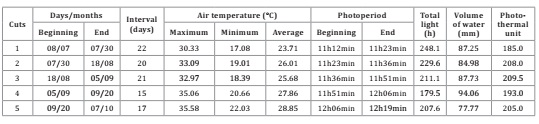
The shortest interval between cuts was 15
days, whereas the longest was 22 days, a difference of 46.6%. This demonstrates
that the environmental conditions in the Goiás’ Cerrado, besides water,
influence forage growth, which is in agreement with the findings from existing
literature.
Regarding the
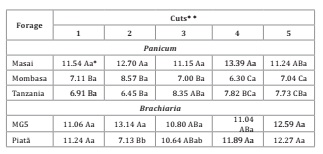
number of tillers, in each cut, variation was observed among forages, with
Masai standing out among the Panicum and no significant differences were
found between the Brachiaria. Among the cuts, a significant difference
(p < 0.05) was observed only for piatã grass (Table 2).
Table 2: Number of tillers in forage plants of Panicum and Brachiaria
during five cuts.
Tabla 2: Número de macollos en plantas forrajeras del
género Panicum y Brachiaria durante cinco cortes.
* Means in the rows followed by the same letter and means in the
column followed by the same letter do not differ by Tukey’s test at 5%
significance.
* Medias en las filas seguidas por la misma
letra y medias en la columna seguida por la misma letra no difieren por la
prueba de Tukey al 5% de significación.
** Dates of cuts of Mombasa, Masai, and Tanzania grasses:
30/07/2016; 18/08/2016; 05/09/2016; 20/09/2016; and 07/10/2016. Dates of cuts for MG5 and Piatã 02/08/2016;
20/08/2016; 07/09/2016; 23/09/2016; and 09/10/2016.
** Día de corte de Mombasa, Masai y Tanzania: 30/07/2016;
18/08/2016; 09/05/2016; 20/09/2016; y 10/07/2016. Fechas de cortes para MG5 y
Piatã 08/02/2016; 20/08/2016; 09/07/2016; 23/09/2016; y 10/09/2016.
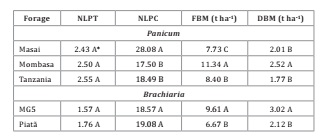
The number of
leaves per tiller of forage grass was not significantly different. Regarding
the number of leaves per plant, Masai was superior to Mombasa and Tanzania,
whereas no differences were observed between the Brachiaria grasses (Table 3).
Table
3: Number of leaves per
tiller (NLPT), number of leaves per clump (NLPC), fresh biomass (FBM), and dry
biomass (DBM) between cuts in forage plants of the genus Panicum and Brachiaria.
Tabla 3: Número de hojas por macollo (NLPT), número de
hojas por racimo (NLPC), biomasa fresca (FBM) y biomasa seca (DBM) entre cortes
en plantas forrajeras del género Panicum y Brachiaria.
* Means in the column followed by the same letter do not differ
according to Tukey’s test at 5% significance.
* Medias en la columna seguida de la misma letra no
difieren por la prueba de Tukey al 5% de significación.
In relation to
the total fresh and dry weights of aerial parts, Mombasa grass stood out among
the Panicum grasses, whereas MG5 was superior to piatã among the Brachiaria
grasses (Table 3).
The ratio
of fresh leaf mass to fresh stem mass did not vary among the forage grasses. In
turn, regarding the ratio of dry leaf mass to dry stem mass, Masai grass was
superior to Mombasa and Tanzania grass, whereas MG5 and piatã grass did not
differ. The fresh and dry masses varied between cuts. The highest fresh mass
was obtained in the cutting with higher average, maximum,
and minimum temperatures and photoperiods. Dry mass did not show this trend (Figure 2).
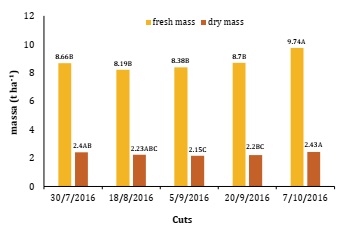
Figure 2: Accumulation of fresh and dry biomass (t ha-1)
among the forages in each cut.
Figura 2: Acumulación de biomasa fresca y seca (t ha-1) entre los forrajes de
cada corte.
Mombasa grass
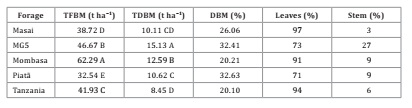
displayed a higher accumulated fresh mass in the five cuts, whereas MG5 grass
had a higher accumulated dry mass in the five cuts (Table 4).
Table
4: Total fresh biomass (TFBM)
and total dry biomass (TDBM) accumulated in the five cuts, percentage of dry
biomass (% DBM), percentage of leaves (%), and percentage of stems (%) in
forage grown in the winter under irrigation in the Goiás’ Cerrado.
Tabla 4: Biomasa fresca total (TFBM) y biomasa seca
total (TDBM) acumulada en los cinco cortes, porcentaje de biomasa seca (% DBM),
porcentaje de hojas (%) y porcentaje de tallos (%) en forraje cultivado en el
invierno bajo riego en el Cerrado de Goiás.
* Means in the rows followed by the same letter and means in the
column followed by the same letter do not differ by Tukey’s test at 5%
significance.
* Medias en las filas seguidas por la misma letra y
medias en la columna seguida por la misma letra no difieren por la prueba de
Tukey al 5% de significación.
The ratio of
dry mass to fresh mass of forage ranged from 20 to 32.41%. The highest
percentage was obtained with MG5 grass, and the lowest with Tanzania grass. For
the grasses of the genus Panicum, this ratio ranged between 20 and 26%,
and for Brachiaria, the ratio was above 32% (Table 4). The ratio of leaf tissue to total biomass was more than
90% in forage plants of the genus Panicum and between 71% and 73% in Brachiaria
(Table 4).
Discussion
Forage
irrigation in winter provided satisfactory growth, overcoming the limitations
of growth and biomass production and allowing forage production to be scaled up
in the Central-West region of Brazil (15).
The forages
studied were C4 plants, which have a higher production of photoassimilates and,
consequently, higher growth, at air temperatures between 30 and 40°C and with
higher luminosity. When temperatures are between 10 and 15°C, the growth of
tropical grasses is hindered; therefore a standard base temperature of 15°C was
adopted for the growth of these plants. However, there are differences between
species and cultivars. Moreno et al. (2014)
estimated the base temperatures to be 16°C for Masai, 11°C for Mombasa, and 7°C
for Tanzania grass. For Brachiaria MG5 and Piatã, there is no published
information on base temperatures, whereas for other Brachiaria, it is
reported as above 16°C.
Brachiaria MG5 grew to a
height above 35 cm, with intervals between cuts maintained to be at least 20
days (7). For plants of
the genus Panicum, the interval was approximately 28 d. Temperature was
not a limiting factor for the growth of the forages studied, and the irrigation
of forage during the winter in the Goiás’ Cerrado yielded plant heights at
intervals between the croppings that were below published values (4).
In the
Southeast and Central-West regions of Brazil, the predicted herbage
accumulation rate of P. maximum increased from October onwards, reached
its highest values in January (100-120 kg DM ha-1 d-1),
and decreased again in May (19). However, with irrigation, it was possible
to anticipate the growth of fodder during winter in Ceres, Goiás, Brazil.
Prado et al. (2014) did not observe any changes in
the population density of tillers as a function of the intensity and frequency
of defoliation, whereas the number of tillers increased with increasing P in a
greenhouse (10).
In studies
conducted with Masai grass, the number of leaves per tiller was higher, ranging
from 4.1 to 5.4 with 0 and 160 kg N ha-1 year-1,
respectively (8). The number of
green leaves in Mombasa grass responded to N doses, reaching values of 5.90 leaf tiller-1 with 269 kg N ha-1
(3).
Decreases in temperature and photoperiod decreased the fresh and dry mass,
height of aerial parts, density of tillering, leaf area,
chlorophyll content, and relative water content in Cynodon dactylon (12).
The photoperiod
and temperature influenced the productivity of Tanzania grass, even without a
water deficit (21). The
production of fresh and dry mass in Mombasa and Masai grass was lower in months
with lower temperatures and shorter days (13). Piatã and MG5 grasses also presented lower
yields of green and dry biomass in the months with shorter days and lower
temperatures (19). This pattern
was not observed in the accumulation of dry mass under the conditions of the
Goiás’ Cerrado with the use of pivot irrigation, indicating a way to minimize
seasonality in the production of these forages under these conditions.
In the
evaluation of the six forage grasses managed by grazing under the effect of
different nitrogen doses and annual seasons, MG5, Mombasa, and Tanzania grass
had higher rates of fresh biomass and dry matter (2). This divergence in the responses of forage
indicates the need to evaluate and select plants that are more promising for
specific climatic conditions in each region (6).
A ratio of 19
to 23% was observed between the culture seasons with Panicum grass (23). The ratio of dry mass to fresh mass in Brachiaria
ruziziensis was approximately 23% (9), 69.6% for marandu, and 93.4% for Mombasa
grass (14).
Conclusion
The
forages showed satisfactory responses in growth and biomass accumulation in an
irrigated culture during winter in the Goiás’ Cerrado. Mombasa grass stood out
among the forages of the genus Panicum and MG5 in Brachiaria.
Thus, Mombasa and Brachiaria MG5 grasses are recommended for the
cultivation of irrigated forage during winter in the Goiás’ Cerrado.
1. Alencar, C. A. B.; Cunha, F. F.; Martins, C. E.; Cóser, A.
C.; Rocha, W. S. D.; Araujo, R. A. S. 2009. Irrigação
de pastagem: atualidade e recomendações para uso e manejo. Revista
Brasileira de Zootecnia. 38: 98-108.
2. Alencar, C. A. B.; Oliveira, R. A.; Cóser, A. C.; Martins, C.
E.; Figueiredo, J. L. A.; Cunha, F. F.; Cecon, P. R.; Leal, B. G. 2010. Produção de seis capins manejados por pastejo sob efeito de diferentes
doses nitrogenadas e estações anuais. Revista Brasileira de Saúde e Produção
Animal. 11: 48-58.
3. Basso, K. C.; Cecato, U.; Lugão, S. M. B.; Gomes, J. A. N.;
Barbero, L. M.; Mourão, G. B. 2010. Morphogenesis and
dynamics of tillering in a pasture of Panicum maximum Jacq. cv.
IPR- 86 Millennium under increasing doses of nitrogen. Revista
Brasileira de Saúde e Produção Animal. 11: 976-989.
4. Berone, G.; Bertrám, N.; Di Nucci, E. 2021. Forage production
and leaf proportion of lucerne (Medicago sativa L.) in subtropical
environments: fall dormancy, cutting frequency and canopy effects. Revista de la Facultad de Ciencias Agrarias. Universidad Nacional de Cuyo. Mendoza.
Argentina. 53(1): 79-88.
5. Braz, A. J. B. P.; Silveira, P. M.; Kliemann, H. J.;
Zimmermann, J. P. 2004. Acumulação de nutrientes em folhas de
milheto e dos capins braquiária e mombaça. Pesquisa
Agropecuária Tropical. 34: 83-87.
6. Chaves Gurgel, A. L.; dos Santos Difante, G.; Baptaglin
Montagner, D.; Romeiro de Araujo, A.; Pacheco Batista Euclides, V. 2021. The
effect of residual nitrogen fertilization on the yield components, forage
quality, and performance of beef cattle fed on Mombaça grass. Revista de la Facultad de Ciencias Agrarias . Universidad Nacional de Cuyo. Mendoza.
Argentina. 53(1): 296-308.
7. Costa, K. A. P.; Oliveira, I. P.; Faquin, V.; Neves, B. P.;
Rodrigues, C.; Sampaio, F. M. T. 2007. Intervalo de corte na
produção de massa seca e composição químico-bromatológica da Brachiaria
brizantha cv. MG-5. Ciência
e Agrotecnologia. 31: 1197-1202.
8. Costa, N. L.; Paulino, V. T.; Magalhães, J. A.; Rodrigues, B.
H. N.; Santos, F. J. S. 2016. Eficiência do nitrogênio, produção de forragem e
morfogênese do capim-massai sob adubação. Nucleus. 13:
31-40.
9. Damaceno, J. B. D.; Ferreira, E.; Oliveira, D. M.; Guimarães,
R. S.; Gama, R. T.; Padilha, F. J. 2018. Produção de biomassa
de Brachiaria ruziziensis adubada com farinha de ossos calcinada sob
tratamentos ácidos. Revista Agrogeoambiental. 10: 1-11.
10. Dias, D. G.; Pegoraro, F. R.; Alves, D. D.; Porto, E. M. V.;
Santos Neto, J. A.; Aspiazú, I. 2015. Produção do capim
Piatã submetido a diferentes fontes de fósforo. Revista Brasileira de
Engenharia Agrícola e Ambiental. 19: 330-335.
11. Embrapa. Manual de métodos de análise de solos.
2011. Rio de Janeiro: Embrapa Solos, 2a edição. 230 p.
12. Esmaili, S.; Salehi, H. 2012. Effects of temperature and
photoperiod on postponing bermudagrass (Cynodon dactylon [L.] Pers.) turf dormancy. Journal
of Plant Physiology. 169: 851-858.
13. Euclides, V. P. B.; Macedo, M. C. M.; Zimmer, A. H.; Jank,
L.; Oliveira, M. P. 2008. Avaliação dos capins mombaça e massai sob
pastejo. Revista Brasileira de Zootecnia. 37: 18-26.
14. Feitosa, T. S. 2017. Respostas agronômicas
de Brachiaria brizantha cv. Marandu e Panicum maximum cv. Mombaça
em função do suprimento de nitrogênio e água. 57p.
Dissertação (Mestrado) - Universidade Federal de Lavras, Lavras.
15. Imvinkelried, H. O.; Pietrobón, M.; Dellaferrera, I. M.
2020. Water and radiation productivity in different cropping sequences in the
north center of Santa Fe. Revista de la Facultad de Ciencias Agrarias . Universidad
Nacional de Cuyo. Mendoza. Argentina. 52(1): 61-71.
16. Maranhão, T. D.; Candido, M. J. D.; Lopes, M. N.; Pompeu, R.
C. F. F.; Carneiro, M. S. S.; Furtado, R. N.; Silva, R. R.; Silveira, F. G. A.
2018. Biomass components of Pennisetum purpureum cv. Roxo managed at
different growth ages and seasons. Revista Brasileira de Saúde e Produção Animal .
19: 11-22.
17. Moreno, L. S. B.; Pedreira, C. G. S.; Boote, K. J.; Alves,
R. R. 2014. xtemperature determination of tropical Panicum
spp. grasses and its effects on degree-day-based models. Agricultural
and Forest Meteorology. 186: 26-33.
18. Oliveira, T. K.; Macedo, R. L. G.; Santos, I. P. A.;
Higashikawa, E. M.; Venturin, N. 2007. Produtividade de Brachiaria
brizantha (Hochst. ex A. Rich.) Stapf cv. marandu
sob diferentes arranjos estruturais de sistema agrossilvipastoril com
eucalipto. Ciência e Agrotecnologia. 31: 748-757.
19. Orrico Junior, M. A. P.; Centurion, S. R.; Orrico, A. C. A.;
Oliveira, A. B. M.; Sunada, N. S. 2013. Structural, morphogenetic and
productive features of Piatã Grass subjected to organic fertilization. Ciência Rural. 43: 1238-1244.
20. Pantojo de Souza, D.; Carniato Sanches, A.; Campos Mendonça,
F.; Macedo Pezzopane, J. R.; Morais Amorim, D.; Lamede Ferreira de Jesus, F.
2021. Crop coefficient estimated by degree-days for ‘Marandu’ palisadegrass and
mixed forage. Revista de la Facultad de Ciencias Agrarias . Universidad
Nacional de Cuyo. Mendoza. Argentina. 53(2): 71-81.
21. Pezzopane, J.; Santos, P. M.; Evangelista, S. R. M.; Bosi,
C.; Cavalcante, A. C. R.; Bettiol, G. M.; Gomide, C. A. M.; Pellegrino, G. Q.
2016. Panicum maximum cv. Tanzânia: climate trends and regional pasture
production in Brazil. Grass and Forage Science. 1:
1-14.
22. Prado, D. A.; Zanine, A. M.; Castro, W. J. R.; Bonelli, E.
A.; Baron, D.; Santos, R. M. 2014. Densidade populacional
de perfilhos e teores de fibra do capim piatã submetido à interceptação
luminosa e lotação intermitente com duas intensidades de pastejo. In: Resumos
Do Ii Encontro Pan-Americano Sobre Manejo Agroecológico De Pastagens. Anais. Pelotas. p. 1-5.
23. Santos, G. O.; Faria, R. T.; Rodriguês, G. A.; Dantas, G.
F.; Dalri, A. B.; Palaretti, L. F. 2017. Forage yield and quality of marandu
grass fertigated with treated sewage wastewater and mineral fertilizer. Acta Scientiarum. Agronomy. 39:
515-523.
24. Torres, F. E.; Oliveira, E. P.; Teodoro, P. E.; Silveira, M.
V.; Ribeiro, L. P.; Silveira, L. P. O. 2013. Produção de forragem de cultivares de Panicum maximum submetidas
a diferentes estações de cultivo e tipos de sementes. Revista
de Ciências Agrárias. 36: 435-440.