Revista de la Facultad de Ciencias
Agrarias. Universidad Nacional de Cuyo. Tomo 54(2). ISSN (en línea) 1853-8665.
Año 2022.
Original article
Physical
and chemical characterization of yacon (Smallanthus sonchifolius) roots
cultivated with different doses of potassium fertilization
Caracterización física y química de raíces de yacón (Smallanthus
sonchifolius) cultivadas con diferentes dosis de fertilización potásica
Fábio Luiz de Oliveira 1
Luciano José Quintão Teixeira
2
Mateus Oliveira Cabral 1
Lidiane dos Santos Gomes Oliveira
1
Joab Luhan Ferreira Pedrosa
1
1Universidade
Federal do Espírito Santo. Departamento de Agronomia. Centro de Ciências
Agrárias e Engenharias. Alegre. Espírito
Santo. Brasil.
2Universidade
Federal do Espírito Santo. Departamento de Engenharia de Alimentos. Centro de
Ciências Agrárias e Engenharias. Alegre.
Espírito Santo. Brasil.
Abstract
The already
marked tendency for functional food consumption, low in calories, and with
biologically active properties, has been increasing. In this scenario, yacon
tuberous roots, with high levels of nutraceutical fructooligosaccharides, gain
importance. However, these nutraceutical properties depend on fertilization
management. Thus, our study aims to evaluate different doses of potassium
fertilization on the physicochemical characteristics of yacon roots. The
experimental design consisted of randomized blocks, with 4 replications and 5
treatments: four doses of potassium fertilization (50%; 100%; 150%; 200%) of
the reference value, corresponding to 178.7 kg.ha-1; 357.4 kg.ha-1; 536.1 kg.ha-1; 714.8 kg.ha-1
of potassium chloride - (KCl), and a control (soil without
fertilization). The chemical features evaluated were pH, total titratable
acidity, soluble solids, conductivity, turbidity, moisture and ashes. The
texture profile was analyzed through toughness, adhesiveness, cohesiveness,
chewability index, elasticity, and gooeyness. Most of the variables were
influenced by potassium soil fertilization. Only turbidity, conductivity and
gumminess showed no response to the applied doses, not fitting the tested
models. Potassium fertilization improved both chemical (higher levels of
soluble solids and less acidity) and physical characteristics (less hardness,
chewability, cohesiveness, and adhesion) of yacon tuberous roots, bringing
greater quality to the final product.
Keywords: Smallanthus
sonchifolius; Fructooligosaccharides; Functional food; Tuberous roots.
Resumen
La tendencia en el consumo de alimentos funcionales, con pocas calorías y
con propiedades biológicamente activas, ha ido en aumento. El consumo de
raíces tuberosas de yacón se adapta a este concepto por los altos niveles de
fructooligosacáridos, lo que le confiere propiedades nutracéuticas. Sin
embargo, estas propiedades pueden modularse mediante el manejo de la
fertilización en el cultivo de esta planta. Así, nuestro estudio tiene como
objetivo evaluar diferentes dosis de fertilización potásica en las
características fisicoquímicas de las raíces de yacón. El diseño experimental
utilizado fue de bloques al azar, con 4 repeticiones y 5 tratamientos: cuatro
dosis de fertilización potásica (50%; 100%; 150%; 200%) del valor de
referencia, correspondiente a 178,7 kg.ha-1;
357,4 kg.ha-1;
536,1 kg.ha-1;
714,8 kg.ha-1 de cloruro de potasio - (KCl),
y un testigo (suelo sin fertilizar). Las características químicas evaluadas
fueron pH, acidez total titulable, sólidos solubles, conductividad, turbidez,
porcentaje de humedad y cenizas. El perfil de textura se elaboró analizando la
tenacidad, la adhesividad, la cohesión, el índice de masticabilidad, la
elasticidad y la pegajosidad. La fertilización con potasio mejoró las
características químicas (mayores niveles de sólidos solubles y menor acidez) y
las características físicas (menor dureza, masticabilidad, cohesión y
adherencia) de las raíces tuberosas de yacón, aportando mayor calidad al
producto final.
Palabras
clave: Smallanthus sonchifolius; Fructooligosacáridos; Comida functional; Raíces tuberosas.
Originales: Recepción: 07/08/2021
Aceptación:
23/06/2022
Introduction
The search for
foods with low carbohydrates and greater amounts of antioxidants and vitamins, i.e.
with biologically active value, has increased (11). In this context, yacon (Smallanthus
sonchifolius) an Asteraceae of Andean origin, gains importance for its
tuberous roots with high concentrations of inulin and fructooligosaccharides
(FOS) (4).
Yacon is
considered a prebiotic food. Several immunostimulatory characteristics promote
antimicrobial, anti-inflammatory, and antioxidant activity (51). It also acts in the regulation of appetite (45), increasing mineral availability (23), positively modulating the immune system (52), in the hypolipidemic effect (33) and preventing diseases such as diabetes and
cancer (40).
The tuberous
roots of yacon are sweet and slightly crunchy, resembling fruits such as apple,
pear, watermelon, and melon, mostly consumed in fresh. However, other forms of
consumption have also been studied (24).
Chemical
characteristics, such as pH, soluble solids, and total titratable acidity,
together with texture, flavor, and appearance constitute some of the quality
attributes leading consumers to accept or reject a given food (28). Variations in the physical and chemical
characteristics of yacon tuberous roots have been studied regarding cultivation
and processing (46, 50). Thus,
studying techniques that improve its production system increasing quality, turns essential for a successful production.
In plant
nutrition, potassium is considered an essential nutrient. It participates in
enzymatic activation, protein formation, photosynthesis (21), regulation of osmotic pressure, and opening
and closing of stomata (48). It is also associated with root size,
shape, texture, color, flavor, acidity, nutrient transport resistance,
nutritional value (38), and even
market value (12). Considering
this, optimizing the use of potassium constitutes an important tool in crop
management, and since information related to this matter is still scarce, our
study aims to evaluate the physicochemical characteristics of yacon tuberous
roots as a function of different doses of potassium fertilization.
Material
and methods
The
experiment was located in the municipality of Alegre, in the State of Espírito
Santo, Brazil, (20°47’1” S, 41°36’56” W, 680 m a. s. l.). Precipitation,
relative humidity, and monthly temperature averages were obtained by automatic
meteorological stations close to the experiment, using Incaper in Iúna,
Espirito Santo, Brazil (20°21’ S, 41°33’ W, 758 m a. s. l. (Figure 1).
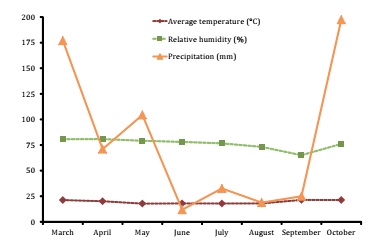
Figure 1: Monthly
averages of precipitation, relative humidity, and temperature during the
experimental period. Alegre-ES,
2020.
Figura 1: Promedios mensuales de precipitación, humedad
relativa y temperatura durante el período del experimento. Alegre-ES, 2020.
Average monthly temperatures fluctuated from
17.79 to 21.43°C, and rainfall summed 638 mm during field experiments.
Soil samples
were collected and subjected to laboratory analysis, showing the following
chemical characteristics: water pH 4.80 , P 3.95 mg dm-3 , K 42.00 mg dm-3 , Ca 0.68 cmolc dm-3,
Mg 0.22 cmolc dm-3 , Al 1.00 cmolc dm-3 , exchangeable bases,1.01 cmolc
dm-3 cation exchange capacity 2.01
cmolc
dm-3 and base saturation index
8.89%.
Soil
preparation was done by plowing and harrowing at a depth of 40 cm. Liming was
performed using dolomitic limestone with 96% PRNT increasing base saturation to
70%, with a period of 60 days for planting. For the propagation of yacon, 30
grams rhizophores with three to four buds were used, as recommended by Pedrosa et al. (2020) and planted individually
on ridges with a spacing of 1.0 m × 0.5 m, as recommended by Carvalho et al. (2020).
The experiment
was conducted in a randomized complete block design, with four replications of
four different doses of potassium fertilization: 50%; 100%; 150%, and 200% of
the reference value (26); and a control
(soil without fertilization). The experimental plot consisted of three lines
with three plants providing nine useful plants for evaluations, bordered by 2
rows and 2 extra plants. The reference value considered, at the end of 210 days
after planting, was 106.8 kg. ha-1 of K in yacon plants (26). Final dose estimation,
considering K2O,
resulted128.65 kg. ha-1.
A recovery efficiency of 60% for K was also considered (43). Thus, potassium chloride (KCl) doses
applied were: 178.7 kg. ha-1;
357.4 kg. ha-1;
-536.1 kg. ha-1 and 714.8 kg. ha-1,
equivalent to 50, 100, 150 and 200%. Two applications were made in coverage.
The first application was performed when 80% of the plants emerged, with the
first pair of leaves open (80 days after planting) and the second application
was done 30 days later (110 days after planting).
Nitrogen and
phosphate fertilization, were added with 382.2 kg.ha-1 of urea and 422.6 kg.ha-1
of simple superphosphate (26), achieving 172 kg.ha-1 for N and 33.2 kg.ha-1
for P (converted to 76.07 kg of P2O5). Phosphate
fertilization was performed at planting while nitrogen fertilization was
performed in coverage along with potassium. During the whole experimental
period, irrigation was done by sprinkling while weeds were manually controlled.
At the
end of the experiment, 210 days after planting, the plants were harvested and
the roots separated and taken to the Food Chemistry Laboratory of the CCAE/UFES
for chemical analyzes such as pH, soluble solids, total acidity, conductivity,
turbidity, humidity, and ashes. A sample of these roots was separated for
physical analysis, at the Food Science and Technology Laboratory (CCAE/UFES),
where the following parameters were observed: toughness, adhesiveness, cohesiveness, index of chewability, elasticity, and gooeyness.
For chemical
analysis, the roots were cut, washed, dried, and taken to a centrifuge to
extract the juice, then filtered with filter paper for later evaluations. Juice
direct readings of pH, electrical conductivity, and soluble solids were
conducted.
Total
titratable acidity was obtained by a diluted sample of the juice (5 mL of juice
+ 50 mL of distilled water), titrated with 0.1 mol L-1
NaOH solution, using phenolphthalin, according to Instituto
Adolfo Lutz (2008). Acidity was calculated as a function of malic acid, the
most expressive acid in yacon. Turbidity, in 10 mL of juice + 40 mL of
distilled water was assessed using a turbidimeter.
Subsequently,
roots from each treatment were grated and a sample was incinerated in the
muffle at 550°C, until constant weight, obtaining ashes. For humidity, another
set of samples was oven-dried at 105°C. Finally, root samples were standardized
at 2 cm thickness and 4 cm diameter for texture analysis. Parameters were
determined using the Brookfield CT3 texturometer and the TA39 needle probe,
with a test speed of 2 mm s-1.
The target distance for drilling was set at 5 mm.
Linear
regression models were tested for data processing. The analysis was performed
based on average values for each treatment (four repetitions). The sum of
squares, R2 (coefficient of
determination), and significance of regression coefficients constituted model
parameters. Statistical analyses were performed with the open code software R (39).
Results
and discussion
Turbidity
and conductivity did not fit any model. The doses used did not influence root
chemical variability (Figure 2 AB).
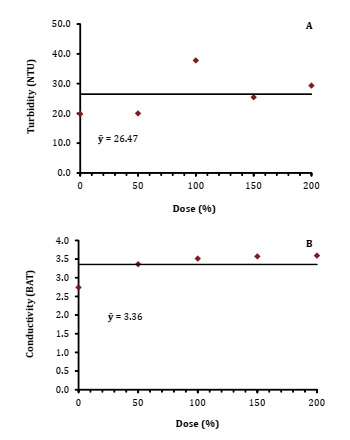
Figure 2: Turbidity (A) and electrical conductivity (B) in juice of yacon
tuberous roots, according to different potassium doses. Alegre-ES, 2020.
Figura 2: Turbidez (A) y conductividad eléctrica (B) en
el jugo de raíces tuberosas de yacón, según las diferentes dosis de potasio. Alegre-ES, 2020.
No change in
juice turbidity means that the tested potassium doses did not influence
insoluble solids in suspension (proteins, pectin, lipids, cellulose, and
hemicellulose) in yacon roots. Insoluble solids remain in suspension after cell
rupture during juice preparation (20). Juice turbidity is essential for market
acceptance (8), thus, the
non-alteration of this characteristic is a positive result evidencing that
potassium fertilization would not cause quality losses.
Likewise,
conductivity did not change, possibly due to the non-variation in turbidity,
since the first is influenced by several factors, such as electrolyte
concentration and temperature (27). Conductivity reflects solutions ionic
behavior, and according to Icier and Ilicali (2005), can be altered by the
content of insoluble solids. Several studies point out this relationship. Some
authors evaluated the effect of suspended-particle size in mango juice and
observed higher electrical conductivity in particle-free samples, noting that,
probably, intermediate-sized particles hinder ionic movement (54). A similar
result was found by Pelacani and Vieira (2003), also
in mango juice and Palaniappan and Sastry (1991), in
carrot juice. Both studies showed that conductivity is higher in solutions with
smaller insoluble particles. Regarding the direct influence of potassium doses,
Gurgel et al. (2010) evaluating postharvest
quality of melons, obtained similar results for juice conductivity, in which
regression analyzes did not fit the tested models.
Soluble
solids, pH, and total titratable acidity achieved linear model fitting. Soluble
solids content showed a slight increase, reaching 10% when comparing the
highest tested dose with the unfertilized treatment (Figure
3A).
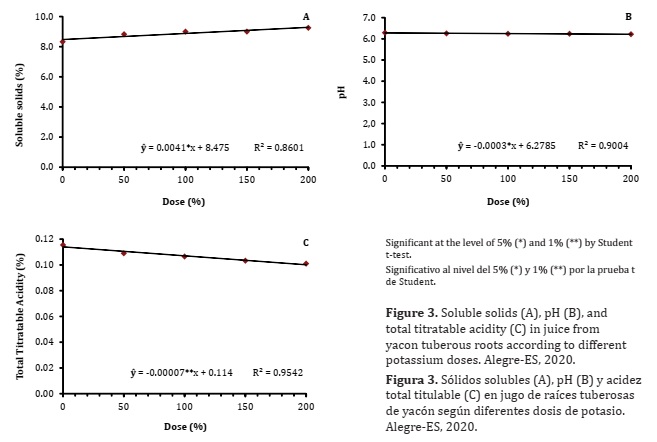
Figure 3: Soluble solids (A), pH (B), and total titratable acidity (C) in
juice from yacon tuberous roots according to different potassium doses. Alegre-ES, 2020.
Figura 3: Sólidos solubles (A), pH (B) y acidez total
titulable (C) en jugo de raíces tuberosas de yacón según diferentes dosis de
potasio. Alegre-ES,
2020.
The pH,
on the other hand, showed a slight decrease, although more pronounced for total
acidity, which decrease by 17% with the highest potassium dose (Figure 3 BC). Increased total soluble
solids with the highest availability of potassium occur as a result of a
potassium-mediated favored carbohydrates formation and translocation (22). Potassium influences plant water transport stimulating
solute storage in organs such as seeds, tubers, roots, and fruits (25, 38).
The results
show a contribution of potassium fertilization for yacon roots quality
evidenced by increased sugar content (main component of soluble solids),
vitamin C, other acids, and some pectins, as previously mentioned (7), rising the possibility for this product´s
market better acceptance.
The observed
subtle decrease in acidity (pH and total acidity) may have occurred after a
greater conversion of sugars (higher levels of soluble solids) and degradation
of organic acids (19, 35), possibly
after accelerated root maturation, given greater availability of potassium.
Similar results were observed by Barreto et al. (2020)
with peach, Delgado et al. (2004) with
grapes, and Veloso et al. (2001) with
pineapple, who reported fruit ripening anticipation, favored by increasing
available potassium.
In fruit
ripening, higher sugar levels cause sharp neutralization of organic acids,
making the fruit less acidic and sweeter (14). This possibility was also pointed out by Silva et al. (2018) for yacon roots, after
observing a reduction in acidity at an established stage of life-cycle ending, then considered as the proper harvest time for sweeter
roots, an essential characteristic for palatability and better market
acceptance.
Regarding
humidity and ashes, an increasing linear fit showed that for the highest potassium
dose (200%) both variables increased 8 and 22%, respectively (Figure 4).
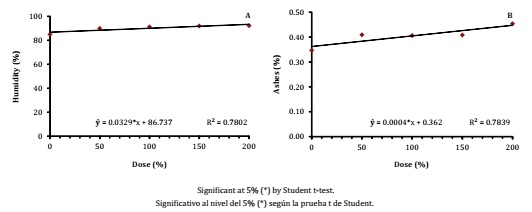
Figure 4: Humidity (A) and ashes (B) in yacon tuberous roots, according to
increasing potassium doses (Alegre-ES, 2020).
Figura 4: Humedad (A) y cenizas (B) en raíces tuberosas
de yacón, según las diferentes dosis de potasio (Alegre-ES, 2020).
This increased
humidity in yacon roots means high water content and low energetic food, both
high-quality standards (41). Humidity may vary depending on a range of
interactive factors, including field conditions, planting, harvest, and
fertilization (34). Similar
results in potato tubers obtained by Quadros et al. (2009)
pointed out that the highest potassium dose provided higher percentages of
humidity. However, considering post-harvest conservation, significant higher
moisture contents may cause greater difficulty in preserving the product (44, 47). Still, the resulted increase (8% for the
highest dose compared to the control) turns irrelevant, as with fast and
adequate storage (dehydration preventing conditions) (49), no significant losses should complicate
commercialization.
The higher
levels of ashes are related to increasing root mineral contents after potassium
fertilization. This was already observed by Quadros et
al. (2009) with common potatoes. Additionally, Oliveira
et al. (2015) state the importance of potassium supply, through
balanced nutrition, since product quality (tuber, rhizomes, and tuberous
roots), may vary according to the performed fertilization.
Regarding
texture analysis, only gooeyness values resulted independent of potassium
doses. For cohesiveness, toughness, index of chewability, and adhesiveness,
increasing potassium doses resulted in decreasing values. Elasticity, in turn,
increased with increasing doses (Figure 5).
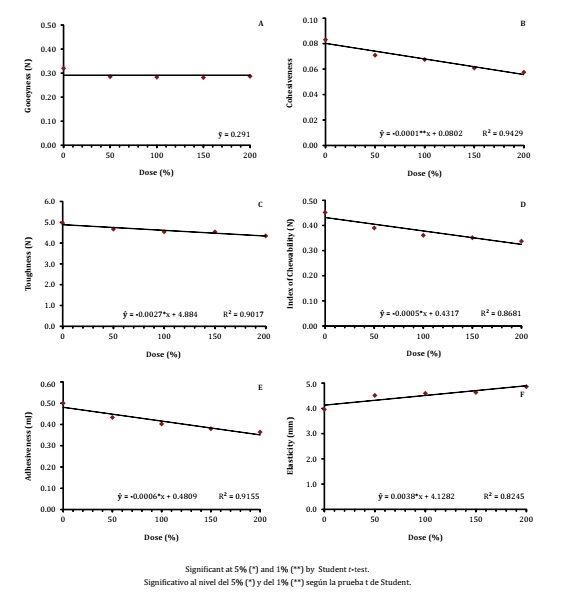
Figure 5: Gooeyness (A),
cohesiveness (B), toughness (C), index of chewability (D), adhesiveness (E),
and elasticity (F) of yacon tuberous roots, as a function of increasing
potassium doses (Alegre- ES, 2020).
Figura 5: Pegajosidad (A), cohesión (B), tenacidad (C),
índice de masticabilidad (D), adhesividad (E) y elasticidad (F) de las raíces
tuberosas de yacón, en función de diferentes dosis de potasio (Alegre- ES,
2020).
Gooeyness is
related to the force required to disintegrate food, by dissociating its mass.
For Bolzan and Pereira (2017), it is associated with
toughness and cohesiveness. However, in this case, despite the linear decrease
in cohesiveness and hardness with the increasing potassium doses, no gooeyness
alteration was evidenced in the analyzed yacon tuberous roots. That is, yacon
roots can withstand rupture (cohesiveness measure), and demand less strength to
be obstructed (toughness measure) (1). In this sense, in a prior sensory analysis
with the application of potassium doses, the roots became softer, requiring
less strength (25% less with the highest dose of potassium) to be squeezed
between the molar teeth at the first bite (14). The same was noticed for chewability
(around 24% reduction of needed strength with the highest dose of potassium) (9). These results evidence gains in sensory
quality of yacon roots fertilized with potassium.
Decreased
adhesion occurred after increasing humidity, which, according to Rahman and Al-Farsi (2005) are inversely proportional
characteristics. In sensory terms, increasing potassium doses, eases food
ingestion, due to lower adherence strength (reduction of around 28% with the
highest dose of potassium), increasing sensory quality.
The resulting
root-increased elasticity was expected since this characteristic is inversely
proportional to hardness, cohesiveness, and chewability (42). This greater elasticity (18% in the maximum
dose) contributed to root quality.
Finally,
texture constitutes an important factor and quality criterion for the sensory
acceptance of food (6). Thus, the
results obtained show that potassium fertilization improves both physical and
chemical characteristics of yacon roots.
Conclusion
Potassium
fertilization improved both physical and chemical characteristics of yacon
roots. The best results were observed with the maximum applied dose (357.4
kg.ha-1
of KCl).
With the
application of the maximum dose, highest levels of soluble solids (9.25%),
moisture (92.24 %), ash (0.454 %) and elasticity (4.86 mm) and lower acidity
(0.101 %) and pH (6.22) were achieved, in addition to lowest chewability
indexes (0,337 N), hardness (4,35 N), cohesiveness (0,058) and stickiness
(0,364 mJ). Such results add greater value to the final quality of the roots.
Acknowlegments
The
authors are grateful to CNPq (National Council for Scientific and Technological
Development) and FAPES (Research Support Foundation of Espírito Santo), for the
financial aid to the research. CAPES (Coordination for
Improvement of Higher Education Personnel) for the master’s scholarship to the
first author.
1. Atallah, A. A.; Morsy, K. M. 2017. Effect of
incorporating royal jelly and bee pollen grains on texture and microstructure
profile of probiotic yoghurt. Journal of Food
Processing and Technology. 8(9): 1-4. DOI: 10.4172/2157-7110.1000693
2. Barreto, C. F.; Ferreira, L. V.; Navroski, R.; Benati, J. A.;
Cantillano, R. F. F.; Vizzotto, M.; Nava, G.; Antunes, L. E. C. 2020. Potassium fertilization in peach fruit quality. Revista de Ciências Agroveterinárias. 19(4): 420-427. DOI:
10.5965/223811711942020420
3. Bolzan, A. B.; Pereira, E. A. 2017. Elaboração
e caracterização de doce cremoso de caqui com adição de sementes da araucária. Brazilian Journal of Food Technology. 20(1). DOI: 10.1590/1981-6723.6116
4. Caetano, B. F.; Moura, N. A.; Almeida, A. P.; Dias, M. C.;
Sivieri, K.; Barbisan, L. F. 2016. Yacon (Smallanthus sonchifolius) as a Food
Supplement: Health-Promoting Benefits of Fructo oligosaccharides. Nutrients. 8(12): 436-440. DOI: 10.3390/nu8070436
5. Carvalho, A. H. O.; Oliveira, F. L.; Lima, W. L.; Teixeira, A.
G.; Pedrosa, J. L. F.; Parajara, M. C. 2020. Production and
profitability of yacon grown in different spatial arrangements. Australian Journal of Crop Science. 14: 1214-1220. DOI:
10.21475/ajcs.20.14.08.p2158
6. Chen, L.; Opara, U. L. 2013. Approaches to
analysis and modeling texture in fresh and processed foods - A review. Journal of Food Engineering. 119(6): 497-507. DOI:
10.1016/j. jfoodeng.2013.06.028
7. Chitarra, M. I. F.; Chitarra, A. B. 2005. Pós-colheita
de frutas e hortaliças: fisiologia e manuseio. Lavras, MG: Universidade Federal
de Lavras.
8. Correa Neto, R. S.; Faria, J. A. F. 1999. Fatores que influenciam na qualidade do suco de laranja. Ciência e
Tecnologia de Alimentos. 19(1): 153-161. DOI:
10.1590/S0101-20611999000100028
9. Curi, P. N.; Carvalho, C. S.; Salgado, D. L.; Pio, R.; Paqual, M.;
Souza, F. B. M.; Souza, V. R. 2017. Influence of different types of sugars in
physalis jellies. Food and Science Technology. 37(3):
349-355. DOI: 10.1590/1678-457X.08816
10. Delgado, R.; Martín, P.; Álamo, M.; González, M. R. 2004. Changes in the phenolic composition of grape berries during
ripening in relation vineyard nitrogen and potassium fertilization rates.
Journal of the Science of Food and Agriculture. 84(7):
623-630. DOI: 10.1002/jsfa.1685
11. Dionísio, A. P.; Silva, L. B. C.; Vieira, N. M.; Goes, T. S.;
Wurlitzer, N. J.; Borges, F. M.; Figueiredo, R. W. 2015. Cashew-apple (Anacardium
occidentale L.) and yacon (Smallanthus sonchifolius) functional
beverage improve the diabetic state in rats. Food Research
International. 77: 171-176. DOI: 10.1016/j.foodres.2015.07.020
12. Filgueira, F. A. R. 2008. Novo
manual de olericultura: agrotecnologia moderna na produção e comercialização de
hortaliças. Viçosa, MG: Universidade Federal de Viçosa.
13. Garrido, J. I.; Lozano, J. E.; Genovese, D. B. 2015. Effect of
formulation variables on rheology, texture, colour, and acceptability of apple
jelly: Modelling and optimization. Food Science and
Technology. 62(1): 325-332. DOI: 10.1016/j.lwt.2014.07.010
14. Grangeiro, L. C.; Cecílio Filho, A. B. 2004. Qualidade de frutos de melancia em função de fontes e doses de potássio. Horticultura
Brasileira. 22(3): 647-650. DOI: 10.1590/S0102- 05362004000300030
15. Gurgel, M. T.; Oliveira, F. H. T.; Gheyi, H. R.; Fernandes, P.
D.; Uyeda, C. A. 2010. Qualidade pós-colheita de variedades de
melões produzidos sob estresse salino e doses de potássio. Revista Brasileira
de Ciências Agrárias. 5(3): 398-405. DOI: 10.5039/agrária.v5i3a507
16. Icier, F.; Ilicali, C. 2005. Temperature
dependent electrical conductivities of fruit purees during ohmic heating.
Food Research International. 38: 1135-1142. DOI:
10.1016/j.foodres.2005.04.003
17. Incaper - Istituto Capixaba de Pesquisa, Assistência Técnica e
Extensão Rural. 2020. Boletim Agrometeorológico. https://meteorologia.incaper.es.gov.br/boletimagrometeorologico-dados?estacao=iuna_auto_inc.xls&municipio=iuna
18. Instituto Adolfo Lutz. Métodos físico-químicos
para análise de alimentos. São Paulo, SP: Instituto Adolfo Lutz.
19. Kader, A. A. 1978. Quality factors: definition and evaluation
for fresh horticultural crops. In Kader, A. A. (Ed.). Postharvest Technology of Horticultural Crops. 118-121.
California: University of California.
20. Klavons, J. A.; Bennett, R. D.; Vannier, S. D. 1994. Physical
and chemical nature of pectin associated with commercial orange juice cloud. Journal of Food Science. 59(2): 399-401. DOI:
10.1111/j.1365-2621.1994.tb06976.x
21. Kumar, P.; Pandey, S. K.; Singh, B. P.; Singh, S. V.; Kumar,
D. 2007. Influence of source and time of potassium application on potato
growth, yield, economics and crisp quality. Potato Research.
50(1): 1-13. DOI: 10.1007/s11540-007-9023-8
22. Lin, D.; Huang, D.; Wang, S. 2001. Effects
of potassium levels on fruit quality of muskmelon in soilless medium culture.
Scientia Horticulturae. 102(1): 53-60. DOI: 10.1016/j.scienta.2003.12.009
23. Lobo, A. R.; Gaievski, E. H. S.; Carli, E.; Alvares, E. P.;
Colli, C. 2014. Fructo-oligosaccharides and iron bioavailability in anaemic rats:
The effects on iron species distribution, ferroportin-1 expression,
crypt bifurcation and crypt cell proliferation in the caecum. British Journal of Nutrition. 112(8): 1286-1295. DOI:
10.1017/S0007114514002165
24. Macedo, L. L.; Araújo, C. S.; Vimercati, W. C.; Saraiva, S.
H.; Teixeira, L. J. Q. 2019. Evaluation of different bleaching methods applied
to yacon. Journal of Food Process Engineering. 42(7). DOI: 10.1111/jfpe.13276
25. Malavolta, E.; Vitti, G. C.; Oliveira, S. A. 1997. Avaliação do estado nutricional das plantas. Piracicaba, SP: Associação
Brasileira para Pesquisa da Potassa e do Fósforo.
26. Mendes, T. P. 2019. Marcha de absorção de
nutrientes em yacon. Dissertação de Mestrado, Curso de Agronomia: Universidade
Federal do Espírito Santo. Alegre.
27. Min, S.; Sastry, S. K.; Balasubramaniam, V. M. 2007. In situ electrical conductivity measurement of select liquid foods
under hydrostatic pressure to 800MPa. Journal of Food
Engineering. 82: 489-497. DOI: 10.1016/j.jfoodeng.2007.03.003
28. Mohsenin, N. N. 1986. Physical properties of plant and animal
materials: structure, physical caracteristics and mechanical properties. Canadá. Gordon and Breach Publishers.
891 p.
29. Oliveira, A. P.; Silva, O. P. R.; Leonel, M.; Guimarães, L. M.
P.; Andrade, G. P. 2015. Inhame (Dioscorea spp). In M. Leonel, A. M. Fernandes, & C. M. L. Franco (Ed.). Culturas amiláceas: Batata-doce, inhame, mandioca e mandioquinha-salsa. 121-182.
Botucatu, SP: Universidade Estadual Paulista.
30. Palaniappan, S.; Sastry, S. K. 1991. Electrical conductivity
of selected juices: influences of temperature, solids contend, applied voltage
and particle size. Journal of Food Process Engineering.
14: 247-260. DOI: 10.1111/j.1745-4530.1991.tb00135.x
31. Pedrosa, J. L. F.; Oliveira, F. L.; Zucoloto, M.; Teixeira, A.
G.; Parajara, M. C.; Tomaz, M. A. 2020. Yacon (Smallanthus
sonchifolius) propagation from rhizophores with different numbers of buds.
Revista de la Facultad de Ciencias Agrarias. Universidad
Nacional de Cuyo. Mendoza. Argentina. 52(2): 52-63.
32. Pelacani, V. P.; Vieira, J. A. G. 2003. Condutividade
elétrica do suco de manga. Alimentos e Nutrição. 14(1): 43-45.
33. Pereira, J. A. R.; Barcelos, M. F. P.; Ferreira, E. B.;
Pereira, R. C.; Angelis-Pereira, M. C. 2016. Changes in
glucose levels and fecal excretion of lipids due to consumption of yacon flour.
Nutrition & Food Science. 46(6): 791-802. DOI:
10.1108/NFS-12-2015-0159
34. Popp, P. R. 2005. Batata para
processamento - aptidão da matéria prima para processamento. Curitiba, PR:
Paulo Popp Consultoria Ltda.
35. Pretty, K. M. 1982. O potássio e a qualidade
da produção agrícola. In T. Yamada; K. Igue; O.
Muzilli; N. R. Usherwood (Ed.). Potássio na agricultura
brasileira. p. 177-194. Piracicaba, SP: Associação Brasileira para Pesquisa da
Potassa e do Fósforo.
36. Quadros, D. A.; Iung, M. C.; Ferreira, S. M. R.; Freitas, R.
J. S. 2009. Chemical composition of potato tubers for
processing, grown in different levels and sources of potassium. Ciência e Tecnologia de Alimentos. 29(2): 316-323. DOI:
10.1590/S0101-20612009000200013
37. Rahman, M. S.; Al-Farsi, S. A. 2005. Instrumental
texture profile analysis (TPA) of date flesh as a function of moisture content.
Journal of Food Engineering. 66(4): 505-511. DOI:
10.1016/j. jfoodeng.2004.04.022
38. Raij, B. 1990. Potássio: necessidade e uso na agricultura
moderna. Piracicaba, SP: Associação Brasileira para Pesquisa da Potassa e do
Fosfato.
39. R Core Team. 2020. R: A language and environment for
statistical computing. Vienna, Austria: R Foundation for Statistical Computing.
40. Saldaña, E.; Siche, R.; Castro, W.; Huamán, R.; Quevedo, R.
2014. Measurement parameter of color on yacon (Smallanthus sonchifolius)
slices using a computer vision system. Food Science and
Technology. 59(2): 1220-1226. DOI: 10.1016/j.lwt.2014.06.037
41. Santana, I.; Cardoso, M. H. 2008. Raiz
tuberosa -de yacon (Smallanthus sonchifolius): potencialidade de
cultivo, aspectos tecnológicos e nutricionais. Ciência Rural. 38(3):
898-905. DOI: 10.1590/S0103-84782008000300050
42. Santos, K. C.; Gonçalves, R. G.; Alegria, C.; Almeida, D. P.
F. 2016. Evolução do perfil sensorial de textura de
pera Rocha durante o período de armazenamento. Actas Portuguesas de
Horticultura. 28: 133-138.
43. Santos, L. P. D. 2016. Modelagem da
recomendação de nitrogênio, fósforo e potássio e métodos de aplicação de
fósforo para a cultura da batata. Dissertação de Mestrado, Curso de Agronomia:
Universidade Federal de Viçosa. Rio Paranaíba, MG.
44. Shekhar, S.; Mishra, D.; Buragohain, A. K.; Chakraborty, S.;
Chakraborty, N. 2015. Comparative analysis of phytochemicals
and nutrient availability in two contrasting cultivars of sweet potato (Ipomoea
batatas L.). Food Chemistry. 173: 957-965.
DOI: 10.1016/j.foodchem.2014.09.172
45. Silva, M. F. G.; Dionísio, A. P.; Carioca, A. A. F.; Adriano,
L. S.; Pinto, C. O.; Abreu, F. A. P.; Wurlitzer, N. J.; Araújo, I. M.; dos
Santos Garruti, D.; Ferreira Pontes, D. S. 2017. Yacon syrup: Food applications
and impact on satiety in healthy volunteers. Food Research
International. 100: 460-467. DOI: 10.1016/j.foodres.2017.07.035
46. Silva, D. M. N.; Lima, R. R.; Oliveira, F. L.; Teixeira, L. J.
Q.; Machado, L. C. A. 2018. Physical and chemical
characterization of yacon tuberous roots at different altitudes and planting
times. Horticultura Brasileira. 36(2): 199-204. DOI:
10.1590/S0102-053620180209
47. Silveira, M. A. 2008. Batata-doce: uma nova
alternativa para a produção de etanol. In Instituto Euvaldo Lodi. Álcool
combustível: Série Indústria em Perspectiva. p. 109-122. Brasília, DF:
Instituto Euvaldo Lodi.
48. Taiz, L.; Zeiger, E. 2004. Fisiologia
vegetal. Porto Alegre, RS: Artmed.
49. Valentová, K.; Stejskal, D.; Bartek, J.; Dvorackova, S.; Kren,
V.; Ulrichova, J.; Simanek, V. 2007. Maca (Lepidium meyenii) and yacon (Smallanthus
sonchifolius) in combination with silymarin as food supplements: in vivo
safety assessment. Food and Chemical Toxicology.
46(3): 1006-1013. DOI: 10.1016/j.fct.2007.10.031
50. Vasconcelos, C. M.; Silva, C. O.; Teixeira, L. J. Q; Chaves,
J. B. P.; Martino, H. S. D. 2010. Determination of the
soluble dietary fiber fraction in yacon (Smallanthus sonchifolius) root
and flour by enzymatic-gravimetric method and high pressure liquid
chromatography. Revista do Instituto Adolfo Lutz. 69: 188-193.
51. Vasconcelos, C. M.; Oliveira, E. B.; Rossi, S. N.; Arantes, L.
F.; Puschmann, R.; Chaves, J. B. P. 2015. Evaluating strategies to control
enzymatic browningof minimally processed yacon(Smallanthus
sonchifolius). Food and Bioprocess Technology.
8(9): 1982-1994. DOI: 10.1007/s11947-015-1558-0
52. Vaz-Tostes, M. G.; Viana, M. L.; Grancieri, M.; Luz, T. C. S.;
Paula, H.; Pedrosa, R. G.; Costa, N. M. B. 2014. Yacon effects in immune
response and nutritional status of iron and zinc in preschool children. Nutrition. 30(6): 666-672. DOI: 10.1016/j.nut.2013.10.016
53. Veloso, C. A. C.; Oeiras, A. H.; Carvalho, E. J. M.; Souza, F.
R. S. 2001. Resposta do abacaxizeiro à adição de
nitrogênio, potássio calcário em latossolo amarelo do nordeste paraense. Revista
Brasileira de Fruticultura. 23(2): 396-402. DOI:
10.1590/S0100-29452001000200040
54. Vieira, J. A. G.; Cartapatti-Stuchi, G. A. S. 2006. Efeito do tamanho das partículas e da tensão aplicada sobre a condutividade
elétrica e o tempo de descongelamento do suco de manga. Sitientibus. (35): 99-109.