Revista de la Facultad de Ciencias
Agrarias. Universidad Nacional de Cuyo. Tomo 55(1). ISSN (en línea) 1853-8665.
Año 2023.
Original article
Biometric
genetics in Cowpea beans (Vigna unguiculata (L.) Walp) II: estimates of
genetic gains through selection indices
Genética biométrica en Caupí (Vigna unguiculata (L.) Walp)
II: estimaciones de ganancias genéticas a través de índices de selección
Francisco Cássio Gomes Alvino
1
Rodolfo Rodrigo de Almeida
Lacerda 2
Leonardo de Sousa Alves 3
Lauter Silva Souto 2
Rômulo Gil de Luna 2
Marcelo Cleon de Castro Silva
2
Jussara Silva Dantas 2
Jabob Silva Souto 4
Diogo Gonçalves Neder 5
João de Andrade Dutra Filho
6*
Anielson dos Santos Souza 2
1 Federal University of
Viçosa. Department of Agricultural Engineering. Av. Peter Henry Rolfs s/n.
Campus Universitário. CEP: 36570-900. Viçosa. Paraíba. Brazil.
2 Federal University of
Campina Grande. Agri-Food Science and Technology Center. Rua Jairo Vieira
Feitosa. 1770. Pereiros. CEP: 58840-000. Pombal. Paraiba. Brazil.
3 Federal Rural University
of the Semiarid. Department of Plant Sciences. Rua Francisco Mota 572. Pres.
Costa e Silva. CEP: 59625-900 Mossoró. Rio Grande do Norte. Brazil.
4 Federal University of Campina
Grande. Forestry Engineering Academic Unit. University Avenue s/n. Santa
Cecília 58700970. Patos. Paraíba. Brazil.
5 Campina Grande State
University. Rua Baraúnas, 351. CEP: 58429-500. Campina Grande. Paraíba. Brazil.
6 Federal University of
Pernambuco. Vitoria Academic Center/ Biological Science Nucleus. Rua Alto do
Reservatório. s/n Bela Vista. CEP: 55608-680. Vitória
de Santo Antão. Pernambuco. Brazil.
* joao.dutrafilho@ufpe.br
Abstract
Low cowpea productivity (Vigna
unguiculata (L.) Walp) in the semi-arid region of Paraíba is due, among
other factors, to poor-quality cultivars. This research tested biometric models
intending to increase productivity of superior cultivars with the following
objectives: i. Estimate genetic gains in production components; ii. Identify
the selection index model providing the greatest gains through simultaneously
selecting a set of variables, and iii. Select cultivars with higher
productivity. The experiment was carried out in the experimental field of the
Agrifood Science and Technology Center of the Federal University of Campina
Grande. Eight cultivars and 13 variables were evaluated. Data were subjected to
ANOVA and means were grouped using the Scott and Knott test. Genetic gains were
estimated by correlated response, classic selection index, rank sum and index
based on desired gains. Direct selection of the secondary pod yield component
provides significant genetic gains in main grain yield. Among the methodologies
used, the classic selection index provided greater distribution of genetic
gains for main grain yield and primary production components. These results
allow concluding that Costela de vaca, BRS Marataoã and Paulistinha cultivars
should be selected for cultivation and commercial exploitation in the semiarid
region of Paraíba.
Keywords: Selection índices; Genetic improvement; Simultaneous selection; Productivity; Correlated respons.
Resumen
En la región semiárida de
Paraíba, el caupí (Vigna unguiculata (L.) Walp) es el principal
producto de la agricultura familiar. El cultivo tiene baja productividad debido
a lluvias irregulares y al uso de cultivares de baja productividad. Con el
objetivo de superar estas limitaciones y aumentar la eficiencia de la selección
de cultivares superiores, se llevó a cabo un extenso estudio utilizando modelos
biométricos en caupí, con los siguientes objetivos: i. Estimar las ganancias
genéticas de los componentes de la producción; ii. Identificar el modelo de
índice de selección que proporciona las mayores ganancias mediante la selección
simultánea de un conjunto de variables y iii. Seleccionar cultivares con mayor
productividad. El experimento se llevó a cabo en el campo experimental del
Centro de Ciencia y Tecnología Agroalimentaria de la Universidad Federal de
Campina Grande. Se evaluaron 13 variables relacionadas con la productividad.
Los datos se sometieron a ANOVA y las medias se agruparon según la prueba de
Scott y Knott p≤ 0,05. También se estimó el coeficiente de heredabilidad de
cada variable. Las ganancias genéticas se estimaron utilizando las siguientes
metodologías: respuesta correlacionada, índice de selección clásico, suma de
rango e índice basado en las ganancias deseadas. Se encontró que la selección
directa del componente de rendimiento de la vaina secundaria proporciona
ganancias genéticas significativas en rendimiento de grano. Entre las
metodologías utilizadas, el índice de selección clásico proporcionó una mayor
distribución de las ganancias genéticas para rendimiento de grano y para los
componentes primarios de producción. Estos resultados permiten concluir que los
cultivares Costela de vaca, BRS Marataoã y Paulistinha pueden seleccionarse
para cultivo y explotación en la región semiárida de Paraíba.
Palabras clave: Indices de selección; Mejoramiento genético; Selección simultánea; Productividad; Respuesta correlacionada.
Originales: Recepción: 26/08/2021
Aceptación:
23/03/2023
Introduction
Cowpea beans (Vigna
unguiculata L. Walp) are one main product of family farming in Paraíba, and
one major source of rural employment and income. As in other northeastern
states, agricultural productivity is greatly affected by semi-arid conditions (37). However, according to Oliveira et al. (2001)
low productivity is not only linked to unfavourable environmental conditions
but also to the use of traditional, poor-quality cultivars.
Superior cultivars should
meet a set of favourable agronomic and yield-related traits while satisfying
both consumer and producer requirements (29). According to Cruz et al. (2012),
selecting one or a few traits turns inefficient. While improving only a few
selected variables, other undesired traits may be unintentionally selected. To
overcome this limitation, breeders have used different selection methodologies (13, 16, 17).
Normally, selection
indices are obtained from linear combinations of a set of variables, allowing a
single value to perform an efficient selection with significant genetic gains (19). In other words, selection indices simultaneously combining
several variables of economic importance, result in superior cultivars choices
for this set of variables, regardless of any correlation among them (1, 17).
Existing literature mentions
several Selection Index methodologies for cowpea (5,
33). However, there is strong need for new sets of variables with
high heritability and ease of measurement. Additionally, these studies are
still scarce in semiarid regions. Given the above, this work aimed to estimate
genetic gains in production components, finding one selection index model
providing greater gains through simultaneous selection of a set of variables
for productive cultivars.
Material and methods
The experiment was carried
out in an experimental field at the Center for Agrifood Science and Technology,
Federal University of Campina Grande, CCTA/UFCG, Campus de Pombal - Paraíba,
(06°46’ South latitude, 37°48’ West longitude) (4). According to Köppen’s classification, the climate is Aw,
semi-arid, with summer and autumn rains and average annual rainfall of 800 mm,
with the rainiest period between February and April, concentrating 60 to 80% of
the total annual precipitation (25).
For experimental set-up,
ploughing was carried out 15 days before sowing, followed by cross harrowing 5
days before bean planting, providing weed control for germination. Soon after
this procedure, the plots were marked and randomly distributed in the field.
Sowing was manual and
holes were opened with a hoe, at approximately 5 cm depth, placing three seeds
per hole. Spacing was 0.5 m with five plants per linear meter (41).
Fertilization was carried
out according to Fernandes (1993). Thinning was close
to the ground, about 15 days after emergence, keeping two plants per hole. Pest
management involved two sprays with Dimethoate (1.0 litre/ha-1)
against aphids (Apis cracyvora Koch) and thrips (Order Thysanoptera),
one spray with Methomyl (0.5 litre/ ha-1)
for armyworm (Spodoptera frugiperda) and one with Imidacloprid and
Beta-cyfluthrin (270 g/ha-1)
for whitefly (Order Hemiptera).
The experimental design
was randomized blocks (18) with eight treatments and
four replications, totalling 32 experimental units, with 2.0 m spacing among
blocks and plots. The treatments consisted of eight cowpea cultivars: Costela
de Vaca (Control), BRS Marataoã, BRS Itaim, BR-17 Gurguéia, BRS Novaera,
Paulistinha, Setentão and BRS Patativa.
Each experimental unit
consisted of 9 m2 with six rows of plants and a
useful area of 4m2.
Spacing between rows was 0.5 meters, with fifteen holes and two plants per
hole. Two lateral rows were considered borders. Data collection was carried out
in the third and fifth rows.
Cultivar evaluation
included phenology. The following characteristics related to precocity were
evaluated: initial flowering (FL) and initial fruiting (DAFFF), determined by
number of days between sowing and 50% of the plants with at least one flower or
an open pod. Precocious plants were those reaching full flowering 70 days after
sowing. This helped obtaining number of days between bloom and fruiting
(DAFFH).
Manual harvest was
performed with completely pale brown (dry) pods. During harvest, several yield
components were measured. Total number of pods (TNP); pod unit mass (PUP, kg);
pod length (PL, cm); pod diameter (PD, mm) obtained with a caliper; pod grain
number (NGP), counting the grains of a sample of 10 pods; number of pods per
plant (NPP), as the ratio between total pods in the usable area and number of
plants; grain yield (GY, kg.) later transformed into tons per hectare; pod bark
productivity (PDC, kg.), later transformed into tons per hectare; pod yield
(PP, kg.), later transformed into tons per hectare, and seed/ pod ratio (PSR),
as the ratio between total mass of grains and pod number.
Data were submitted to
ANOVA using linear additive model of randomized blocks, according to Cruz (2006a). Means were grouped by the Scott
and Knott test (1974) at 5% probability.
Genetic gains were
estimated through Correlated response, Classic selection index proposed by Smith (1936) and Hazel (1943), Rank-sum-based index
proposed by Mulamba and Mock (1978) and the index based
on gains proposed by Pesek and Baker (1969) and Cruz et al. (2012). For genetic gain calculation in
the correlated response and classic selection index, k value was established at
0.3, according to Cruz (2006b) for multicollinearity, allowing a correlation of
0.90 between the index and the genotypic aggregate. The methodologies proposed
by Mulamba and Mock (1978) and Pesek
and Baker (1969) exclude multicollinear variables. All genetic-statistical
analyzes were performed by Genes software (11).
Results and discussion
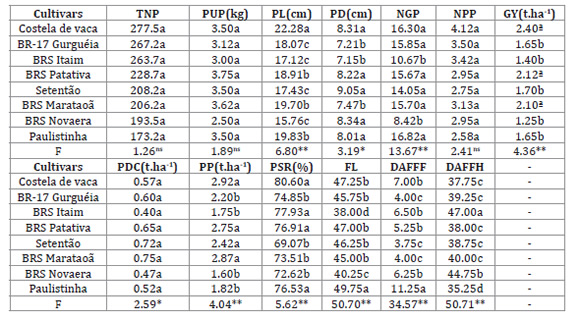
The ANOVA revealed significant
differences between the evaluated variables, except for TNP, PUP and NPP. Means
grouping allowed the establishment of superior groups regarding the variables
PL, PD, NGP, GY, PP, PSR, FL, DAFFF and DAFFH (Table 1).
Table 1: Mean grouping for evaluated in an experiment conducted in an
experimental field at the Center for Food Science and Technology of the Federal
University of Campina Grande in the city of Pombal - Paraíba.
Tabla 1: Agrupación de los promedios de los caracteres evaluados en el
campo experimental del Centro de Ciencia y Tecnología de Alimentos de la Universidad
Federal de Campina Grande en la ciudad de Pombal - Paraíba.
Total number of pods (TNP), pod unit mass (PUP, kg), pod length
(PL, cm), pod diameter (PD, mm), pod grain number (NGP), number of pods per
plant (NPP), grain yield (GY, kg.), pod bark productivity (PDC, kg.), pod yield
(PP, kg.), seed/pod ratio (PSR), initial flowering (FL), initial fruiting
(DAFFF) and number of days between bloom and fruiting (DAFFH). Means followed
by the same letter belong to the same group by the Scott and Knott test at 5%
probability. ** and * show significance at 1 and 5%
probability; respectively by the F test. ns
non-significant by the F test.
Número total de cápsulas (TNP); masa unitaria de la vaina (PUP,
kg); longitud de la vaina (PL, cm); diámetro de la vaina (DP, mm); grano de
vaina número (NGP); vainas por planta (NPP), grano rendimiento (GY, kg.);
corteza de vaina productividad (PDC, kg.), rendimiento de vaina (PP, kg.),
semilla/proporción de cápsulas (PSR), inicial floración (FL), inicial
fructificación (DAFFF) y número de días entre florecer y fructificar (DAFH). Las
medias seguidas de la misma letra pertenecen al mismo grupo según la prueba de
Scott y Knott al 5% de probabilidad. ** y * muestran
significancia al 1 y 5% de probabilidad; respectivamente; por la prueba de F.
ns no significativa; por prueba F.
The ANOVA showed great
genetic variability among cultivars, as verified by Rocha et
al. (2003) and Silva and Neves (2011), who also
detected significant cultivar effect on grain yield (39). This result allows the application of different selection index
methods with favourable perspectives of simultaneous gains in a set of
variables (24). Rodrigues
et al. (2017), verified the existence of genetic variability in
cowpea cultivars under water stress conditions and successfully applied
different selection index methodologies, identifying superior genotypes.
Regarding mean grouping,
three groups were established for PL, emphasizing cultivar Costela de vaca,
with the greatest pod length and separately allocated in group ‘a’. According
to Araújo (2019), pod length varies from 15 to 20 cm.
This author emphasizes the importance of smaller pods for mechanized harvesting
and larger pods for manual harvesting. In the present work, the results were
diverse with smaller pod cultivars for mechanized harvesting and larger pods
(> 18cm) for manual harvesting, suitable for small farmers without financial
and technological resources to implement mechanized harvesting.
For PD, two groups are
observed. Group "a" comprises cultivars Costela de vaca, BRS
Patativa, Setentão, BRS Novaera and Paulistinha. For Costa et
al. (2021), larger diameter pods would contain heavier seeds.
Two groups were also
established for NGP. Cultivars Costela de vaca, BRS Marataoã, BR-17 Gurguéia,
Paulistinha, Setentão and BRS patativa were allocated to group ‘a’. This
variable has already been stated as one primary component of production (40), Andrade et al. (2010) estimated
genetic parameters and correlations in cowpea demonstrating that this variable
must be carefully studied in selection indices models, since it is related to
other primary components, including PL.
Regarding GY variables,
cultivars Costela de vaca, BRS Marataoã and BRS Patativa were allocated to
group ‘a’ while cultivars Costela de vaca, BRS Marataoã, Setentão and BRS
Patativa were allocated to group ‘a’ for GY and PP. According to Freire Filho et al. (2007), grain yield constitutes
an important commercial trait for expanding consumption, industrial processing
and commercialization of seeds among farmers. These authors also emphasize that
high off-season production reaches high market prices. Cultivars Costela de
vaca, BRS Marataoã and BRS Patativa showed better GY performance than the other
cultivars due to gene recombination and possible transgressive segregation (31). However, before effectively selecting these cultivars, it must
be considered that GY is determined by several genes and correlated with several
other primary components. Therefore, to truly obtain superior cultivars,
evaluating models of selection indices simultaneously gathering several
favourable attributes, becomes necessary (5, 12).
For PSR, Costela de vaca, BRS
Itaim, Paulistinha and BRS Patativa were placed in group ‘a’. Regarding FL,
four groups were found and Paulistinha was separately allocated to group ‘a’.
Noteworthy is that BRS Itaim showed higher precocity in relation to the others.
As to DAFFF, three groups resulted with Paulistinha separately allocated to
group ‘a’.
Finally, for DAFFH, four
groups separately allocated BRS Itaim in group ‘a’ and cultivar Paulistinha in
group ‘d’.
Genetic gains obtained by
correlated responses, that is, by direct and indirect selection, are shown in Table 2.
Table 2: Estimates of original means (o), selected cultivars (s), broad sense
heritability (h2)
and direct and indirect selection gains (GS) for 13 traits, evaluated in 8
cowpea cultivars.
Tabla 2: Estimaciones de medias originales (o), cultivares seleccionados (s),
heredabilidad en sentido amplio (h2)
y ganancias de selección directa e indirecta (GS) para 13 caracteres, evaluados
en 8 cultivares de caupí.
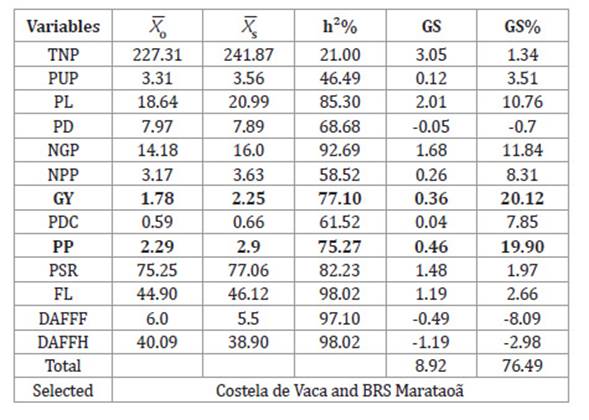
It appears that direct
selection of PP provides, for most of the studied variables, considerable
genetic gains, PD, DAFFF and DAFFH.
The variable PP is the
main GY determinant, given high direct phenotypic and genotypic effects. Direct
selection on this easy-to-measure secondary component allows a response
correlated with a high magnitude (>20%) genetic gain in the main variable GY.
Direct selection in POS
also provides considerable gains in NGP, NPP, PL and PDC. For the variables
TNP and PUP, whose heritability coefficients were low, it is possible to obtain
genetic gains.
Falconer
(1987) states that obtaining greater gains with indirect selection is
possible when the auxiliary variables have higher heritability than the main
variable, as for NGP and PL. Corroborating this, Gonçalves et
al. (2007), stated that to obtain superior cultivars by simultaneously
combining a series of favourable attributes and higher productivity, evaluating
different selection index methodologies is important (28). Selection gains obtained by the
methodology of Smith (1936) and Hazel
(1943) are presented in Table 3.
Table 3: Estimates of original means (o), selected cultivars (s), heritability
(h2), covariances
(Cov) and indirect selection gains (GS) based on the Smith
(1936) and Hazel (1943) index for 7 traits,
evaluated in 8 cowpea cultivars.
Tabla 3: Estimaciones de medias originales (o), cultivares seleccionados (s),
heredabilidad (h2),
covarianzas (Cov) y ganancias de selección (GS) indirecta basadas en los
índices de Smith (1936) y Hazel (1943) para 7
caracteres, evaluados en 8 cultivares de caupí.
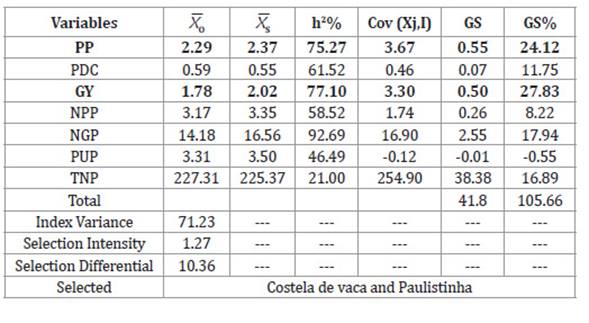
This methodology allows
obtaining significant and simultaneous genetic gains in important primary yield
components, with the exception of PUP. However, this simultaneous selection only
caused few changes in this variable (-0.01). Therefore, one can consider null
changes in PUP and proceed with a safe selection.
In popcorn, Granate et al. (2002) used several selection index
methodologies and obtained significant genetic gains. Gains obtained with the Smith (1936) and Hazel (1943)
indices were superior to those predicted with other indices, as also obtained
by Rodrigues et al. (2017), when selecting
cowpea populations under water stress. According to Cruz et
al. (2012), the Smith (1936) and Hazel (1943) indices are superior to direct selection
because they consist of linear combinations of several economic variables,
whose weighting coefficients maximize the index/genotypic aggregate
correlation.
Table 4 shows genetic gains obtained according to Mulamba and Mock (1978), considering variable exclusion
after multicollinearity.
Table 4: Original means (o), of selected cultivars (s), heritability
(h2), covariances
(Cov) and indirect selection gains based on the sum of ranks for 7 traits,
evaluated in 8 cowpea cultivars.
Tabla 4: Estimaciones de medias originales (o),
cultivares seleccionados (s), heredabilidad
(h2) y ganancias de
selección indirecta (GS) basadas en la suma de rangos para 7 caracteres,
evaluados en 8 cultivares de caupí.
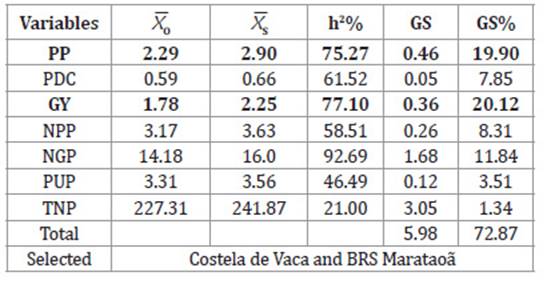
Once again, significant
and simultaneous genetic gains were obtained in primary components of
production. No undesired changes in PUP were obtained through the rank sum
methodology. In fact, given the simplicity of result interpretation, the rank
sum methodology is among the most used in genetic improvement for estimating
selection gains. The significant genetic gains here obtained using the sum of
ranks, although slightly lower than those obtained by Smith
(1936) and Hazel (1943) methodologies, are given by
an economic weight equivalent to CVg that considers all the evaluated variables
as the main ones (6).
Table 5, shows genetic gain estimates based on the desired gain
methodology proposed by Pesek and Baker (1969).
Table 5: Original averages (o), of selected cultivars (s), heritability (h2),
covariances (Cov) and indirect selection gains based on selection by the Pesek
and Baker (1969) index for 7 traits evaluated in 8 cowpea cultivars.
Tabla 5: Estimaciones de medias originales (o),
cultivares seleccionados (s),
heredabilidad (h2)
y ganancias de selección indirecta (GS) basadas en la selección por médio del
índice de Pesek y Baker (1969) para 7
caracteres, evaluados en 8 cultivares de caupí.
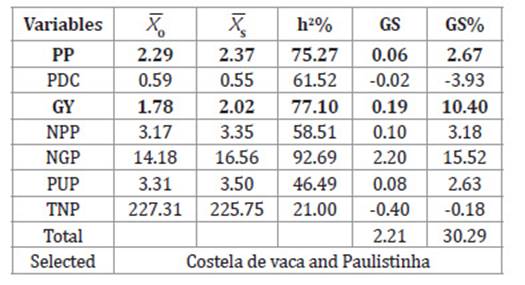
The methodology based on
desired gains provided simultaneous gains in the POS, GY, NPP, NGP and PUP
variables. However, it caused undesired changes in PDC. Despite having provided
significant gains in NGP (above 15%), it did not provide greater gains in POS
and GY, as also evidenced in other studies (36). It should be noted that this methodology was developed after the
difficulty of establishing relative economic weights to the variables, replacing
them with the desired gains. These desired gains, according to Crossbie et al. (1980) and Vieira
(1988) could be replaced by the genetic standard deviation for each
variable. However, despite the use of genetic standard deviation, the results
do not outweigh gains obtained with other indices. Rodrigues
et al. (2017) also used the Pesek and Baker
(1969) methodology along with the sum of ranks and the classic Smith (1936) and Hazel (1943)
indices, obtaining similar results in magnitude and direction, but undesired
changes in grain index when using the desired gains index. These divergent
results can be explained by the limitations of the genetic structure of the
breeding population (23). Thus, it is up to the
breeder choosing the best methodology to find the greatest genetic gains, and
practice selection with greater safety.
Conclusions
Direct selection in the
secondary component PP provides significant genetic gains in the main variable
GY;
The classic selection
index presents a greater distribution of genetic gains for the main variable
and for the primary components of production;
Cultivars Costela de vaca, BRS Marataoã and Paulistinha are
recommended for cultivation and commercial exploitation in the semiarid region
of Paraíba.
Acknowledgments
To the National Council for
Scientific and Technological Development (CNPq) for granting the PIBIC
scholarship.
1.
Amaral Júnior, A. T.; Freitas Júnior, S. P.; Rangel, R. M.; Pena, G. F.;
Ribeiro, R. M.; Morais, R. C.; Schuelter, A. R. 2010. Improvement of a popcorn
population using selection indexes from a fourth cycle of recurrent selection
program carried out in two different environments. Genetics and Molecular
Research. 9: 340-370.
2.
Andrade, F. N.; Moura, R. M.; Gomes, R. L.; Rodrigues, F. F. F.; Ramos, S. R.
2010. Estimation of genetic parameters in cowpea genotypes evaluated for fresh
southern pea. Ciência Agronômica. 41: 253-258.
3.
Araújo, K. C. 2019. Evaluation of improved strains of cowpea (Vigna
unguiculata L. Walp) in the Northwest Fluminense region to study the value
of cultivation and use. Doctoral thesis in Vegetal Production. State University
of North Fluminense Darcy Ribeiro. Rio de Janeiro. Brasil. 115 p.
4.
Beltrão, B. A.; Souza Júnior, L. C.; Morais, F.; Mendes, V. A.; Miranda, J. L.
F. 2005. Diagnosis of the municipality of Pombal. Project to register
underground water supply sources. Recife: Ministry of Mines and
Energy/CPRM/PRODEM. 23.
5.
Bertini, C. H. C. D. M.; Almeida, W. S. D.; Silva, A. P. M. D.; Silva, J. W.
L.; Teófilo, E. M. 2010. Multivariate analysis and selection index for
identification of cowpea genotypes. Acta Scientiarum Agronomy. 32: 613-619.
6.
Costa, M. M.; Di Mauro, A. O.; Unêda-Trevisoli, S. H.; Arriel, N. H. C.;
Bárbaro, I. M.; Muniz, F. R. S. 2004. Genetic gain by different selection
criteria in soybean segregant populations. Pesquisa Agropecuária Brasileira.
39: 1095 -1102.
7.
Costa, J. A.; Peixoto, C. P.; Almeida, A. T. A. T.; Santos, J. M. D. S.;
Oliveira, E. R.; Silva, S. J. 2021. Analysis of path in agromorphological
characters of peanut genotypes of Valencia type. Brazilian Journal of
Development. 7: 29368-29382.
8.
Crosbie, T. M.; Mock, J. J.; Smith, O. S. 1980. Comparison of gains predicted
by several selection methods for cold tolerance traits of two maize populations
1. Crop Science. 20: 649-655.
9.
Cruz, C. D. 2006a. Programa Genes - Estatística Experimental e Matrizes. Ed.
Viçosa: UFV . 285 p.
10.
Cruz, C. D. 2006b. Programa Genes - Biometria. Ed. Viçosa: UFV. 382 p.
11.
Cruz, C. D. 2013. Genes: a software package for analysis in experimental
statistics and quantitative genetics. Acta Scientiarum. Agronomy. 35: 271-276.
12.
Cruz, C. D.; Regazzi, A. J.; Carneiro, P. C. S. 2012. 4° ed. Modelos
biométricos aplicados ao melhoramento genético. Ed. UFV 508 p.
13.
Dutra Filho, J. de A.; Souto, L. S.; de Luna, R. G.; Souza, A. dos S.;
Gomes-Silva, F.; Silva, F. A. C.; Simões Neto, D. E.; Calsa Júnior, T. 2021.
Mixed modeling for fiber yield genetic selection in sugarcane (Saccharum
officinarum). Revista de la Facultad de Ciencias Agrarias. Universidad
Nacional de Cuyo. Mendoza. Argentina. 53(2): 11-19.
14.
Falconer, D. S. 1987. Introdução à genética quantitativa. Ed. UFV. 279 p.
15.
Fernandes, V. L. B. 1993. Recomendações de adubação e calagem para o estado do
Ceará. Ed. UFC. 248 p.
16.
Freire Filho, F. R.; Rocha, M. M.; Ribeiro, V. Q.; Ramos, S. R. R.; Machado, C.
F. 2007. New gene producing green cotyledon in cowpea. Ciência Agronômica . 38: 286-290.
17.
Freitas, I. L. D. J.; Amaral Junior, A. T. D.; Viana, A. P.; Pena, G. F.; Cabral,
P. D. S.; Vittorazzi, C.; Silva, T. R. D. C. 2013. Genetic gain evaluated with
selection indices and with REML/Blup in popcorn. Pesquisa Agropecuária
Brasileira. 48: 1464-1471.
18.
Galon, L.; do Amarante, L.; Favretto, E. L.; Cavaletti, D. C.; Henz Neto, O.
D.; Brandler, D.; Senhori , V. M.; Concenço, G. V. M.; Stradioto Melo, T.;
Aspiazú, I.; Muzzel Trezzi, M. 2022. Competitive ability of bean Phaseolus
vulgaris cultivars with Urochloa plantaginea. Revista de la Facultad de
Ciencias Agrarias .
Universidad Nacional de Cuyo. Mendoza. Argentina. 54(1): 117-131.
19.
Garcia, A. A.; Souza Júnior, C. L. D. 1999. Comparison of non-parametric
selection indices for the selection of cultivars. Bragantia. 58: 253-267.
20.
Gonçalves, G. M.; Viana, A. P.; Bezerra Neto, F. V.; Pereira, M. G.; Pereira,
T. N. S. 2007. Selection and heritability in the prediction of genetic gain in
yellow passion fruit. Pesquisa Agropecuária Brasileira. 42: 193-198.
21.
Granate, M. J.; Cruz, C. D.; Pacheco, C. A. P. 2002. Prediction of genetic gain
with different selection indices in popcorn CMS-43. Pesquisa Agropecuária
Brasileira. 37: 1001-1008.
22.
Hazel, L. N. 1943. The genetic basis for constructing selection indexes.
Genetics. 28: 476-490.
23.
Martins, I. S.; Cruz, C. D.; Regazzi, A. J.; Pires, I. E. 2003. Comparison of
direct and indirect selection processes and selection indices in Eucalyptus
grandis. Revista Árvore. 27: 327-333.
24.
Martins, I. S.; Martins, R. D. C. C.; Santos, P. D. 2006. Alternatives of
indices of selection in a Eucalyptus grandis population. Cerne. 12:
287-291.
25.
Moura, E. M.; Righetto, A. M.; Lima, R. R. M. 2011. Assessment of water
availability and water demand in the Piranhas-Açu River Section between
Coremas-Mãe D’água and Armando Ribeiro Gonçalves Weirs. Revista Brasileira de
Recursos Hídricos. 16: 07-19.
26. Mulamba, N. N.; Mock, J. J. 1978. Improvement of yield
potential of the ETO blanco maize (Zea mays L.) population by breeding
for plant traits [Mexico]. Egyptian
Journal of genetics and Cytology. 7: 40-51.
27.
Oliveira, A. P.; Araújo, J. S.; Alves, E. U.; Noronha, M. A.; Cassimiro, C. M.;
Mendonça, F. G. 2001. Yield of cowpea-beans cultivated with bovine manure and
mineral fertilization. Horticultura Brasileira. 19: 81- 84.
28.
Pereira Ribeiro, L.; Dessaune Tardin, F.; Beserra de Menezes, C.; Botega
Baldoni, A.; Teodoro, P. E.; Lopes Bhering, L. 2021. Combining yield, earliness
and plant height in a single genotype: a proposal for breeding in grain sorghum
(Sorghum bicolor L.). Revista
de la Facultad de Ciencias Agrarias .
Universidad Nacional de Cuyo. Mendoza. Argentina. 53(1): 11-21.
29.
Perina, E. F.; Carvalho, C. R. L.; Chiorato, A. F.; Gonçalves, J. G. R.;
Carbonell, S. A. M. 2010. Evaluation of the stability and adaptability of
genotypes of common beans (Phaseolus vulgaris L.) through multivariate
analysis of genotype performance. Ciência e Agrotecnologia. 34: 398-406.
30.
Pešek, J.; Baker, R. J. 1969. Desired improvement in relation to selection
indices. Canadian journal of plant Science. 49: 803-804.
31.
Ramalho, M. A. P.; Santos, J. B.; Pinto, C. A. B. P.; Souza, E. A.; Gonçalves,
F. M. A.; Souza, J. C. 2012. 5° ed. Genética na agropecuária. Ed. UFLA. 463 p.
32.
Rocha, M. D. M.; Campelo, J. E. G.; Freire Filho, F. R.; Ribeiro, V. Q.; Lopes,
A. D. A. 2003. Estimates of genetic parameters in white coat cowpea genotypes.
Ciência Rural. 8: 135-141.
33.
Rodrigues, E. V.; Damasceno-Silva, K. J.; Rocha, M. D. M.; Bastos, E. A.;
Teodoro, P. E. 2017. Selection of cowpea populations tolerant to water deficit
by selection index1. Ciência agronômica. 48: 889-896.
34.
Scott, A. J.; Knott, M. 1974. A cluster analysis method for grouping means in
the analysis of variance. Biometrics. 30: 507-512.
35.
Silva, J. A. L. D.; Neves, J. A. 2011. Production components and their
correlations in caupi bean genotypes in rainfed and in irrigated cultivation. Ciência Agronômica . 42: 702-713.
36.
Smith, H. F. 1936. A discriminant function for plant selection. Annals of
eugenics. 7: 240-250.
37.
Souza, R. F. 2010. Phosphorus dynamics in soils influenced by liming and
organic fertilization, cultivated with common bean. Thesis Doctorate in Soils
and Plant Nutrition. Federal University of Lavras, MG. 141 p.
38.
Suwantaradon, K.; Eberhart, S. A.; Mock, J. J.; Owens, J. C.; Guthrie, W. D.
1975. Index Selection for Several Agronomic Traits in the BSSS2 Maize
Population 1. Crop Science. 15: 827-833.
39.
Tiraboschi Leal, F.; Trombeta Bettiol, J. V.; Filla, V. A.; Prates Coelho, A.;
Checchio Mingotte, F. L.; Borges Lemos, L. 2021. Grain quality of common bean (Phaseolus
vulgaris L.) cultivars under low and high nitrogen dose. Revista de la Facultad de
Ciencias Agrarias. Universidad Nacional de Cuyo. Mendoza. Argentina. 53(1):
118-127.
40.
Torres, F. E.; Sagrilo, E.; Teodoro, P. E.; Ribeiro, L. P.; Cargnelutti Filho,
A. 2015. Number of replicates for the evaluation of characters in cowpea
genotypes. Bragantia. 74: 161-168.
41.
Vinícius Castro Guimarães, B.; de Carvalho, A. J.; Aspiazú, I.; Santana da
Silva, L.; Pereira da Silva, R. R.; Leal Pimenta, A. M.; Almeida Moura, M. M.
2021. Optimal plot size for experimentation of common beans (Phaseolus
vulgaris L.) in the northern region of Minas Gerais, Brazil. 2021. Revista de la Facultad de
Ciencias Agrarias. Universidad Nacional de Cuyo. Mendoza. Argentina. 53(2):
55-63.
42.
Vieira, J. 1988. Herdabilidade, correlações e índice de seleção (Daucus
carota L.). Tese. Doutorado em Genética e Melhoramento. Universidade Federa
de Viçosa. MG. 86 p.