Revista de la Facultad de Ciencias
Agrarias. Universidad Nacional de Cuyo. Tomo 54(2). ISSN (en línea) 1853-8665.
Año 2022.
Original article
Sowing
date effects on yield of three winter forage crops in
the northern oasis of Mendoza
Efecto de la fecha de siembra en el rendimiento de tres verdeos invernales
en el oasis norte de Mendoza
Alejandra Bertona1
Cecilia Rebora1
1 Universidad Nacional de Cuyo. Facultad de Ciencias
Agrarias. Alte. Brown 500. Chacras de Coria. Mendoza. Argentina. M5528AHB.
*libarguren@fca.uncu.edu.ar
Abstract
The increasing
livestock farming in the province of Mendoza requests the acquisition of
further knowledge on winter forage crops, annual grasses that produce a large
volume of good quality biomass in a short time. The most widely used winter
forage crops in Argentina are oats, rye and barley. To assess forage
productivity in the northern oasis of Mendoza, an experimental factorial design
combined 2 sowing dates (March 21, 2019, and April 29, 2019) and three winter
forage crops: oats (Blanca Cristal INTA), rye (Lisandro INTA) and barley
(Alicia INTA). Results showed no interaction between sowing dates and forage
species. March sowing date was 27% more productive and offered a longer grazing
period than April sowing (more than five months in March sowing and more than
one month in April sowing). Oat showed the highest yield, differing
significantly from rye and barley.
Keywords: Avena sativa; Secale cereale; Hordeum vulgare.
Resumen
La intensificación de la producción animal en la provincia de Mendoza requiere
ampliar el estudio de recursos forrajeros. Los verdeos de invierno son
gramíneas anuales que producen gran volumen de forraje de buena calidad, y son
importantes en las cadenas forrajeras desde comienzos de otoño hasta avanzada
la primavera. En Argentina, los verdeos invernales más utilizados son: avena,
centeno y cebada. En el oasis norte de Mendoza, se planteó un experimento
factorial combinando 2 fechas de siembra (21 de marzo de 2019 y 29 de abril de
2019) y los tres verdeos invernales: avena (Blanca Cristal INTA), centeno
(Lisandro INTA) y cebada (Alicia INTA). No hubo interacción entre fechas de
siembra y especies de verdeos invernales. La primera fecha de siembra resultó
un 27% más productiva y su ventana de aprovechamiento fue mayor que en la
segunda; resultando de más de cinco meses en la siembra de marzo y de un mes en
la siembra de abril. La avena fue el cultivo con mayor producción,
diferenciándose significativamente del centeno y la cebada.
Palabras
clave: Avena sativa; Secale cereale; Hordeum
vulgare.
Originales: Recepción: 13/10/2021
Aceptación:
30/11/2022
Introduction
Winter forage
crops are annual grasses that produce a large volume of good-quality biomass in
a short time. They play an important role in the forage chains from early
autumn to late spring, when perennial cultivated or natural pastures show low
forage availability (1, 9). Thus, given
high seasonal production, winter forage crops are one efficient resource to be
supplemented with perennial pastures, besides supporting stable forage
production all year round (6). In addition, given they extend the grazing
season through winter, they constitute an economically
valuable alternative to the generally more expensive reserves (hay or silage).
According to
the Ministerio de Agricultura, Ganadería y Pesca de Argentina, the most widely
used winter forage crops in Argentina are oats (Avena sativa), barley (Hordeum
vulgare) and rye (Secale cereale) (4). The average cultivated area during the 2020
campaign was: 1,405,535 ha of oats; 1,237,023 ha of barley and 667,809 ha of
rye. These numbers represent the total planted area (hectares) regardless of
whether they are harvested, grazed or two-fold purpose (8). Livestock migration to extra-pampean
regions after the intrusion of agriculture has allowed Mendoza to develop
intensive livestock farming activities.
The available information
on forage crops in the irrigated oases of Mendoza is scarce. In the last years,
some studies on alfalfa (12), corn and sorghum silages (5, 13) were reported. In this sense, determining
the best sowing date is key for forage production.
Records from different cultivated areas of the country show that, in general,
early sowing of winter forage crops results in more productivity (1, 3,
10), However, species
production potential may vary among environments (11). Given this situation and aiming to generate
information on winter forage production in the northern oasis of the Mendoza
Province, the following hypotheses were formulated: depending on the species
(oats, rye, barley), early sowings (March) produce higher forage yields than
late sowings (April).
Materials
and methods
The
experiment was conducted at the San Antonio farm of the Facultad de Ciencias
Agrarias, Universidad Nacional de Cuyo, at 33°00’38” S and 68°52’28” W, on
poorly developed alluvial silt loam soil. Mean annual temperature is 16.5°C,
average relative humidity is 50% and average annual rainfall is 225 mm. Table 1 shows monthly mean, minimum
and maximum temperatures during the forage growing period:
Table
1: Monthly mean,
minimum and maximum temperatures in degrees Celsius, from March to November
2019, Luján de Cuyo, Mendoza.
Tabla 1: Temperaturas medias, mínimas y máximas
mensuales en grados centígrados, de marzo a Noviembre 2019, Luján de Cuyo,
Mendoza.

The
factorial experimental design was conducted in random blocks with 3
replications on 18 experimental plots: Two sowing dates (March 21, 2019, and
April 29, 2019) for 3 winter forage crops: oats
(Blanca Cristal INTA), rye (Lisandro INTA) and barley (Alicia INTA), and 3
replications per treatment. Table 2 shows crop management.
Table 2: Crop management of experimental plots.
Tabla 2: Manejo de las parcelas experimentales.
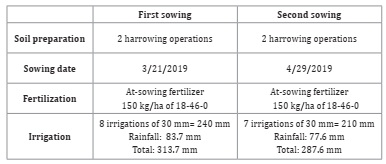
Ten m2
experimental plots (ten rows, 5m long and spaced 0.20 m), were
sowed at a rate of 250 pl/m2 (1, 3, 4, 9).
Cuts were made at 40 cm forage height (ensuring appropriate plant anchorage and
coverage between rows), leaving a remnant of 10 cm.
Forage fresh weight was determined after each cut. Then, the percentage of
oven-dried dry matter (% MS) was obtained at 60°C with forced-air circulation
(on a 200 g sample). Finally, forage production per surface unit (kg DM/ha) was
calculated. Each treatment was cut as many times as possible. At the end of the
growing season, accumulated dry matter was determined.
Data on
accumulated dry matter (kg) were analyzed through ANOVA and mean comparison
(Tukey test) with Infostat, student’s version (2).
Results
and discussion
Sowing
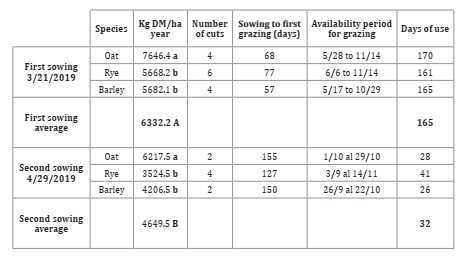
date and species showed no interaction (p=0.9990). March sowings were
significantly more productive (p=0.0017) than April sowings. In turn,
considering annual kg of dry matter/ha, oat was significantly different
(p=0.0037) from rye and barley (Table 3).
Table
3: Accumulated forage biomass
(kg DM/ha/year), number of cuts, sowing to first grazing (days), availability
period for grazing and days of use for oats, rye and barley during a productive
cycle, 2019.
Tabla 3: Biomasa forrajera acumulada (kg MS/ha/año),
número de cortes, siembra a primer pastoreo (días), período de disponibilidad
para pastoreo y días de uso para avena, centeno y cebada, ciclo 2019.
Means in capital letters indicate significant differences among
sowing dates (p<0.05). Means in lowercase letters indicate significant
differences among species (p<0.05).
Medias en mayúsculas indican diferencias
significativas entre fechas de siembra (p<0,05). Medias en minúsculas
indican diferencias significativas entre especies (p<0,05).
Previous
studies at INTA EEA Barnetche have also shown more productive early sowings
(late February/early March), than late sowings (end of March). However, they
identified barley as the most productive crop (10)
while our results show oats yielding the highest dry matter. Another study
conducted by INTA EEA General Villegas found no differences in dry mass
accumulation among barley, triticale, oats, wheat and rye (7).
The number of
cuts obtained (Table 3) in each species differed from
other growing sites in Argentina. Experiences at INTA Manfredi report 4 to 5
cuts for oat cultivars and 3 cuts for rye cultivars (14). In this sense, local studies are especially relevant
since environment and crop management might condition productive performance.
Special emphasis lies on cutting time since such a decision may affect yield.
In this study, cutting was made at 40 cm plant height, while in Manfredi, cuts were made at 25-30 cm plant height.
On the other
hand, the number of days from sowing to grazing was lower in March than in
April (Table 3), meaning that for earlier
sowings, the first grazing can occur earlier, as observed in Alto Valle de Río
Negro (3) and Bordenave,
Province of Buenos Aires (15).
Concerning
forage availability period for grazing purposes, sowing in March provides
forage between May and October/November, depending on the species, while if
sowing occurs during the second half of April, the first grazing can occur in
early September. Considering forage availability periods of early sowed crops,
they may constitute an alternative to dormant alfalfa, from late April/early
May to late October/early November.
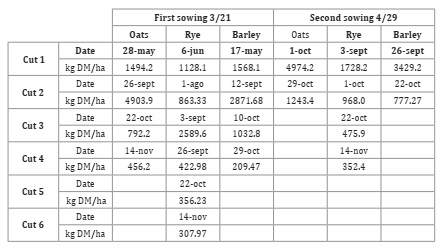
Table 4 shows cutting dates and yield for each treatment.
Table
4: Cutting dates and dry
matter obtained from each forage crop, 2019.
Tabla 4: Fechas de corte y materia seca obtenida de
cada verdeo invernal, 2019.
For the
March sowing date, barley was the most precocious forage, first cut on May 17,
agreeing with the results obtained in Bolívar, Buenos Aires, where barley also
resulted to be the most precocious species (10).
By contrast, during April sowing, the most precocious forage was rye, first cut
on September 3. On both sowing dates, rye production remained steady until
mid-November. It should be pointed out that the cutting criteria adopted in
this paper, only considering forage height, may have influenced the results
obtained since such height could be related to different phonological stages of
forage crops.
Conclusions
Early sowings
(March) yielded more forage than late sowings (April) in all three species.
Forage availability period for grazing purposes, as well as cutting number, was
higher for March sowings.
Considering
environmental effects and the adopted cutting criterion, oats yielded more
forage during both sowing dates.
The obtained
results show that winter forage crops could constitute a forage resource for
livestock systems in Mendoza, which could be complemented with alfalfa.
Future studies
should compare cultivars and cutting criteria, and include forage quality
determinations.
Acknowledgments
Special thanks
to the staff at Finca San Antonio, Facultad de Ciencias Agrarias, Universidad
Nacional de Cuyo, for the commitment and dedication, and to the willingness of
the Experimental field coordinator, agronomist Alfredo Draque, who provided
field personnel whenever needed.
Thanks
should also go to the following students, some of them already colleagues: Azúl
Burrutto, Leandro Caetano, Facundo Laurenti, Álvaro López, Roberto Sabatini, Noelia Uvilla y Julieta Venturini.
1. Chiossone, J.; Vicini, R.; Lertora, R. 2017. Verdeos de invierno. https://inta.gob.ar/sites/default/files/inta_informe_verdeos_de_invierno-actualizacion_2017-1.pdf (consultado en
abril 2021).
2. Di Rienzo, J. A.; Casanoves, F.; Balzarini, M. G.; Gonzalez,
L., Tablada, M.; Robledo, C. W. 2008. InfoStat,
versión 2008, Grupo InfoStat, FCA. Universidad Nacional de Córdoba. Argentina
(consultado en noviembre 2022).
3. Domini, S. 2020 Aprovechamiento de verdeos
de invierno mediante pastoreo directo. https://repositorio.inta.gob.ar/bitstream/handle/20.500.12123/8309/INTA_CRPatagoniaNorte_EEAAltoValle_Domini_S_Aprovechamiento_verdeos_de%20_jnvierno_mediante_pastoreo_directo.pdf?sequence=1&isAllowed=y (consultado en septiembre 2021).
4. Gallego, J.; Barbarossa, R.; Neira Zilli, F.; Miñon, D. 2014. Verdeos de invierno. https://repositorio.inta.gob.ar/xmlui/bitstream/handle/20.500.12123/4020/INTA_CRPatagoniaNorte_EEAValleInferior_Gallego_J_Verdeos_de_invierno.pdf?sequence=1&isAllowed=y (consultado en abril
2021).
5. Ibarguren, L.; Rebora, C.; Bertona, A.; Antonini, C. 2020. Sorghum silage production in the northern oasis of Mendoza,
Argentina. Revista de la Facultad de Ciencias Agrarias.
Universidad Nacional de Cuyo. Mendoza. Argentina. 52(1): 121-127. http://revistas.uncu.edu.ar/ojs3/index.php/RFCA/article/view/2983/2132 (consultado en abril 2021).
6. Kloster, A. M.; Amigone, M. A. 2005. Utilización
de verdeos de invierno bajo pastoreo en invernada. http://www.produccion-animal.com.ar/produccion_y_manejo_pasturas/pasturas_cultivadas_
verdeos_invierno/13-utilizacion_verdeos.pdf (consultado
en abril 2021).
7. Maeka, M.; Fantino, F. 2011. Silaje
de cereales de invierno: acumulación de biomasa y composición química.
Diponible en: https://inta.gob.ar/sites/default/files/script-tmp-mt2011_
maekawa_silaje_cereales_invierno.pdf (consultado en
abril 2021).
8. Ministerio de Agricultura Ganadería y
Pesca http://datosestimaciones.magyp.gob.ar/reportes.php?reporte=Estimaciones (consultado en
abril 2021).
9. Moreyra, F.; Giménez, F.; López, J.; Trainer, E.; Ortellado,
M.; Kruger, H.; Mayo, A.; Labarthe, F. 2014. Verdeos
de invierno. INTA Ediciones. https://inta.gob.ar/sites/default/files/script-tmp-inta-_verdeos_de_invierno_1.pdf (consultado en abril 2021).
10. Pérez, G. 2013. Evaluación de diferentes verdeos de invierno,
tres fechas de siembra y 2 niveles de fertilización nitrogenada. https://inta.gob.ar/sites/default/files/script-tmp-inta-_evaluacin_de_diferentes_verdeos_de_invierno_bol.pdf (consultado en abril 2021).
11. Quiroga, A.; Frasier, I.; Pordomingo, A.; Fernández, R.;
Garay, J. 2010. Estrategias de producción de cereales
invernales en sistemas mixtos. https://fertilizar.org.ar/wp-content/uploads/2021/02/2010-no-14-Estrategias-de-produccio%CC%81n-de-cereales-invernales-en-sistemas-mixtos.pdf (consultado en agosto 2022).
12. Rebora, C.; Barros, A.; Ibarguren, L.; Bertona, A.; Antonini,
C.; Arenas, F. 2015. Efecto del grado de reposo invernal de
alfalfa (Medicago sativa L.) sobre el rendimiento de heno en el oasis
norte de Mendoza. Revista de la Facultad
de Ciencias Agrarias .
Universidad Nacional de Cuyo. Mendoza. Argentina. 47(2): 43-51. https://revistas.uncu.edu.ar/ojs3/index.php/RFCA/article/view/3302/2427 (consultado en abril 2021).
13. Rebora, C.; Ibarguren, L.; Barros, A.; Bertona, A.; Antonini,
C.; Arenas, F; Calderón, M.; Guerrero, D. 2018. Corn silage
production in the northern oasis of Mendoza, Argentina. Revista de la Facultad de Ciencias Agrarias . Universidad Nacional de Cuyo. Mendoza.
Argentina. 50(2): 369-375. http://revista.fca.uncu.edu.ar/images/stories/pdfs/2018-02/Cp_26_Rbora_Nota_cientfica.pdf (consultado en abril 2021).
14. Spada, M.; Mombelli, J. 2009. Producción
de verdeos de invierno en la región central de Córdoba. https://www.produccion-animal.com.ar/produccion_y_manejo_pasturas/pasturas_
cultivadas_verdeos_invierno/53-cordoba.pdf (consultado en agosto 2021).
15. Tranier, E. 2014. Manejo de cultivo:
criterios a tener en cuenta en la realización de un verdeo de invierno. https://inta.gob.ar/sites/default/files/script-tmp-inta-_verdeos_de_invierno_1.pdf p. 33-38
(consultado en septiembre 2021).