Revista de la Facultad de Ciencias
Agrarias. Universidad Nacional de Cuyo. Tomo 54(2). ISSN (en línea) 1853-8665.
Año 2022.
Original article
Metallic elements in
foliar material and fruits of three tree species as bioindicators
Elementos metálicos en material foliar y frutos de tres
especies arbóreas como bioindicadores
Jorge Alonso Alcalá Jáuregui 1*
Juan C. Rodríguez Ortiz 1
Maria Flavia Filippini 2
Eduardo Martínez Carretero
3
Alejandra Hernández Montoya
1
Ángel Natanael Rojas Velázquez
1
Heriberto Méndez Cortés 1
Felix Alfredo Beltrán Morales
4
1 Universidad Autónoma de San Luis Potosí. Facultad de
Agronomía y Veterinaria. Carretera San Luis Potosí - Matehuala Km. 14.5 Ejido
Palma de la Cruz CP. 78321 Soledad de Graciano Sánchez. San Luis Potosí. México.
2 Universidad Nacional de Cuyo. Facultad de Ciencias
Agrarias. Cátedra de Química Agrícola. Almirante
Brown 500. M5528AHB. Chacras de Coria. Mendoza.
Argentina.
3 IADIZA-CONICET,
Mendoza. Geobotánica
y Fitogeografía. Universidad Nacional de San Juan. Facultad de Ciencias.
Exactas, Físicas y Naturales. Argentina.
4 Centro
de Investigaciones Biológicas del Noroeste, Carretera a San Juan de La Costa El
Comitán Km. 1, Playa Palo de Santa Rita Sur; La Paz, B.C.S. México. 23096.
* jorge.alcala@uaslp.mx.
Abstract
This study
aimed to determine the presence of metal elements in fruits and leaves of three
tree species as bioindicators in San Luis Potosi, Mexico. Ninety fruit and 90
leaf samples (30 per tree species) were collected at five sites (agricultural,
suburban, commercial and services, urban, and mining), using the site and the
presence of P. laevigata, S. molle, and A. farnesiana as
references. Total concentrations of 13 metal elements were determined using an
inductively coupled plasma mass spectrometer (ICP-MS). The species were
significantly affected by Co, As, and Pb (ANOVA,
p≤0.05). Considering the land use and the species, the contents determined in
the leaves and fruits of the three species had sufficient and phytotoxic
contents of Al, Cd, Co, Ni, Mn, Ti, and Cr, and excessive ranges with the
possible phytotoxic effect of As, Cu, Pb, Zn, V, and Fe. The A. farnesiana had
the highest concentrations of 12 heavy metals analyzed (HM). The variation in
total metal concentrations between leaves and fruits ranged from 84.70 to
99.06%, with V, As, and Cr being prominent. The
functionality of these tree species as phytoremediators and bioindicators is
reviewed to evaluate environmental impacts on land use.
Keywords: P. laevigata; S. molle; A. farnesiana; Land uses; Bioindicator.
Resumen
El objetivo del estudio fue determinar la presencia de elementos metálicos
en frutos y hojas de tres especies arbóreas como bioindicadoras en San Luis
Potosí, México. En cinco usos de suelo (agrícola, suburbano, comercio y servicios,
urbano y minero) y tomando como referencia la ubicación y presencia de 30
árboles de P. laevigata, S. molle y A. farnesiana. Fueron
colectadas en total 90 muestras de frutos y 90 de hojas (30 por especie). Las
concentraciones totales de 13 elementos metálicos se determinaron utilizando un
equipo de espectrometría de masas de plasma acoplado inductivamente (ICP-MS).
La especie tuvo efecto significativo en Co, As y Pb (ANOVA, p≤0,05).
Considerando los usos de suelo y la especie, los niveles determinados en hoja
y fruto en las tres especies presentaron niveles suficientes y fitotóxicas en
Al, Cd, Co, Ni, Mn, Ti y Cr y excesivos con posible efecto fitotóxico de As,
Cu, Pb, Zn, V y Fe. A. farnesiana obtuvo las concentraciones más altas
de 12 metales pesados (MP). La variación en las concentraciones totales de
metales entre hoja a fruto osciló de 84.70 a 99.06%, destacando V, As y Cr. Se
comprueba la funcionalidad de estas especies arbóreas como fitorremediadoras y
bioindicadoras para evaluar el impacto ambiental en usos de suelo.
Palabras
clave: P. laevigata; S. molle; A.
farnesiana; Usos
de suelo; Bioindicador.
Originales: Recepción:
08/03/2022
Aceptación: 06/12/2022
Introduction
Tree species
represent a potential bioindicator for studying environmental pollutants due to
their ability to accumulate heavy metals. Among the ecological services
provided by vegetation, microenvironmental enhancement, runoff reduction,
carbon sequestration and accumulation, noise reduction, air purification, and
pollutant sequestration are essential (19). Heavy metals (HM) are of interest in
environmental studies, and tree species serve as bioindicators (42). Plants have evolved mechanisms to take up
and tolerate these potentially toxic elements (36). They accumulate readily and are persistent
because they are not biodegradable or thermally degradable and can be toxic at
high concentrations (21, 32). Some
oligo-elements, such as Fe, Mn, Zn, Cu, Mg, Mo, and Ni, have biological
significance, while others, such as Cd, Cr, Pb, Co, Ag, Se, and Hg, are
phytotoxic (18, 28). Human
activities such as car exhaust, industrial factories, urban waste, intensive
use of fertilizers, and others (28, 29) are the primary sources of emissions.
Vegetation can absorb HM through roots, stems, and leaves; however, accumulation
depends on the specific metal element, plant species, and environmental
conditions (15, 19). In addition,
HM exhibits different behavior and mobility patterns in the plant, with some
tending to immobilize and accumulate in the roots, while others migrate to the
aboveground organs (15). In different
regions of the world, interest in the study of HM is based on biological and
phytogeographical characteristics of urban trees (19, 30).
In Mexico,
anthropogenic activity, especially mining, is thought to have increased,
contaminating with HM such as Hg, As, Pb, and Cr (17). San Luis Potosi (Mx) has sites contaminated
with As and Pb (21). In the urban and suburban areas of San Luis
Potosi and Graciano Sanchez, atmospheric particles contaminated with Fe, Pb,
Cr, Mn, Ni, Cu, Cd, As, and Ti, among others, were found in soils, river
sediments, and leaves and bark of trees (5, 6, 7,
8, 9, 12, 35). These data
demonstrate the environmental impact of habitat fragmentation due to soil
diversification and urban-industrial activities. The study is focused mainly on
determining the concentrations of HM in plants, and in some cases, their
hyperaccumulation potential was highlighted. However, there is a need to
investigate the effects of HM on plant populations and the associated impacts
on ecosystems and genetic and biological diversity (25). This work aimed to examine metallic
elements in fruits and leaves of three common tree species in the urban area of
San Luis Potosi (Mx).
Material
and methods
The study
area is located in the state of San Luis Potosi, in the urban-suburban area of
the municipalities of San Luis Potosi (22°09’05” North, 100°58’37 West, 18640 m a.s.l.) and Soledad de Graciano Sanchez
(22°11’16” North, 100° 56’ 14” West, 1850 m a.s.l.) (23).
The climate is semiarid (BS1k), very arid (BWk), and
very dry semiarid (BWh), with an annual rainfall of 400-500 mm. The predominant
soils are Vertisols, Durisol, and Leptosol (23).
According to the urban and suburban dynamics between the cities of San Luis
Potosí and Soledad de Graciano Sanchez, a road route was established and
defined by the influence of five land uses, agriculture, urban development,
commerce, services, and mining. For each land use, six points were determined
considering the presence of the three tree species: Prosopis laevigata L.
Willd. (Mesquite), Acacia farnesiana L. Willd. (Huizache) and Schinus molle L. (Pirul). Trees
aligned along the road, considering a maximum distance of 10 m between
individuals of each species. A total of 90 leaves and 90 fruit samples (30 for
each material and tree species), with an average weight of about 50 g, were
randomly selected on the left and right sides of branches with a height of 1.60
to 1.80 m. The samples were collected in July and August 2018 (Figure 1).
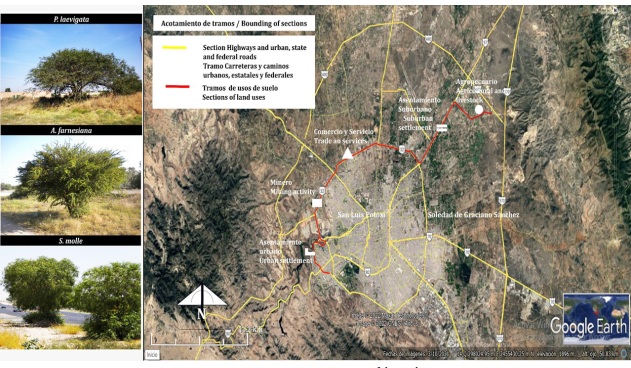
Figure 1: Location of the study area.
Figura 1: Localización del área de estudio.
The collected material was
washed with distilled water and dried in an oven at 60°C. From each collected
material, 1 g was calcined to triplicate at 450° C, then the niter extract was
prepared (nitric acid 1%) and filtered. The following elements were analyzed:
Al, Ti, V, Cr, Mn, Fe, Co, Ni, Cu, Zn, As, Cd, and Pb using the ICP-MS
(inductively coupled plasma mass spectrometry) (5, 6, 7, 8, 9, 40). All the analyses were
performed in the laboratories of Environmental Engineering and the Institute of
Geology (UASLP, Mx). The results were expressed in mg kg-1 dry weight. In addition, the
concentrations of HM in the leaves and fruits were used to calculate the
difference between materials (mg kg-1 in dry weight) and the
percentage variation in concentration between species. Data were statistically
analyzed using ANOVA and Pearson correlation coefficient (α≤0.05), including
interactions among factors of soil use, species, and biological material
(leaves and fruits). In addition, principal component analysis was performed
considering 13 HM. All analyses were performed using MINITAB 16® statistical
software.
Results
and discussion
13 HM,
evaluated in 180 samples, showed an average concentration ratio in leaves and
fruits of the three tree species (mg kg-1 dry weight) oscillated at the
ratio of Al > Fe > Zn > Mn > Pb > Cu > Ti > As > V >
Ni > Cd > Cr > As. Correlation analysis revealed that 78 interactions
were positively significant (p≤0.05, Table 1).
Table
1: Significant relations of
the Pearson correlation coefficient in metallic elements assessed in leaves and
fruits material of trees of the three species (p≤0.05, n=180).
Tabla 1: Relaciones significativas del coeficiente de
correlación de Pearson en elementos metálicos evaluados en hojas y frutos de árboles
de las tres especies (p≤0,05, n=180).
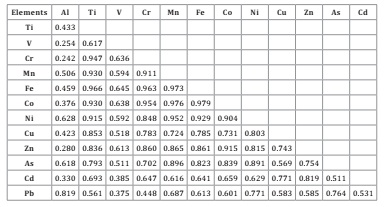
Of these, the
highest values were for Co-Fe (r=0.979), Co-Mn (r=0.976), and Fe-Mn (r=0.973).
The analysis of
ANOVA showed no significant effect on the concentrations of HM in the leaves
and fruits of the trees when the impact of land use was taken into account.
However, the influence of tree species significantly affected only three HM of
the 13 HM identified. In both cases, the non-significant and significant
results indicate concentrations considered adequate or regular, toxic or
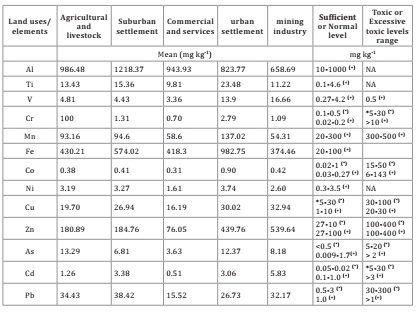
excessively toxic according to various technical sources (Table 2 and Table 3).
Table
2: Ratio of average
concentrations of metal elements in fruits and leaves of the three tree species
as a function of land use and reference values for normal and toxic levels
(n=180).
Tabla 2: Relación de concentraciones medias de
elementos metálicos en frutos-hojas de las tres especies arbóreas según los
usos de suelo y referencia de niveles normales y tóxicos (n=180).
(*) The Site and Soil Characterization Guide for Hazardous Waste
Sites considers excessive or toxic areas in various plants (14). (+) The Trace Element Handbook (24) considers reference concentrations in multiple plants. NA. Data not available
(*) Guía de Descripción de Sitios y Suelos para la
Caracterización de Sitios de Residuos Peligrosos considera rangos excesivos o
tóxicos en varias plantas (14). (+) El manual de Oligoelementos (24) considera concentraciones de referencia en
varias plantas. NA. Dato no disponible.
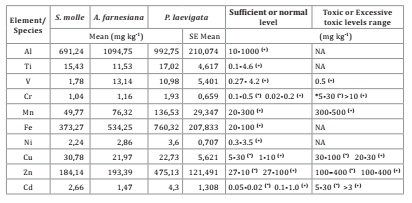
Table
3: Ratio of concentrations of
non-significant metallic elements in leaves and fruits according to tree
species and reference of average and phytotoxic values (n=180).
Tabla 3: Relación de concentraciones no significativas
de elementos metálicos en hojas y frutos según especie arbórea y referencia de
niveles normales y fitotóxicos (n=180).
(*) The Site and Soil Characterization Guide for Hazardous Waste
Sites considers excessive or toxic areas in various plants (14). (+) The Trace Element Handbook (24) considers reference concentrations in multiple plants. NA. Data not available
(*) La Guía de Descripción de Sitios y Suelos para la
Caracterización de Sitios de Residuos Peligrosos considera rangos excesivos o
tóxicos en varias plantas (14). (+) El manual de Oligoelementos (24) considera concentraciones de referencia en
varias plantas. ND. Dato no disponible. NA. Dato no disponible.
Regarding the
non-significant concentrations of HM in the leaves and fruits of the samples
from the different land use types, it is noticeable that the mean
concentrations of As, Cu, Pb, Zn, V, and Fe are above the values considered
sufficient or regular, toxic or excessively toxic (Table 2). Likewise, it is noted that the mean concentrations of
Co, Ni, Ti, Cr, Mn, and Fe in leaf material and fruits were higher in samples
with urban use; and V, Cu, Zn, and Cd in samples with mining-industrial land
use, in cases with phytotoxic levels (14,
15, 16, 24).
Regarding the presence of Al and Pb, concentrations were higher in suburban
land use, and As was more elevated in leaf and fruit
samples from trees in agricultural land use. Similar studies using leaf
material of the same species found that the concentrations of As, Co, and Pb
were higher in trees located on mining land (6). Comparing the concentrations of the 13 elements in leaf
and fruit samples of the three tree species studied, the effect was
not-significant for Al, Ti, V, Zn, Cr, Mn, Fe, Ni, Cu, and Cd (Table 3). For Co, As, and Pb, the
significant concentrations depended on the tree species (Table
4).
Table
4: Ratio of significant Co,
As, and Pb concentrations in three studied trees (p≤0.05).
Tabla 4: Relación de concentraciones significativas de
Co, As y Pb en las tres especies de árboles (p≤0,05).
(*) The Site
and Soil Characterization Guide for Hazardous Waste Sites considers excessive
or toxic areas in various plants (14). (+) The Trace Element Handbook (24) considers reference concentrations in multiple plants.
(*) La Guía de Descripción de Sitios y Suelos para la
Caracterización de Sitios de Residuos Peligrosos considera rangos excesivos o
tóxicos en varias plantas (14). (+) El manual de Oligoelementos (24) considera concentraciones de referencia en
varias plantas.
First, it is
noticeable that the ratio of the average concentrations of the metallic
elements in the three tree species in leaves in the order Al > Fe > Zn
> Mn > Pb > Cu > Ti > As > V > Cd > Ni > Cr > Co
and in fruits Al > Fe > Zn > Mn > Ti > Cu > Pb > Ni >
As > V > Cd > Cr > Co.
For the
ten HM, where the concentrations presented in Table 3 were not-significant, values considered excessively
phytotoxic were obtained for As, Cu, Pb, Zn, V, and Fe, with reference, values
greater than 5-20 mg kg-1,
20-100 mg kg-1,
30-300 mg kg-1,
100-400 mg kg-1,
and 5-10 mg kg-1 and > 500 mg kg-1, respectively (14, 16, 24). These data indicate the influence of humans on metal
elements. It has been shown that the spatial distribution of plant species, the
location of point sources of pollution, and urban climatic factors (especially
the wind factor) can be crucial in studying Cd, As, Pb, Cr, Cu, and Mn (39).
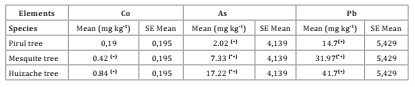
Table 4 shows the relationship of the significant concentrations
to the results of the substantial effect of Co (p=0.063), As
(p=0.033), and Pb (p=0.002) and their toxicity reference. Co is naturally
associated with rocks, soil, water, plants, and animals (2). Other sources include steel and metal industries, carbon
combustion, and components for colored glass, ceramics, paints, and glazes (2, 19). On the other hand, Co is associated with delaying leaf
senescence, increasing the drought resistance of seeds, and inhibiting ethylene
biosynthesis, among others (33). As occurs naturally in soil and in the form of emissions from the
steel and metal industries and coal and oil combustion (3, 19). As
for Pb, plants can be contaminated by automobile exhaust, dust, and gasses from
the steel and metal industry, oil, and coal combustion (4, 19, 37, 42). Higher
significant concentrations of Co and As were found in leaves and fruits of
huizache, with mean values of 0.84 mg kg-1 and 17.22 mg kg-1,
respectively (Table 4);
consequently, Co reached the toxic level and As reached excessive levels and
phytotoxic (14, 24). Huizache was
found to have a higher capacity to accumulate As, Pb, and Co in leaf material
when used in mining soils (6). Prosopis
laevigata could be a hyper-accumulating Pb species that responds in
contaminated soils as a phytoremediator in arid and semiarid climates (13). In this study, Pb concentrations in huizache were higher
at 41.7 mg kg-1,
which was within a toxic range (25, 27).
Intrinsic
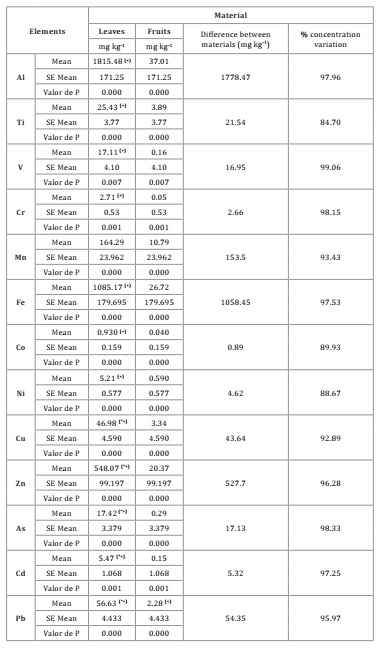
comparison of total HM in leaves and fruits revealed significant differences in
the 13 elements evaluated. It is reported that Al, V, Cr, Fe, Co, Ni, Cu, Zn,
As, Cd, and Pb had concentrations higher than those designated as regular,
including excessive phytotoxic levels (Table 5).
Table
5: Ratio of significant
concentrations of metal elements in leaves and fruits of the three studied
species (p≤0.05, n=180).
Tabla 5: Relación de concentraciones significativas de
elementos metálicos en hojas-frutos de las tres especies estudiadas (p≤0,05, n=180).
(*) The Site
and Soil Characterization Guide for Hazardous Waste Sites considers excessive
or toxic areas in various plants (14). (+) The Trace Element Handbook (1997) considers reference
concentrations in multiple plants.
(*) La Guía de Descripción de Sitios y Suelos para la
Caracterización de Sitios de Residuos Peligrosos considera rangos excesivos o
tóxicos en varias plantas (14). (+) El manual de Oligoelementos (1997)
considera concentraciones de referencia en varias plantas.
In addition, concentration differences among
materials (mg kg-1)
ranged from 84.70 to 99.06%. The data indicate a decrease in the concentrations
of 10 elements: V 99.06%, As 98.33%, and Cr 98.15%.
Usually, the concentration of HM is higher in leaves than in fruits of tree
species (22). In the
species studied, another factor is the timing of leaf and fruit maturity, as
well as the possible differences between individual mesquite, huizache, and
pirul species in terms of their biocapacity to concentrate and accumulate HM,
as well as their availability to interfere with physiological processes in
minimal amounts in some cases. Other studies indicate that the environmental
impact of HM may occur in the biological cycle of plant leaves and fruits, as
well as in other processes such as seed germination, growth and development,
the decline in biomass production, the decline in flowering and fruiting, and
yield reduction. This is because HM disrupts photosynthetic activity,
interrupts nitrogen cycling and fixation, decreases chlorophyll content, causes
deterioration of enzyme systems and intracellular mechanisms, and in some
cases, impairs the uptake of other beneficial elements for plants (10, 20).
When
analyzing the effects of the dual interaction between species and biological
material (leaf-fruit) factors, a significant statistical relationship was found
only for the concentrations of As and Pb (Figure 2).
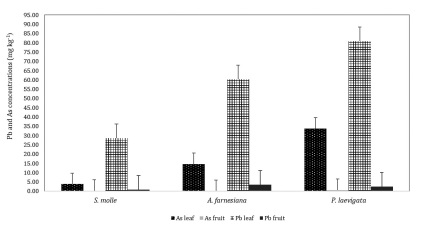
Figure 2: Comparative ratio of significant concentrations of As and Pb in the fruit and leaf of the three species
studied.
Figura 2: Relación comparativa de concentraciones
significativas de As y Pb en fruto y hoja de las tres especies estudiadas.
The highest As value was found in samples of huizache, with 33.79 mg kg-1
in leaves and 0.65 mg kg-1 in fruits. Huizache showed the
highest Pb concentration in leaves with 80.92 mg.kg-1
and in mesquite fruits with 3.57 mg kg-1.
Acacia farnesiana shows potential for phytostabilization and high Pb
accumulation in roots, limiting translocation to new shoots (27);
this follows the relationship stem >leaf > root (25),
which is related to nitrogen in the soil and favors translocation to
aboveground parts (25). These species show a
higher accumulation capacity of As in roots, stems,
and leaves (37). Consequently, huizache
and mesquite are important bioindicator plants for contamination by HM (30).
In many regions of San Luis Potosi, soil disturbance has resulted in high As and Pb concentrations (27).
Principal
component analysis shows that the first two components account for 84% of the
total variance. In the PC1, the positive coefficient appears about Ti, Mn, Ni,
and Co; in the PC2 of Al, Pb, and As and the negative
in Cr, Zn, and V (Figure 3).
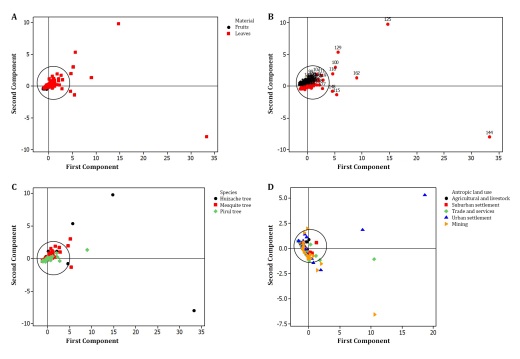
Figure 3: Eigenvalue
distribution of metallic elements in (A) leaves and fruits, (B) number of
samples, (C) species, and (D) land use resulting from principal components
analysis.
Figura 3: Distribución eigenvalores de los elementos
metálicos en A) hojas y frutos, B) número de muestras, C) especies y D) uso de
suelo resultante del análisis de componentes principales.
An isolated group refers to the leaves and
fruits of huizache (Figure 3BC).
Figure 3D shows a group with samples of urban, mining, commercial
and services land uses. Atmospheric particles are a source of HM, such as Fe,
Mn, Cu, Zn, Pb, and Cd, and can be taken up by tree species (11). Differences in the content of heavy metals in the leaves
of urban species have been found, including Pb, Zn, Cu, Cr, Ni, and Mn. It is
noted that the elemental composition of plant leaves may differ in different
systems of land-use-plant-atmosphere particles (26).
The similarity
analysis revealed values ranging from 64.53% to 97.64% in the elements of
leaves and fruits of three tree species (Figure 4A).
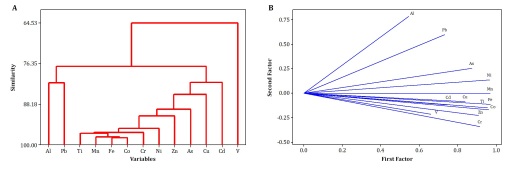
Figure 4: Dendrogram (A)
and vectors (B) from component analysis of metallic elements in leaves and
fruits of the three tree species.
Figura 4: Dendrograma (A) y vectores (B) derivados del
análisis de componentes en elementos metálicos de hojas y frutos de los árboles
de las tres especies.
Chromium, Ni,
Zn, As, Cu, and Cd have an 81-96% association. These
data suggest an intrinsic species response to HM enrichment and serve as
bioindicators (10, 19, 30, 31, 34, 36, 38). Vector analysis showed that the three
determining factors explained 90% of the variance, with a significant relationship
between metal elements in leaves and fruits of the three species according to
land use (Figure 4B).
Natural
and anthropogenic factors influence the presence of HM in the environment. The
latter include vehicle emissions, corrosion of metal parts, industrial
activities, and construction materials. Factors such as climate, precipitation,
wind direction and speed, and soil characteristics are involved in dispersion (1, 41).
Conclusion
Three tree
species evaluated in the five land use factors showed bioindication potential
through the concentration of HM in their leaves and fruits. Although the land
use factor did not have a significant effect on the concentrations of HM, it
can be said that the three species located in agricultural, livestock,
suburban, commercial and services, urban, and mining lands had normal, toxic,
and excessively phytotoxic levels in at least 12 elements. The factor species
significantly influences Co, As, and Pb levels. The
huizache, the species with the highest concentrations in leaves and fruits, and
others in 9 elements that were not significant; however, the levels determined
were normal, toxic, and excessively toxic. In the intrinsic relation of leaf
and fruit, the concentrations of 10 elements were reduced by more than 90% from
one material to another. Al, Cd, Co, V, Ni, Ti, Cr, As, Cu, Pb, Zn, V, and Fe
reached toxic concentrations. These results demonstrate the value of plant
species as bioindicators and their potential use in phytoremediation measures
under different land use conditions in the studied region.
1. Abbasi, S.; Ali Mohammadian, H.; Hosseini, S.; Khorasani, N.;
Karbasi, A.; Aslani, A. 2017. The concentration of heavy metals in precipitated
particles on the leaves of street side trees in the urban environments
(Tehran-Iran). Anthropogenic Pollution Journal. 1(1):
1-8. doi: 10.22034/apj.2017.1.1.18
2. Agency for Toxic Substances and Disease Registry (ATSDR). 2004.
Toxicological Profile for Cobalt (Update). Atlanta. GA: U.S. Department of
Health and Human Services. Public Health Service.
3. Agency for Toxic Substances and Disease Registry (ATSDR). 2007a. Toxicological Profile for Arsenic (Update). Atlanta.
GA: U.S. Department of Health and Human Services. Public
Health Service.
4. Agency for Toxic Substances and Disease Registry (ATSDR). 2007b. Toxicological Profile for Lead (Update). Atlanta. GA:
U.S. Department of Health and Human Services. Public Health
Service.
5. Alcalá Jáuregui, J.; Ávila Castorena, C.; Rodríguez Ortíz, J.
C.; Hernández Montoya, A.; Beltrán Morales, F. A.; Rodríguez Fuentes, H.; Loya
Ramírez, J. 2012. Metales pesados como indicador de impacto de
un sistema ecológico fragmentado por usos de suelo, San Luis Potosí, México.
Revista de la Facultad de Ciencias Agrarias. Universidad Nacional de Cuyo. Mendoza.
Argentina. 44(2): 15-29. https://revistas.uncu.edu.ar/ojs/index.php/RFCA/article/view/6260.
6. Alcalá Jáuregui, J.; Rodríguez Ortíz, J. C.; Villaseñor Zuñiga,
M. E.; Hernández Montoya, A.; García Arreola, M. El.; Beltrán Morales, F. A.;
Rodríguez Fuentes, H. 2013. Vegetación bioindicadora de metales pesados
en un sistema semiárido. Revista de la Facultad de Ciencias Agrarias . Universidad
Nacional de Cuyo. Mendoza. Argentina. 45(1):27-42. https://revistas.uncu.edu.ar/ojs/index.php/RFCA/article/view/5835.
7. Alcalá-Jáuregui, J. A.; Rodríguez Ortiz, J. C.; Hernández
Montoya, A.; Villarreal-Guerrero, F.; Cabrera Rodríguez, A.; Beltrán Morales,
F. A.; Díaz Flores, P. E. 2014. Heavy metal contamination in
sediments of a riparian area in San Luis Potosi, Mexico. Revista de la Facultad de Ciencias Agrarias . Universidad Nacional de Cuyo. Mendoza.
Argentina. 46(2): 203-221. https://revistas.uncu.edu.ar/ojs/index.php/RFCA/article/view/5617.
8. Alcalá Jáuregui, J.; Rodríguez Ortíz, J. C.; Hernández Montoya,
A.; Diaz Flores, P. E.; Filippini, M. F.; Martínez Carretero, E. 2015. Cortezas de Prosopis laevigata (Fabaceae) y Schinus molle (Anacardiaceae)
como bioindicadoras de contaminación por metales pesados. Revista de la Facultad de Ciencias Agrarias . Universidad Nacional de Cuyo. Mendoza.
Argentina. https://revistas.uncu.edu.ar/ojs/index.php/RFCA/article/view/3305.
9. Alcalá Jáuregui, J.; Rodríguez Ortíz, J. C.; Hernández Montoya,
A.; Filippini, M. F.; Martínez Carretero, E.; Diaz Flores, P. E. 2018. Capacity of two vegetative species of heavy metal accumulation. Revista de la Facultad de Ciencias Agrarias . Universidad Nacional de Cuyo. Mendoza.
Argentina. 50(1): 123-139. https://revistas.uncu.edu.ar/ojs/index.php/RFCA/article/view/3007.
10. Ali, E.; Hussain, A.; Ullah, I.; Khan, F. S.; Kausar, S.;
Rashid, S. A.; Rabbani, I.; Imran, M.; Kakar, K. U.; Shah, J. M.; Cai, M.;
Jiang, L.; Hussain, N.; Sun, P. 2020. Cadmium phytotoxicity: issues, progress,
environmental concerns and future perspectives. Revista de la Facultad de
Ciencias Agrarias . Universidad Nacional de Cuyo. Mendoza. Argentina. 52(1): 391-405. https://revistas.uncu.edu.ar/ojs/index.php/RFCA/article/view/3068.
11. Ali, M.; Al-Qahtani, K. 2012. Assessment of
some heavy metals in vegetables, cereals, and fruits in Saudi Arabian markets.
The Egyptian Journal of Aquatic Research. 38: 31-37.
https://doi.org/10.1016/j.ejar.2012.08.002
12. Aragón-Piña, A.; Campos-Ramos, A. A.; Leyva-Ramos, R.;
Hernández-Orta, M.; Miranda-Ortiz, N.; Luszczewski-Kudra, A. 2006. Influencia de emisiones industriales en el polvo atmosférico de la ciudad
de San Luis Potosí, México. Revista internacional de contaminación ambiental.
22(1): 5-15. http://www.scielo.org.mx/scielo.php?script=sci_arttext&pid=S0188-49992006000100005&lng=es&tlng=es.
13. Buendía-González, L.; Orozco-Villafuerte, J.; Estrada-Zúñiga,
M. E.; Barrera Díaz, C. E.; Vernon Carter, E. J.; Cruz-Sosa, F. 2010. In
vitro lead and nickel accumulation in mesquite (Prosopis laevigata)
seedlings. Revista mexicana de ingeniería química. 9(1):
01-09. http://www.scielo.org.mx/scielo.php?script=sci_arttext&pid=S1665-27382010000100001&lng=es&tlng=
14. Cameron, E. 1992. Guide to site and soil description for
Hazardous waste site characterization. Volume 1: Metals. EPA/600/4-91/029
March. United States Environmental Protection Agency.
15. Cheng, S. 2003. Heavy metals in plants and
phytoremediation. Environ Sci & Pollut Res 10: 335- 340.
https://doi.org/10.1065/espr2002.11.141.3
16. Cho-Ruk, K.; Kurukote, J.; Supprung, P.; Vetayasuporn, S.
2006.Perennial plants in the phytoremediation of lead-contaminated soils. Biotechnology. 5(1): 1-4.
17. Covarrubias, S.; Peña Cabriales, J. 2017. Contaminación ambiental por metales pesados en México: problemática y
estrategias de fitorremediación. Revista Internacional de Contaminación
Ambiental. 33: 7-21. doi:
http://dx.doi.org/10.20937/RICA.2017.33.esp01.01
18. Dadea, C.; Russo, A.; Tagliavini, M.; Mimmo, T.; Zerbe, S.
2017.Tree species as tools for biomonitoring and phytoremediation in urban
environments: A review with special regard to heavy metals. Arboriculture
& Urban Forestry. 43: 155-167.
19. Dagne, B.; Teju, E.; Tesfahun, K.; Negash, D. 2019. Levels of
some toxic heavy metals (Cr, Cd and Pb) in selected vegetables and soil around
eastern industry zone, central Ethiopia. African Journal of
Agricultural Research. 14. 92-101. 10.5897/AJAR2018.13324.
20. Demirhan Aydın, Ş.; Pakyürek, M. 2020. Heavy metal accumulation potential in pomegranate fruits and leaves
grown in roadside orchards. PeerJ: 8, e8990.
https://doi.org/10.7717/peerj.8990.
21. Díaz-Barriga, F.; Marcos, F.; Carlos, T.; Javier L. 2011. Modelo conceptual de riesgo ambiental por arsénico y plomo en el distrito
minero de Santa María de la Paz. San Luis Potosí. México. e-Gnosis. 9: 1-25.
22. Habib, R. H.; Awadh, S. M.; Muslim, M. Z. 2012. Toxic heavy metals in soil and some plants in Baghdad. Iraq.
Journal of Al-Nahrain University. Science.
15(2): 1-16.
23. INEGI. 2017. Anuario estadístico y geográfico de San
Luis Potosí. 2017. Instituto Nacional de Estadística y Geografía. México. p.
623.
24. Istvan, P.; Benton, J. 1997. The handbook of
trace elements. Lucie Press. Boca Raton. Florida.
25. Landeros-Márquez, O.; Tejo-Calzada, R.; Reveles-Hernández, M.;
Valdez-Cepeda, R. D.; Arreola Ávila, J. G.; Pedroza-Sandoval, A.; Ruíz-Torres,
J. 2011. Uso potencial del huizache (Acacia
farnesiana L. Will) en la fitorremediación de suelos contaminados con
plomo. Revista Chapingo serie ciencias forestales y del ambiente. 17(spe): 11-20.
https://doi. org/10.5154/r.rchscfa.2010.08.059.
26. Li, C. C.; Du, D. L.; Gan, Y. D.; Ji, S. P.; Wang, L. F.;
Chang, M. J.; Liu, J. 2022. Foliar dust as a reliable environmental monitor of
heavy metal pollution in comparison to plant leaves and soil in urban areas. Chemosphere. 287(Pt 3):132341. doi:
10.1016/j.chemosphere.2021.132341.
27. Maldonado-Magaña, A.; Favela-Torres, E.; Rivera-Cabrera, F.
2011. Lead bioaccumulation in Acacia farnesiana and its effect on lipid
peroxidation and glutathione production. Plant Soil 339.
377-389. https://doi.org/10.1007/s11104-010-0589-6
28. Manju, M. 2015. Effect of heavy metals on
human health. International Journal of Research
Granthaalayah. 31: 1-7.
29. Murtić, S.; Brković, D.; Đurić, M.; Vujinović, I. 2014. Heavy metal dynamics in the soil-leaf-fruit system under intensive
apple cultivation. Acta agriculturae Serbica.
19(38): 123-132.
30. Naveed, N.; Batool, A.; Rehman, F.; Hameed, U. 2010. Leaves of roadside plants as bioindicator of traffic related lead
pollution during different seasons in Sargodha. Pakistan. African Journal of Environmental Science and Technology.
4(11): 770-774. http://www.academicjournals.org/AJEST
31. Neelesh Babu, T.; Varaprasad, D.; HimaBindu Y.; KeerthiKumari,
M.; Dakshayani, L; Reddy, M.C.; Chandrasekhar, T. 2014. Impact of heavy metals (Cr, Pb and Sn) on in vitro seed
germination and seedling growth of green gram (Vigna radiata (L.)
R. Wilczek). Current Trends in Biotechnology and Pharmacy.
8: 160-165.
32. Noriega-Luna, B.; Morales-Rodríguez, A. A.; Luna-Quintanilla,
R.; Ulloa-Vázquez, T.; Cruz-Jiménez, G.; Serafín-Muñoz, A. H.;
Gutierrez-Ortega, N. L. 2016. Identificación de especies vegetales
asociadas a jales del distrito minero de Guanajuato. Acta
Universitaria. 26(NE-2). 71-77. doi:
10.15174/au.2016.1465.
33. Palit, S.; Sharma, A.; Talukder, G. 1994. Effects
of cobalt on plants. Bot. 60: 149-181.
https://doi.org/10.1007/BF02856575.
34. Parveen, R.; Abbasi, A. M.; Shaheen, N.; Shah, M. H. 2020. Accumulation of selected metals in the fruits of medicinal plants
grown in urban environment of Islamabad. Pakistan. Arabian
Journal of Chemistry. 13(1): 308-317.
35. Pérez-Martínez, I.; M. Romero, F. 2015. Uso
de parámetros indirectos para la evaluación de la contaminación de suelos por
metales pesados en una zona minera de San Luis Potosí, México. Boletín de la
Sociedad Geológica Mexicana. 67(1): 01-12. http://www.scielo.org.mx/scielo.php?script=sci_arttext&pid=S1405-3222015000100001&lng=es&tlng=es.
36. Poschenrieder, C.; Busoms, S.; Barceló, J. 2019. How plants
handle trivalent (+3) elements. International journal of
molecular sciences. 20(16): 3984. https://doi.org/10.3390/ijms20163984
37. Puga, S.; Sosa, M.; Mora, A.; Pinedo, C.; Jiménez, J. 2006. Concentraciones de as y zn en vegetación nativa cercana a una presa de
jales. Revista internacional de contaminación ambiental. 22(2): 75-82. http://www.scielo.org.mx/scielo.php?script=sci_arttext&pid=S0188-49992006000200075&lng=es&tlng=es
38. Pulford, I. D.; Watson, C. 2003. Phytoremediation
of heavy metal-contaminated land by trees - A review. Environment
International. Elsevier Ltd. https://doi.org/10.1016/S0160-4120(02)00152-6
39. Qili Yang, J. G.; Dongli Wang, Y. Y.; Weili, D.; Zhiwen, L.;
Qiaohong, X.; Gang, L. 2022. Occurrence of trace heavy metals in leaves of
urban greening plants in Fuxin. Northeast China: Spatial Distribution &
Plant Purification Assessment. Sustainability. MDPI. 14(14): 1-10.
40. Shaheen, N.; Irfan, N. M.; Khan, I. N.; Islam, S.; Islam, M.
S.; Ahmed, M. K. 2016. Presence of heavy metals in fruits and vegetables:
Health risk implications in Bangladesh. Chemosphere. 152:
431-438. https://doi.org/10.1016/j.chemosphere.2016.02.060
41. Sobukola, O. P.; Adeniran, O. M.; Odedairo, A. A.; Kajihausa,
O. E. 2010. Heavy metal levels of some fruits and leafy vegetables from
selected markets in Lagos. Nigeria. Afr. J. Food Sci. 4(2): 389-393.
42. Tangahu, B. V.; Sheikh Abdullah, S. R.; Basri, H.; Idris, M.;
Anuar, N.; Mukhlisin, M. 2011. A review on heavy metals (As,
Pb, and Hg) uptake by plants through phytoremediation. International Journal of Chemical Engineering.
https://doi.org/10.1155/2011/939161