Revista de la Facultad de Ciencias
Agrarias. Universidad Nacional de Cuyo. Tomo 55(1). ISSN (en línea) 1853-8665.
Año 2023.
Original article
Selectivity
of latifolicides associated with glyphosate applied in postemergence on soybean
(Glycine max) cultivars
Selectividad de latifolicidas asociados con glifosato aplicados en
post-emergencia en cultivares de soja (Glycine max)
Jhonatan Coradin1
Guilherme Braga Pereira Braz1
Alessandro Guerra da Silva1
Sérgio de Oliveira Procópio2
Guilherme Sales Vian1
Paulo Victor Leão Lima Chavaglia1
Marco Antonio Rodrigues Goulart1
Matheus de Freitas Souza1
1 Graduate Program in Plant Production. Universidade de Rio Verde.
Rio Verde (Goiás), Brazil. Zip code: 75901-970. guilhermebrag@gmail.com
2
Research Department. EMBRAPA Meio Ambiente. Jaguariúna (São Paulo), Brazil. Zip
code: 13918-110.
Abstract
The genetic
improvement of soybean cultivars over the years has focused on increasing the
yield potential and tolerance to some abiotic and biotic factors. However,
during the transfer of genes of interest, some genes responsible for a lower
tolerance to herbicides can be integrated into the genome of the new cultivar.
Thus, the objective of this study was to evaluate the selectivity of herbicide
associations applied in the postemergence period of three soybean cultivars.
The experiment was conducted in a randomized completely block design, with four
replications. The selected cultivars were M7110 IPRO®,
Foco IPRO®, and Bônus IPRO®. The herbicides and the
respective doses (g a.i. ha-1)
used were glyphosate (1176), glyphosate + bentazon (1176 + 600), glyphosate +
fomesafen (1176 + 175), glyphosate + lactofen (1176 + 120), glyphosate +
imazethapyr (1176 + 100), glyphosate + chlorimuron (1176 + 10), glyphosate +
cloransulam (1176 + 39.5), and a control without herbicide application. The
visual note of intoxication was evaluated for each treatment. The components of
growth and yield evaluated were height, stand, weight of one hundred grains,
and yield. The application of postherbicide herbicides did not alter the plant
stands of soybean cultivars. Additionally, these herbicides did not reduce the
yield of the M7110 IPRO® and
Foco IPRO®
cultivars. Glyphosate isolated and in association with lactofen
or imazethapyr reduced the grain yield of the Bônus IPRO® cultivar.
Keywords: Chemical control; Glycine max; Herbicides; Phytointoxication.
Resumen
El
mejoramiento genético de los cultivares de soja a lo largo de los años se ha
centrado en aumentar la capacidad productiva y la tolerancia a algunos factores
abióticos y bióticos. Sin embargo, durante la transferencia de genes de
interés, algunos genes responsables de una menor tolerancia a los herbicidas
pueden integrarse en el genoma del nuevo cultivar. El objetivo de este estudio
fue evaluar la selectividad de las asociaciones de herbicidas aplicadas en la
post-emergencia de tres cultivares de soja. El diseño experimental utilizado
fue un bloque completamente al azar, con cuatro repeticiones. Los cultivares
seleccionados fueron M7110 IPRO®,
Foco IPRO®
y Bônus IPRO®.
Los herbicidas y las respectivas dosis (g a.i. ha-1)
utilizados fueron: glyphosate (1176), glyphosate + bentazon (1176 + 600),
glyphosate + fomesafen (1176 + 175), glyphosate + lactofen (1176 + 120), glyphosate
+ imazethapyr (1176 + 100), glyphosate + chlorimuron (1176 + 10), glyphosate +
cloransulam (1176 + 39,5), y un control sin aplicación de herbicida. Se hizo
una nota visual de intoxicación para cada tratamiento. Los componentes de
crecimiento y rendimiento evaluados fueron: altura, rodal, peso de cien granos
y rendimiento. La aplicación de herbicidas en post-emergencia no alteró la masa
vegetal de los cultivares de soja. Además, estos herbicidas no redujeron el
rendimiento de los cultivares M7110 IPRO® y Foco IPRO®.
Tanto el glifosato aislado como mezclado con lactofen o imazethapyr redujeron
el rendimiento del cultivar Bônus IPRO®.
Palabras clave: Control químico; Glycine max; Herbicidas; Fitointoxicación.
Originales: Recepción:
03/03/2022
Aceptación: 13/02/2023
Introduction
The
repetitive use of the same herbicide can generate risks to the sustainability
of agricultural systems, as it causes important changes in the composition of
the weed community present in agricultural areas. The emergence of
herbicide-resistant weed biotypes is among the main concerns related to plant
protection globally (5, 14).
Due to the
large-scale adoption of Roundup Ready® (RR®)
technology, which gives plants tolerance to glyphosate, postemergence
applications of this herbicide have become quite frequent in large crops such
as soybeans (17). This fact significantly
contributed to the increase in the population of weed species tolerant (13) to this herbicide in the cultivated areas, in addition to
accelerating the selection of resistant biotypes. This change in the weed
community has led to the need to complement chemical control, especially with
the application of latifolicides in soybean crops (1).
The
association among herbicides with different modes of action has become an
important strategy for the control of a wider spectrum of weed species (21), in addition to mitigating the occurrence of weed resistance to
herbicides (18). Currently, ALS (e.g.,
imazethapyr, chlorimuron) and PPO (e.g., fomesafen, lactofen) inhibitors
are among the most widely used herbicides in postemergence soybean crops and
are used mainly in association with glyphosate. Despite showing satisfactory
control for several weed species, especially broadleaves, these herbicides can
cause injuries to soybean plants, with internal chlorosis and leaf tissue
necrosis as the most frequent visual symptoms, which can negatively affect
crop yield (2).
In a study
by Alonso et al. (2011), it was observed that
the use of glyphosate isolated and in association with other postemergence
herbicides provided visual symptoms of injuries in RR® soybean plants, causing a
reduction in crop yield components. The most common symptom caused by the
isolated application of glyphosate on RR® soybean is the chlorosis of
the trifoliated leaves positioned in the upper portion of the plants; however,
other negative effects were observed in studies with this herbicide, such as
reduced nutrient absorption and plant growth (6, 22).
The
postemergence herbicide applications in soybean crops are more effective in
weed control when carried out at the early stages of development. Fornazza et al. (2011) reported that some
combinations of herbicides applied in the initial postemergence of soybean can
affect the grain yield due to the low selectivity observed for some cultivars.
The selectivity of herbicides for soybean cultivars, mainly related to the use
of these products in associations, is an aspect to be carefully observed,
mainly due to the current use in Brazil of genotypes with great phenotypic
variation, highlighting relevant aspects, such as maturation groups, growth types,
leaflet area, leaf inclination angle, and pubescence. The correct choice of
soybean cultivars can avoid losses in grain yield resulting from low tolerance
to herbicides.
In this
context, the objective was to study the selectivity of latifolicides in
association with glyphosate applied in the postemergence period of three RR®
soybean cultivars in the Midwest region of Brazil.
Materials and methods
Three experiments were
carried out in the field in the same plot located in the municipality of Rio
Verde (Goiás State), Brazil (17°52’05”S and 50°55’36”W; altitude: 741 m), from
November 18th,
2020 to March 18th,
2021. In each experiment, the selectivity of herbicides applied postemergence
to a soybean cultivar of indeterminate growth type and with great
representation in terms of cultivated area in the Midwest region of Brazil was
evaluated. The evaluated cultivars were M7110 IPRO® (maturity group - MG: 6.8),
Focus IPRO® (MG: 7.2), and Bônus IPRO®
(MG: 7.9).
According
to Köppen’s classification, the climate of the municipality where the experiments
were carried out is of the Aw type, which is called “tropical with the dry
season”, characterized by more intense rainfall in summer than in winter. In Figure 1, there are climatological data related to temperature and
relative humidity of the air, luminosity, and rainfall during the period of
conducting the experiments.
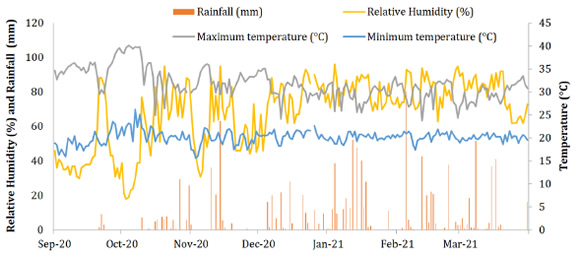
Source: INMET - Instituto Nacional de Meteorologia. Collection
station: Rio Verde (Goiás State).
Fuente: INMET - Instituto Nacional de Meteorología. Estación de
recolección: Rio Verde (Estado de Goiás).
Figure 1: Data on temperature and
relative air humidity, luminosity and rainfall during the period of conducting
the experiments. Rio Verde (Brazil), 2020/2021.
Figura 1: Datos
sobre temperatura y humedad relativa del aire, luminosidad y precipitación
durante el período de realización de los experimentos. Rio Verde (Brasil),
2020/2021.
Before the
installation of the experiments, the analysis of soil samples collected at
depths from 0 to 20 cm was carried out, which revealed the following
physicochemical properties: pH in CaCl2 of 4.8; 5.0 cmolc
dm-3 of H+
+ Al+3;
2.78 cmolc
dm-3 of Ca 2+;
1.09 cmolc
dm-3 of Mg+2;
0.11 cmolc
dm-3 of K+;
4.3 mg dm-3 of P; 30.2 g dm-3
organic matter; 42% sand; 7% silt and 51% clay (sandy clay
texture). Before sowing, the weeds present in the experimental area received
two herbicide applications (burndown desiccation), the first being carried out
ten days before sowing (November 8th,
2020) with the application of glyphosate (720 g a.e. ha-1)
and the second on the day of sowing (November 18th,
2020), with the application of glyphosate + flumioxazin (900 + 20 g a.i. ha-1) in association with
the addition of Joint Oil® (0.5% V/V).
Soybean
sowing was carried out mechanically, adopting a spacing of 0.5 m between rows.
Twenty-two, 16, and 10 seeds of soybean were distributed per linear meter for
the cultivars M7110 IPRO®,
Foco IPRO®, and Bônus IPRO®, respectively. The
seeds used in the experiments received industrial treatment with fungicides
and insecticides. Fertilization was carried out at sowing time, with
application in the furrow of the equivalent of 400 kg ha-1 of 02-20-28 (N-P-K). The
emergence of soybean seedlings of the three cultivars occurred on November 25th, 2020.
In all
experiments, a randomized complete block design was used, evaluating eight
treatments with four replications. The treatments consisted of the evaluation
of herbicide associations applied in the postemergence period of soybean (Table 1).
Table 1: Treatments
evaluated in post-emergence applications of soybean cultivars. Rio Verde
(Brazil), 2020/2021.
Tabla 1: Tratamientos evaluados en aplicaciones de post-emergencia de
cultivares de soja. Rio Verde (Brasil), 2020/2021.
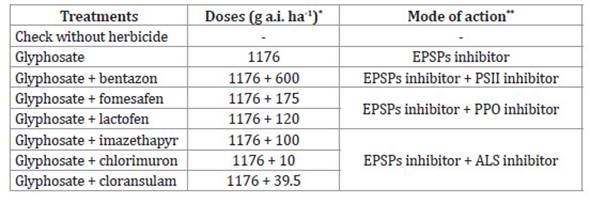
1/ For glyphosate 1176 g of active ingredient (a.i.) ha-1
corresponds to 960 g of acid equivalent (a.e.) ha-1. 2/ EPSPs = 5-
enolpyruvylshikimate- 3-phosphate synthase; PSII = photosystem II; PPO =
protoporphyrinogen oxidase; ALS = acetolactate synthase.
1/ Para el glifosato 1176 g de ingrediente activo (i.a.) ha-1
corresponde a 960 g de ácido equivalente (e.a.) ha-1. 2/ EPSPs =
5-enolpiruvilshikimato- 3-fosfato sintase; PSII = fotosistema II; PPO =
protoporfirinógeno oxidase; ALS = acetolactato sintase.
It is
worth noting that no adjuvants were added to the application of any of the
treatments; this criterion was adopted because all the associations contained a
glyphosate-based product in their composition. The experimental units
consisted of six sowing lines, with a length of 5.0 m (15.0 m2).
Only the four central lines of each experimental unit were considered useful
areas for the evaluations, excluding 0.5 m from each end.
The
treatments application in the three experiments was carried out on December 18th. 2020 (23 days after
emergence- DAE). On this occasion, the soybean plants were at stage V5 (5
trifoliated leaves) for the cultivars M7110 IPRO® and Foco IPRO® and at V4 (4 trifoliated
leaves) for the Bônus IPRO® cultivar, with plant height
varying between 15 and 18 cm. At the time of application, the soil was wet, the
temperature and relative humidity, minimum and maximum, were 23.1 and 25.1 °C
and 60 and 64%, respectively, and the sky had the presence of few clouds and
wind speed at values close to 1.2 km h-1.
The applications were carried out using a CO2 pressurized back sprayer
equipped with a boom fitted with 6 fan-type spray tips XR-110.015 spaced 50 cm
apart and regulated to a pressure of 0.24 MPa. These application conditions
provided an application rate equivalent to 150 l ha-1.
To ensure
that the soybean plants were only exposed to the effect of herbicide treatments,
manual weeding of the species that made up the weed community of all
experimental units was carried out throughout the entire crop cycle. In
addition, during the development of soybean, cultural practices were carried
out following the recommendations of Embrapa (2013), to
control pests and diseases without letting them negatively influence the development
of the crop. All phytosanitary applications, except for the herbicide
treatments that were the object of evaluation, were carried out using a tractor
sprayer machine, adopting an application rate equivalent to 150 l ha-1.
Injury level
evaluations of soybean cultivars were carried out at 7 and 28 days after
herbicide application (DAA), using for this evaluation the scale proposed by
the SBCPD (1995), which presents grades ranging from 0%
to 100%, where 0% means the absence of symptoms and 100% represents the death
of all plants present in the useful area. Plant height assessments (cm) were
carried out at 50 DAE and at harvest time with the aid of a graduated measuring
tape, measuring the distance from the soil surface to the apex in 5 plants per
experimental unit. In addition, at the time of harvest, an evaluation of the
plant stand was carried out, counting the number of plants present in a 3 m
row, with the data for this variable presented as the number of plants per
linear meter (plants m-1).
Additionally,
in harvest, the yield components, number of pods per plant, and mass of 100
grains were evaluated. To evaluate the number of pods per plant, the count of
pods present in 5 plants per experimental unit was performed. In the evaluation
of 100 grain masses, 100 grains were counted and weighed on a precision scale,
correcting the humidity content to 13%. To determine the grain yield, all
plants present in the useful area of each experimental unit were plucked
manually (M7110 IPRO® and Foco IPRO®,
harvested on March 13th,
2021; Bônus IPRO®,
harvested on March 18th,
2021), where this material was later submitted to threshing, packaging,
identification, weighing and grain humidity correction processes to 13%.
Statistical
analyses were performed using SISVAR software (2011).
Data from all experiments were submitted to analysis of variance by the F test
(p≤0.05), and when there was a significant effect, the Scott‒Knott mean
grouping criterion (p≤0.05) was applied.
Results and discussion
Experiment I: Selectivity of herbicide associations applied
postemergence to the soybean cultivar M7110 IPRO®
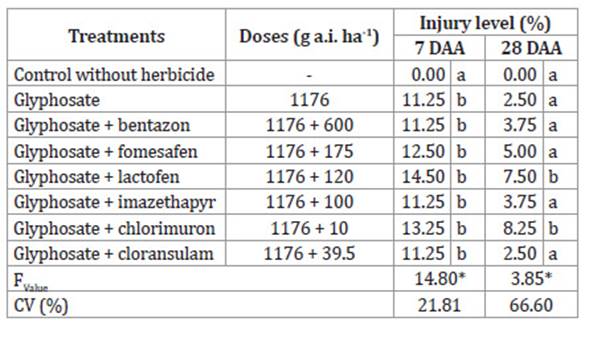
Observing the
phytotoxicity results for the cultivar M7110 IPRO® at 7 DAA, it can be seen that
the levels of injuries caused by the herbicides varied from 11.25 and 14.50%,
with no significant difference among the herbicide treatments; however, all
differed from the control without herbicide application (Table 2).
Table 2: Injury level of soybean (cultivar: M7110 IPRO®)
after application of post-emergence herbicide associations. Rio Verde (Brazil),
2020/2021.
Tabla 2: Fitointoxicación
de la soja (cultivar: M7110 IPRO®)
después de la aplicación de asociaciones de herbicidas de postemergencia. Rio
Verde (Brasil), 2020/2021.
a.i. = active ingredient; DAA = days after application. *
Significant by F test (p≤0.05). Means followed by different letters in
the column differ from each other by the Scott-Knott test (p≤0.05).
i.a. = ingrediente activo; DAA = días después de la aplicación. *
Significativo por prueba F (p≤0,05). Medias seguidas de letras
diferentes en la columna difieren entre sí por la prueba de Scott-Knott (p≤0,05).
Furthermore,
it is worth emphasizing that, in this evaluation, the latifolicides associated
with glyphosate postemergence did not enhance injury levels compared to the
application of glyphosate isolated.
In the
evaluation carried out at 28 DAA, the highest percentages of injury levels were
seen in soybean plants that received postemergence applications of the
association’s glyphosate + chlorimuron and glyphosate + lactofen, which
presented values of 8.25% and 7.50%, respectively (Table 2). In a study by Alonso et al. (2010),
it was observed that the association glyphosate + lactofen did not present
selectivity for the soybean cultivar CD 214 RR®.
In this final evaluation, except for the treatments mentioned above, no
differences were observed between the other treatments and the control without
herbicide application in terms of injury levels, which demonstrates the crop’s
ability to recover from the negative effects caused by these herbicides.
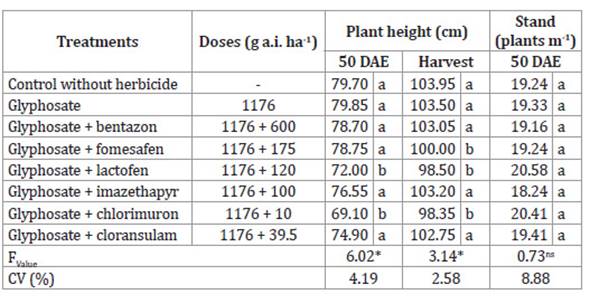
The
evaluation of plant height showed a direct relationship with the results of
injury levels, since the treatments that provided higher percentages of
injuries promoted a reduction in soybean size at 50 DAE (Table 3).
Table 3: Height and stand of soybean plants (cultivar: M7110 IPRO®) after application of
post-emergence herbicide associations. Rio Verde (Brazil), 2020/2021.
Tabla 3: Altura y
soporte de plantas de soja (cultivar: M7110 IPRO®)
después de la aplicación de asociaciones de herbicidas de postemergencia. Rio
Verde (Brasil), 2020/2021.
a.i. = active ingredient; DAE = Days after emergence. * and ns Significant and
non-significant, respectively, by the F test (p≤0.05). Means followed by
different letters in the column differ from each other by the Scott-Knott test
(p≤0.05).
i.a. = ingrediente activo; DAE = Días después de la emergencia. * y ns Significativo y no
significativo, respectivamente, por la prueba F (p≤0,05). Medias
seguidas de letras diferentes en la columna difieren entre sí por la prueba de
Scott-Knott (p≤0,05).
On this
occasion, the combination of glyphosate + chlorimuron and glyphosate + lactofen
directly affected the plant size of this cultivar, providing reductions of
9.66% and 6.02%, respectively, for the height values measured in the control
without herbicides. The low levels of foliar injuries found in the last
phytotoxicity evaluation in the other treatments were not able to induce a
reduction in the growth of soybean plants, since the height values were similar
to the control without herbicide application.
At harvest,
the PPO inhibitor herbicides fomesafen and lactofen and the ALS inhibitor
chlorimuron, all in association with glyphosate, promoted significant
reductions in plant height compared to the control without herbicide (Table 3). The average reduction in height value imposed by these
treatments reached values of 4.81%, with no differences among these three
herbicide treatments. The other herbicide treatments did not differ from the
control regarding the final plant height. It is noteworthy that the height of
plants can influence certain parameters of the soybean crop, such as the
potential for plant lodging or yield losses in the mechanized harvesting
operation due to the presence of pods at lower heights concerning the height work
of the harvester cutting deck (8).
None of the
herbicide treatments applied postemergence resulted in decreases in the range
of plants evaluated at harvest (Table 3). In general, when the
herbicide is registered for use in the crop and its positioning is followed
correctly, it is unlikely that the plants will die, causing reductions in the
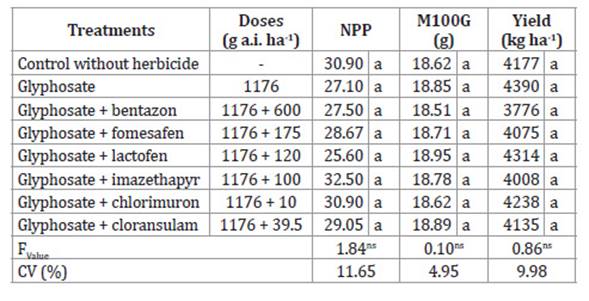
final population of the crop. Regarding the evaluations of yield components, as
well as soybean grain yield, there were no significant differences among
treatments (Table 4).
Table 4: Number of pods per plant (NPP), the mass of 100 grains (M100G),
and soybean grain yield (cultivar: M7110 IPRO®)
after application of post-emergence herbicide associations. Rio Verde (Brazil),
2020/2021.
Tabla 4: Número de
vainas por planta (NPP), masa de 100 granos (M100G) y rendimiento de grano de
soja (cultivar: M7110 IPRO®)
después de la aplicación de asociaciones de herbicidas de postemergencia. Rio
Verde (Brasil), 2020/2021.
a.i. = active ingredient. ns Not significant by the F test
(p≤0.05).
i.a. = ingrediente activo. ns No significativo por la prueba
F (p≤0,05).
In this
sense, it is observed that the occurrence of foliar injuries associated with
the reduction in the size of plants caused by some herbicide treatments was not
enough to affect the productive response of soybean cultivar M7110 IPRO®.
This fact
can be explained by the regular rainfall in the months after spraying the treatments
(Figure 1), which may have promoted greater crop recovery capacity
after light foliar stresses caused by the herbicides used in the experiment,
preserving the yield components (number of pods per plant and mass of 100
grains), as well as grain yield. Work carried out by Alonso
et al. (2010, 2011, 2013) also demonstrated the selectivity of these
herbicides to soybean crops. Despite this, selectivity studies are always
necessary, since genetic variations of cultivars are one of the main factors
influencing the greater or lesser tolerance of plants to a particular active
ingredient (19).
Based on the
results obtained in the study with this cultivar, it is evident that all
herbicide associations applied postemergence showed selectivity for M7110 IPRO®
at the doses and application stage in which they were used. In
addition, it appears that the cultivar M7110 IPRO® has good adaptability to
cultivation in the region where the experiment was conducted since it presented
high yield levels.
Experiment II: Selectivity of herbicide associations applied
postemergence to the soybean cultivar Foco IPRO®
Cultivar
Foco IPRO®
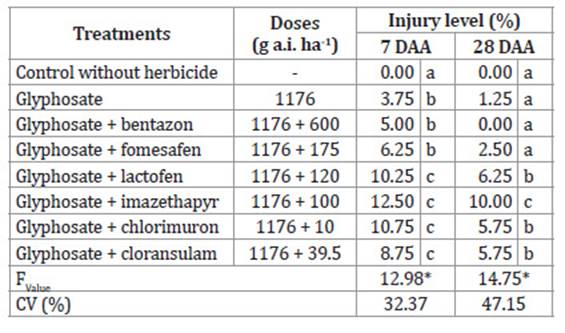
showed differential susceptibility to the variable injury level,
with significant differences among herbicide treatments and the control without
application (Table
5).
Table 5: Injury level of soybean (cultivar: Foco IPRO®)
after application of post-emergence herbicide associations. Rio Verde (Brazil),
2020/2021.
Tabla 5: Fitointoxicación
de la soja (cultivar: Foco IPRO®)
después de la aplicación de asociaciones de herbicidas de postemergencia. Rio
Verde (Brasil), 2020/2021.
a.i. = active ingredient; DAA = Days after application. *
Significant by F test (p≤0.05). Means followed by different letters in
the column differ from each other by the Scott-Knott test (p≤0.05).
i.a. = ingrediente activo; DAA = días después de la aplicación. *
Significativo por prueba F (p≤0,05). Medias seguidas de letras
diferentes en la columna difieren entre sí por la prueba de Scott-Knott (p≤0,05).
In the
evaluation carried out at 7 DAA, glyphosate in association with lactofen, as
well as in association with ALS-inhibitors herbicides, imazethapyr,
chlorimuron, and cloransulam, provided the highest percentage of injuries to
soybean plants, at levels ranging from 8,75 to 12.50%. The application of
glyphosate isolated and the associations of this herbicide with bentazon or
fomesafen at 7 DAA resulted in lower levels of intoxication than the other
herbicide treatments but were still higher than the control.
Regarding
the results obtained in the evaluation carried out at 28 DAA, the association
of glyphosate with imazethapyr provided the highest level of injury for this
cultivar (10.00%) (Table 5), with leaf chlorosis being
the main observed visual symptom. Following the treatments with higher levels
of injuries, lactofen, chlorimuron, and cloransulam were all applied in
association with glyphosate. Furthermore, in this evaluation, the ability of
the cultivar Foco IPRO® to recover from the
phytotoxicity caused by these previously mentioned herbicides inhibiting PPO
and ALS was evident. According to Oliveira Jr. et al. (2008),
the effects of applying glyphosate to soybeans with RR® technology may vary according
to the genotype, the time of application, and the dose of herbicide used.
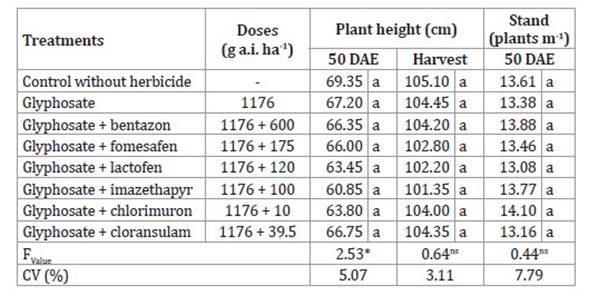
The data
referring to the evaluations of plant height (50 DAE and harvest) and plant
stand at harvest are presented in Table 6.
Table 6: Height and stand of soybean plants (cultivar: Foco IPRO®) after application of
post-emergence herbicide associations. Rio Verde (Brazil), 2020/2021.
Tabla 6: Altura y
soporte de plantas de soja (cultivar: Foco IPRO®)
después de la aplicación de asociaciones de herbicidas de postemergencia. Rio
Verde (Brasil), 2020/2021.
a.i. = active ingredient; DAE = Days after emergence. * and ns Significant and
non-significant, respectively, by the F test (p≤0.05). Means followed by
different letters in the column differ from each other by the Scott-Knott test
(p≤0.05).
i.a. = ingrediente activo; DAE = Días después de la emergencia. * y ns Significativo y no
significativo, respectivamente, por la prueba F (p≤0,05). Medias
seguidas de letras diferentes en la columna difieren entre sí por la prueba de
Scott-Knott (p≤0,05).
Regarding
the evaluation of plant height, the herbicide treatments did not cause changes
in the plant height of soybean (cultivar Focus IPRO®)
in both evaluations, with no significant differences from the control without
application. With the above, there is a quick recovery of the stresses promoted
by the herbicides applied postemergence, detected in the visual evaluations of
injury levels, allowing that the vegetative growth of the plants was not
negatively affected.
The final
stand of the plants was also not affected by the herbicide treatments (Table 6), which demonstrates, once again, the safety regarding the
use of these herbicides for the soybean cultivar Foco IPRO®.
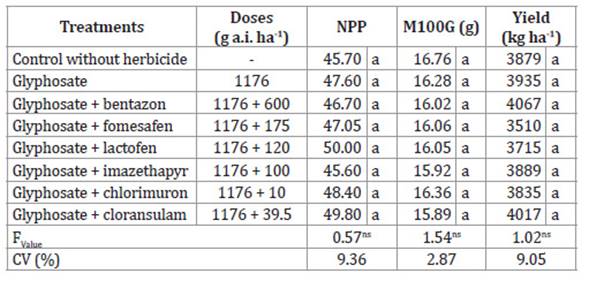
The evaluated herbicides did not influence yield components (number of pods per
plant and weight of 100 grains) or grain yield, not showing significant
differences from the control without application (Table 7).
Table 7: Number of pods per plant (NPP), mass of 100 grains (M100G) and
soybean grain yield (cultivar: Focus IPRO®)
after application of post-emergence herbicide associations. Rio Verde (Brazil),
2020/2021.
Tabla 7: Número de
vainas por planta (NPP), masa de 100 granos (M100G) y rendimiento de grano de
soja (cultivar: Focus IPRO®)
después de la aplicación de asociaciones de herbicidas de postemergencia. Rio
Verde (Brasil), 2020/2021.
a.i. = active ingredient. ns Not significant by the F test
(p≤0.05).
i.a. = ingrediente activo. ns No significativo por la prueba
F (p≤0,05).
Marchi et al. (2013) reported that the association
of glyphosate (1176 g a.i. ha-1)
with chlorimuron (10 g a.i. ha-1)
applied to soybean plants at stage V2-V3 resulted in a significant reduction in
the mass of 100 grains but without an impact on the grain yield. Regular and
expressive rainfall observed mainly in the months of January and February
favored the cultivar Foco IPRO® in the aspect of reestablishing
foliar intoxication initially promoted by the herbicides, favoring the
demonstration of herbicide selectivity. The cultivar Foco IPRO® presented, regardless of the
herbicide treatments, yields ranging from 3,510 to 4,067 kg ha-1,
which demonstrates its good adaptability to the southwestern region of Goiás
State.
Experiment III: Selectivity of herbicide associations applied
postemergence to the soybean cultivar Bônus IPRO®
The injury
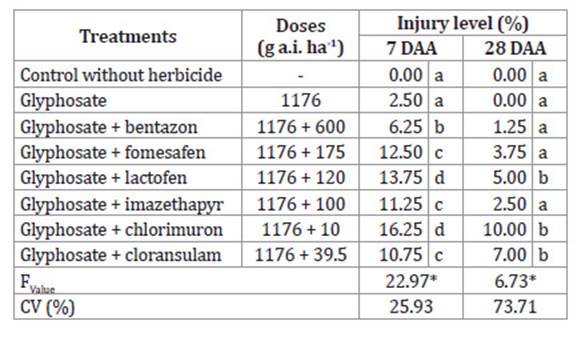
level caused by the herbicide treatments for the Bônus IPRO® soybean cultivar is shown in Table 8.
Table 8: Injury level of soybean (cultivar: Bônus IPRO®)
after application of post-emergence herbicide associations. Rio Verde (Brazil),
2020/2021.
Tabla 8: Fitointoxicación
de la soja (cultivar: Bônus IPRO®)
después de la aplicación de asociaciones de herbicidas de postemergencia. Rio
Verde (Brasil), 2020/2021.
a.i. = active ingredient; DAA = Days after application. *
Significant by F test (p≤0.05). Means followed by different letters in
the column differ from each other by the Scott-Knott test (p≤0.05).
i.a. = ingrediente activo; DAA = días después de la aplicación. *
Significativo por prueba F (p≤0,05). Medias seguidas de letras
diferentes en la columna difieren entre sí por la prueba de Scott-Knott (p≤0,05).
As seen for
the other cultivars, more accentuated levels of phytotoxicity occurred in the
first evaluation (7 DAA), with a partial or complete recovery of most soybean
plants in the later evaluation (28 DAA).
At 7 DAA,
the PPO and ALS inhibitors lactofen and chlorimuron, respectively, both associated
with glyphosate, presented the highest percentages of injury levels to the
soybean cultivar Bônus IPRO®,
with averages of 13.75% and 16,25%, respectively, differing significantly from
the other treatments and the control without herbicide application. These data
corroborate the results presented by Alonso et al. (2010),
who verified that the association of herbicides with PPO and ALS modes of
action to glyphosate present symptoms of foliar phytotoxicity to soybean plants
superior to other tested mixtures in evaluations carried out at 7 and 15 DAA.
The initial
leaf symptoms observed after the application of these herbicides were similar
to those described by Alonso et al. (2013),
including chlorimuron chlorosis followed by necrosis in the apical leaves and
chlorosis with subsequent necrosis and wrinkling for lactofen. Even at 7 DAA,
the associations of glyphosate with cloransulam, imazethapyr, or fomesafen
showed intermediate levels of injuries, with phytotoxicity varying from 10.75
to 12.50%, not differing from each other. The PSII inhibitor bentazon, in
association with glyphosate, promoted mild injury symptoms (6.25%),
characterized by small and few chlorotic and necrotic spots on the leaves.
At 28 DAA,
the soybean plants of the Bônus IPRO® cultivar already showed good
recovery from the symptoms of injuries; however, higher levels of injuries were
observed in treatments involving the association of glyphosate with lactofen,
chlorimuron, and cloransulam, where the levels were in the range of 5.00 to
10.00%. The other herbicide treatments evaluated did not show significant
differences among them, with a maximum percentage of injuries of 3.75%, and
were statistically equivalent to the control, which was without application.
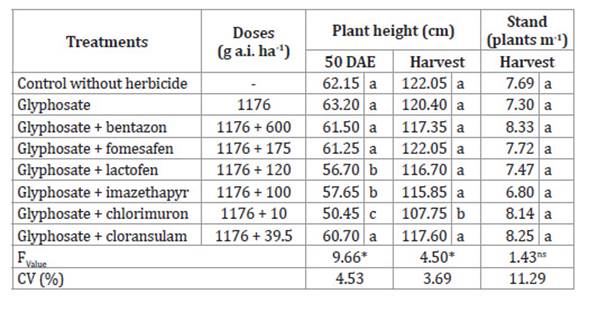
At 50
DAE, a significant reduction was observed in the soybean plant size of the
Bônus IPRO® cultivar that received a
postemergence application of the association glyphosate + chlorimuron, with an
average decrease of 18.31% in plant height when compared to the control without
herbicide application (Table 9).
Table 9: Height and stand of soybean plants (cultivar: Bônus IPRO®) after application of
post-emergence herbicide associations. Rio Verde (Brazil), 2020/2021.
Tabla 9: Altura y
soporte de plantas de soja (cultivar: Bônus IPRO®)
después de la aplicación de asociaciones de herbicidas de postemergencia. Rio
Verde (Brasil), 2020/2021.
a.i. = active ingredient; DAE = Days after emergence. * and ns Significant and
non-significant, respectively, by the F test (p≤0.05). Means followed by
different letters in the column differ from each other by the Scott-Knott test
(p≤0.05).
i.a. = ingrediente activo; DAE = Días después de la emergencia. * y ns Significativo y no
significativo, respectivamente, por la prueba F (p≤0,05). Medias
seguidas de letras diferentes en la columna difieren entre sí por la prueba de
Scott-Knott (p≤0,05).
The
glyphosate + imazethapyr and glyphosate + lactofen treatments also resulted in
a lower plant height of soybean, but at a lower magnitude, with an average
reduction of 7.42%. All other herbicide treatments did not significantly affect
the size of soybean plants when compared to the control without herbicide
application. Of the morphological variables, plant height was the most affected
by herbicides applied postemergence and is an important parameter for
measurement in selectivity experiments (12).
At harvest, plants of the
cultivar Bônus IPRO® recovered for the variable
height, with no more differences among the glyphosate + imazethapyr and
glyphosate + lactofen associations and the control without herbicide
application (Table
9). Only the glyphosate + chlorimuron treatment
provided a lower final plant height, with an average reduction of 9.56%,
compared to the average height of soybean plants present in the control
treatment plots without herbicides. Correia and Durigan
(2007), evaluating the selectivity of eight commercial formulations of
glyphosate-based products to two RR® soybean cultivars, found that
none of the herbicides influenced the plant height.
The final
stand of plants for the Bônus IPRO® cultivar remained
statistically the same for all treatments, with no significant reduction
occurring among the experimental units that received the herbicides and the
control (Table 9). This result consolidates the
results found for the cultivars M7110 IPRO® and Foco IPRO®,
where it is verified that the evaluated herbicide treatments did not reduce the
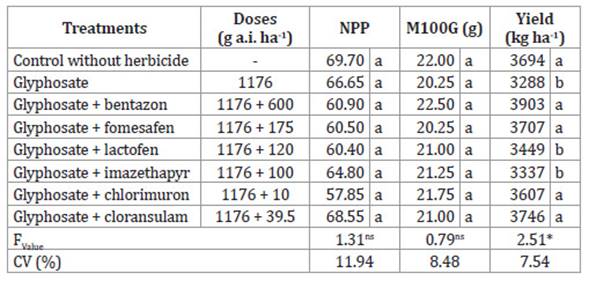
plant stand. For the variables number of pods per plant and mass of 100 grains,
negative changes were not verified in the soybean plants of the cultivar Bônus
IPRO®
due to the application of postemergence herbicides (Table 10).
Table 10:
Number of pods per plant (NPP), mass of 100 grains (M100G) and
soybean grain yield (cultivar: Bônus IPRO®)
after application of post-emergence herbicide associations. Rio Verde (Brazil),
2020/2021.
Tabla 10: Número de
vainas por planta (NPP), masa de 100 granos (M100G) y rendimiento de grano de
soja (cultivar: Bônus IPRO®)
después de la aplicación de asociaciones de herbicidas de postemergencia. Rio
Verde (Brasil), 2020/2021.
a.i. = active ingredient. * and ns
Significant and non-significant, respectively, by the F test (p≤0.05).
Means followed by different letters in the column differ from each other by the
Scott-Knott test (p≤0.05).
i.a. = ingrediente activo. * y ns
Significativo y no significativo, respectivamente, por la prueba
F (p≤0,05). Medias seguidas de letras diferentes en la columna difieren
entre sí por la prueba de Scott-Knott (p≤0,05).
This
result differs from the study carried out by Alonso et
al. (2011), where it was verified that the association of glyphosate
and lactofen promoted a significant reduction in the mass of 100 grains.
Regarding
grain yield, the treatments isolated glyphosate, glyphosate + lactofen, and
glyphosate + imazethapyr provided significant reductions in this parameter of
8.99%, 6.62%, and 9.67%, respectively, compared to the grain yield recorded in
the control without herbicide application (Table 10). These results demonstrate the lack of selectivity of
these herbicide treatments for use in production areas that use this cultivar.
According to Constantin et al. (2016), the
attenuation of negative effects, such as foliar injuries, caused by the
herbicide glyphosate in genetically modified soybean cultivars (RR®) can be minimized,
maintaining the crop’s yield potential through the use of biostimulant
products. The other herbicide treatments did not damage the grain yield of the
cultivar Bônus IPRO®,
which presented yields ranging from 3,288 to 3,903 kg ha-1,
regardless of the evaluated herbicide treatments.
Conclusion
The stand of
plants at harvest of soybean cultivars M7110 IPRO®,
Foco IPRO®, and Bônus IPRO®
was not decreased by postemergence applications of glyphosate,
either isolated or in association with bentazon, fomesafen, lactofen,
imazethapyr, chlorimuron, and cloransulam.
None of the
evaluated herbicide treatments caused a reduction in the grain yield of
cultivars M7110 IPRO® and Foco IPRO®;
however, the herbicides lactofen and chlorimuron, in association with
glyphosate, were the ones that caused the highest levels of phytotoxicity to
M7110 IPRO®,
and the combination of glyphosate with imazethapyr caused greater phytotoxicity
in the cultivar Foco IPRO®.
Post-emergence
application of glyphosate was isolated, and the associations of glyphosate +
lactofen and glyphosate + imazethapyr decreased the grain yield of the Bônus
IPRO®
soybean cultivar.
The results
of the present work reinforce the need for care in choosing the soybean
cultivar and the selection of the herbicides to be applied postemergence, as
the genetics of the material are decisive for the response in terms of
sensitivity to the applied herbicides.
Acknowledgements
Thanks to the Universidade de
Rio Verde (UniRV), Fundação de Amparo à Pesquisa do Estado de Goiás (FAPEG),
and Coordenação de Aperfeiçoamento de Pessoal de Nível Superior (CAPES)
for the financial research support of this research (Process number:
201810267001546).
1. Albrecht, L. P.; Albrecht, A. J. P.; Moreira Silva, A. F.;
Ramos, R. A.; Rodrigues da Costa, K. Y.; Viana de Araújo, G.; Mundt, T. T.;
Colombari, C. 2022. Sequential application of herbicide options for controlling
Conyza sumatrensis in soybean pre-sowing. Revista de la Facultad de
Ciencias Agrarias. Universidad Nacional de Cuyo. Mendoza. Argentina. 54(2):
83-93.
2. Alonso, D. G.;
Constantin, J.; Oliveira Jr., R. S.; Biffe, D. F.; Raimondi, M. A.; Gemelli,
A.; Blainski, E.; Carneiro, J. 2010. Selectivity of glyphosate in tank mixtures
for RR soybean in sequential applications with mixtures only in the first or
second application. Planta Daninha. Brazil. 28(4): 865-875.
3. Alonso, D. G.;
Constantin, J.; Oliveira Jr., R. S.; Arantes, J. G. Z.; Cavalieri, S. D.;
Santos, G.; Rios, F. A.; Franchini, L. H. M. 2011. Selectivity of glyphosate
tank mixtures for RR soybean. Planta
Daninha. Brazil. 29(4): 929-937.
4. Alonso, D. G.;
Constantin, J.; Oliveira Jr., R. S.; Santos, G.; Dan, H. A.; Oliveira Neto, A.
M. 2013. Seletividade de glyphosate isolado ou em misturas para soja RR em
aplicações sequenciais. Planta
Daninha. Brazil. 31(1): 203-212.
5. Beckie, H. J. 2011. Herbicide-resistant weed management: focus
on glyphosate. Pest Manag. Sci. 67(9): 1037-1048.
6. Bott, S.; Tesfamariam, T.;
Candan, H.; Cakmak, I.; Römheld, V.; Neumann, G. 2008. Glyphosate induced
impairment of plant growth and micronutrient status in glyphosate-resistant
soybean (Glycine max L.). Plant and Soil. 312(1): 85-194.
7. Constantin, J.; Oliveira Jr., R. S.; Gheno, E. A.; Biffe, D.
F.; Braz, G. B. P.; Weber, F.; Takano, H. K. 2016. Prevention of yield losses
caused by glyphosate in soybeans with biostimulant. Afr. Jour. Agri. Res.
11(18): 1601-1607.
8. Constantin, J.; Braz,
G. B. P.; Oliveira Jr., R. S.; Andrade, C. L. L.; Pereira, B. C. S.; Machado,
F. G. 2020. Performance of RR soybean submitted to postemergence application of
glyphosate with a foliar elicitor product. Arquiv. Inst. Biol. Brazil. 87:
e0492019.
9. Correia, N. M.; Durigan,
J. C. 2007. Seletividade de diferentes herbicidas à base de glyphosate a soja
RR. Planta Daninha . Brazil. 25(2): 375-379.
10. Embrapa. Tecnologias
de Produção de Soja. 2013. Região Central do Brasil. Londrina, PR: Embrapa
Soja. 265 p.
11. Ferreira, D. F. 2011.
Sisvar: a computer statistical analysis system. Ciên. Agr. Brazil. 35(6):
1039-1042.
12. Fornazza, F. G. F.;
Constantin, J.; Machado, F. G.; Oliveira Jr., R. S.; Silva, G. D.;
Rios, F. A. 2018. Selectivity of pre-and post-emergence herbicides to
very-early maturing soybean cultivars. Comum. Sci. 9(4): 649-658.
13. Galon, L.; Konzen, A.;
Bagnara, M. A. M.; Brunetto, L.; Aspiazú, I.; da Silva, A. M. L.; Brandler, D.;
Linsingen Piazzetta, H. V.; Radünz, A. L.; Perin, G. F. 2022. Interference and
threshold level of Sida rhombifolia in transgenic soybean cultivars. Revista
de la Facultad de Ciencias Agrarias Universidad
Nacional de Cuyo. Mendoza. Argentina. 54(2): 94-106.
14. López-Ovejero, R. F.;
Penckowski, L. H.; Podolan, M. J.; Carvalho, S. J. P.; Christoffoleti, P. J.
2006. Alternativas de manejo químico da planta daninha Digitaria ciliaris resistente
aos herbicidas inibidores da ACCase na cultura de soja. Planta Daninha . Brazil. 24(2): 407-414.
15. Marchi, S. R.;
Borgoni, D.; Biazzi, L.; Bellé, J. R. 2013. Associações entre glifosato e
herbicidas pósemergentes para o controle de trapoeraba em soja RR®. Rev. Bras.
Her. Brazil. 12(1): 23-30.
16. Oliveira Jr., R. S.;
Dvoranen, E. C.; Constantin, J.; Cavalieri, S. D.; Franchini, L. H. M.; Rios,
F. A.; Blainski, E. 2008. Influência do glyphosate sobre a nodulação e o
crescimento de cultivares de soja resistente ao glyphosate. Planta Daninha . Brazil. 26(4): 831-843.
17. Osipe, J. B.; Oliveira
Jr., R. S.; Constantin, J.; Biffe, D. F.; Rios, F. A.; Franchini, L. H. M.;
Gheno, E. A.; Raimondi, M. A. 2014. Seletividade de aplicações combinadas de
herbicidas em pré e pósemergência para a soja tolerante ao glyphosate. Bio.
Jour. Brazil. 30(3): 623-631.
18. Owen, M. D. K.;
Zelaya, I. A. 2005. Herbicide-resistant crops and weed resistance to
herbicides. Pest Manag. Sci. 61(3): 301-311.
19. Priess, G. L.;
Norsworthy, J. K.; Roberts, T. L.; Gbur Jr., E. E. 2020. Impact of
postemergence herbicides on soybean injury and canopy formation. Weed Tech.
34(5): 727-734.
20. Sociedade Brasileira
da Ciência Das Plantas Daninhas (SBCPD). 1995. Procedimentos para instalação,
avaliação e análise de experimentos com herbicidas. Londrina: SBCPD. 42 p.
21. Vieira Júnior, N. S.;
Jakelaitis, A.; Cardoso, I. S.; Rezende, P. N.; Moraes, N. C.; Tavares, C. J.
2015. Associação de herbicidas aplicados em pós emergência na cultura do milho.
Global Sci. and Tech. 8(1): 1-8.
22. Zobiole, L. H. S.; Oliveira Jr., R. S.; Huber, D. M.;
Constantin, J.; Castro, C.; Oliveira, F. A.; Oliveira Júnior, A. 2010.
Glyphosate reduces shoot concentrations of mineral nutrients in glyphosate
resistant soybeans. Plant
and Soil . 328: 57-69.