Revista de la Facultad de Ciencias
Agrarias. Universidad Nacional de Cuyo. Tomo 55(1). ISSN (en línea) 1853-8665.
Año 2023.
Original article
Conventional
to organic transition of Citrus x sinensis (L.) Osbeck (pro. sp.) orchards in
municipalities of northern Veracruz state
Transición
de huertos de Citrus x sinensis (L.) Osbeck (pro. sp.)
convencionales a orgánicos en municipios de la zona norte de Veracruz
Sherell Zamora Juárez 1
Daniel Arturo
Rodríguez-Lagunes 1
Lissette Cristina
Bustillo-García 2*
Odón Castañeda-Castro 3
Rosalía Núñez-Pastrana 1
Juan Carlos Noa-Carrazana 4
Francisco Osorio-Acosta 5
1 Universidad Veracruzana.
Facultad de Ciencias Biológicas y Agropecuarias. Carretera Peñuela Amatlán km
177. Córdoba. Veracruz. México. C. P. 94500.
2 Universidad Veracruzana.
Facultad de Ingeniería en Sistemas de Producción Agropecuaria. Carretera Costera
del Golfo. km 220. Col. Agrícola Micahapan. Veracruz. México. C. P. 96100.
3 Universidad Veracruzana.
Facultad de Ciencias Químicas. Oriente 6. 1009. Rafael Alvarado. Orizaba.
Veracruz. México. C. P. 94340.
4 Instituto de
Biotecnología y Ecología Aplicada. Avenida de las Culturas Veracruzanas 101.
Colonia Emiliano Zapata. Xalapa. Veracruz. México. C. P. 91090.
5
Colegio de Postgraduados. Campus Veracruz. Carretera Xalapa-Veracruz. km 88.5.
Tepetates. Municipio de Manlio Fabio Altamirano. Veracruz. México. C. P. 91690.
Abstract
This research determined the degree of transition towards organic
production and management of Valencia orange in the municipalities of northern
Veracruz State. One hundred and six surveys were administered to producers
grouped into four consolidated civil associations. A constructed transition
index considering six variables revealed an average of 0.768. Citrus
grower/institution positively correlated with intercropping (p = 0.0281) and
with internal factors (p = 0.0257). Determinant factors for transition index
were intercropping (p = 0.00009), and citrus grower/institution interaction (p
= 0.0000). These internal and external factors together with years of
conversion, averaging six years, resulted in an intermediate transition degree
towards organic Valencia orange production. Municipalities of northern Veracruz
State stand on varying degrees of transition towards organic agriculture. Yet,
many growers still conserve some management practices not consistent with
organic production.
Keywords:
Organic agriculture;
Transition index;
Citrus.
Resumen
El objetivo de la
investigación fue determinar el grado de transición hacia la producción
orgánica y el manejo de naranja Valencia de los municipios de la zona norte de
Veracruz. Se aplicaron 106 encuestas a productores agrupados en cuatro
asociaciones consolidadas y se construyó un índice de transición con seis
variables. El índice promedio de transición fue 0,768. Se hallaron
interacciones positivas entre citricultor/institución vs. intercalado de cultivos (p = 0,0281) y vs. factores internos (p = 0,0257). Los factores determinantes
para el índice de transición son el intercalado del cultivo (p = 0,00009) y la
interacción citricultor/institución (p = 0,0000). Estos factores internos y
externos junto con los años en trabajo de conversión, con un promedio de seis
años, resultan en un grado intermedio de transición orgánica de los productores de naranja Valencia. En conclusión, aun cuando
la zona norte del estado de Veracruz se encuentra en transición hacia la
agricultura orgánica, algunos productores mantienen prácticas de manejo que no
siguen las guías de este tipo de producción.
Palabras clave: Agricultura orgánica; Indice de transición; Cítricos.
Originales:
Recepción: 08/11/2021
Aceptación: 23/02/2023
Introduction
Organic agriculture (OA) produces chemical-free food for human
consumption and under safer environmental conditions than conventional
agriculture. OA considers minimum external inputs while avoiding synthetic
fertilizers and pesticides (1, 17, 22, 30, 31). Globally, approximately 2.7 million producers
distributed mainly in India, Uganda, and Mexico (7), cultivate under OA. The North American continent represents 16% of
worldwide OA, with 11.2 million hectares (ha) of organic production (7). OA in Mexico began in the 1980s. During 2018, the Servicio de
Información Agroalimentaria y Pesquera (SIAP) (Fisheries Agrifood Information
Service) reported 1,126,000 ha organically managed, 162,386 ha planted and
certified as organic, and 11,380 ha of orchards in transition from conventional
to organic (6, 24). In 2019, Mexico ranked
sixth globally for Valencia orange [Citrus x sinensis (L.) Osbeck (pro. sp.)]; production, contributing 6.3% of global volume (10, 25).
Due to global demand for citrus, Mexico is investing in citriculture,
primarily in Veracruz and Michoacan states. In Veracruz, different citrus
industries have invested in organic Valencia orange production (12). Within the OA scope, organizations establish requirements and
standards. At the beginning of 2001, the Research Institute of Organic
Agriculture (FiBL) developed an integrated organic management strategy to
control and regulate the vector of Citrus Huanglongbing disease, Diaphorina
citri Kuayama in Mexico (3, 21). This
infection, previously called Citrus Greening Disease is caused by unculturable
phloem-limited bacteria. In February 2006, the Organic Products Law was issued
in Mexico, then followed by specific regulations in
2010. In 2013, an agreement was signed on guidelines for the organic operation
of agricultural activities (26). The National Institute of Forestry, Agricultural and Livestock
Research (INIFAP), together with the Consejo de Productores y exportadores de
limon Persa (COPELP) (Council of Producers and Exporters of Persian Lemon A.C.)
in 2017, compiled a list of bioinsecticides against D. citri allowed
within organic citriculture (8).
Conceptual framework addressing OA
Agricultural sustainability is defined/limited
by the effects of conventional or intensive agriculture. The Food
and Agriculture Organization of the United Nations (1991) conceptualizes
sustainable agriculture as:
“The management and conservation of natural resources
and the orientation of technological and institutional changes in order to
ensure the continuous satisfaction of human needs for present and future
generations. Such sustainable development conserves soil, water, and animal and
plant genetic resources; does not degrade the environment; and is technically
appropriate, economically viable and socially acceptable.”
Thus, sustainability is an interaction between society and nature over
time, including social progress towards agroecosystem sustainability (4).
In a three-dimensional approach considering broad agroecology, Toledo (2012) emphasized the relationship between
scientific research, new practices, and social movements in Latin America
(including the Caribbean), describing the five regional kernels of agroecology:
Brazil, the Andean Region, Central America, Mexico, and Cuba. He found a
tripartite and interrelated innovation process (knowledge, technology, and
sociopolitics) interacting with recent political and cultural events (e.g. the
emergence of governments with social perspective, and indigenous and peasant
resistance). Contemporary agroecology encompasses the relationship between
scientific paradigms and technological changes with social and political
movements, providing important transformational gains toward building
sustainable societies (27). Agroecology enhances perspectives for researchers, growers, and
industries seeking more environmentally friendly production practices to
protect soil, flora, fauna, and ecosystems.
Among management methods for improving agroecosystems, OA (which focuses
on agroecology) uses efficient technologies combined with ecological knowledge
to reduce negative environmental impact (30). Niggli (2015) states that OA is a practical way of developing sustainable
agriculture.
There are four fundamental pillars in agroecology (28). The first pillar is “to build biodiverse agroecosystems such that the
composition (species richness, with high genetic variability) and structure
(abundance and spatial/temporal distribution of species) acquire complexity,
achieving the objectives sought by farmers to maintain ecosystem
functionality…” The second pillar consists of “capturing as much solar energy
as possible through photosynthesis. This energy supports a complex food chain
and agroecosystemic productivity”. The third pillar refers to “promoting the
greatest recycling of materials introduced into the production process, the
incorporation of organic fertilizers compensating for harvest output, the least
physical soil intervention, and the use of green manures and ground cover for
erosion prevention...” The fourth pillar states the “efficient use of water, a
scarce resource”. These pillars help build resilient, sustainable, and socially
accepted agroecosystems for communities internationally.
According to IFOAM basic standards (13), “Organic Agriculture is a
production system that sustains the health of soils, ecosystems, and people. It
relies on ecological processes, biodiversity and cycles adapted to local
conditions, rather than the use of inputs with adverse effects. Organic
Agriculture combines tradition, innovation, and science to benefit the shared
environment and promote fair relationships and good quality of life for all
involved.”
In Mexico, the Secretary of Agriculture and Rural Development defined OA
as an activity prescinding from agrochemicals and
developed using natural inputs (no artificial fertilizers or pesticides) aiming
to obtain vegetables and animal products or subproducts free of toxic residues (23). According to Niggli (2015), the objective is
to support farm ecological and social quality, increasing food production. OA
development can be characterized by comprehensive social, ecological, and
technological innovations, where dynamic interactions among farmers and
scientists are included. According to Kodirekkala (2017),
social internal factors interact with external factors, affecting traditional
ecological knowledge. Internal factors include socioeconomic and environmental
conditions determining decision-making processes, which together with external
factors, such as local economy and society, are affected by markets and
regulations.
Our research studied the transition degree of Valencia orange orchards
towards OA in northern Veracruz State. To this end, the approach described by Niggli (2015) was complemented by the internal and
external factors proposed by Kodirekkala (2017). Our
research also followed the principles and practices of OA promoted by the
International Federation of Organic Agriculture (13,
22), considering production vs. environment (16). This included the law and regulations of organic products (15, 20) and the Guidelines for the Organic Operation
of agricultural activities (11), describing all regulations for OA transition in Mexico.
The hypothesis stated that Valencia orange producers in northern
Veracruz State are transitioning towards organic production, resulting from the
dynamic temporal interactions between farmers and institutions strengthening
this producing model. Therefore, the objective was to determine the degree of
transition towards organic production and management of Valencia orange in the
municipalities of northern Veracruz State.
Materials and methods
Sample collecting
Our investigation was performed in northern Veracruz State, in the
municipalities of Álamo Temapache, Tantoyuca, Chalma, Chicontepec, and
Ixhuatlán de Madero, where Valencia orange producers are transitioning from
conventional to organic management. To determine management transition,
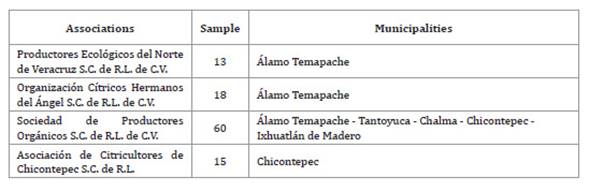
structured interviews were conducted on 106 organic producers of Valencia
orange [(Citrus x sinensis (L.) Osbeck (pro.
sp.)]. These producers were grouped into four established civil
associations (Table 1).
Table 1: Number of interviewed producers per Association and Municipality in
northern Veracruz State.
Tabla 1: Número de productores entrevistados en cada asociación de cítricos
orgánicos de municipios de la zona norte de Veracruz.
In the absence of an official register of organic Valencia orange
producers in northern Veracruz State, we implemented a non-probabilistic
sampling protocol using the snowball method (5), carried out in March 2021.
Operationalization, variable weighting,
and transition index construction
Table 2 lists all variables
and indicators.
Table 2: Variables and indicators contributing to the Transition Index.
Tabla 2: Definición de variables e indicadores que componen el Índice de
Transición.
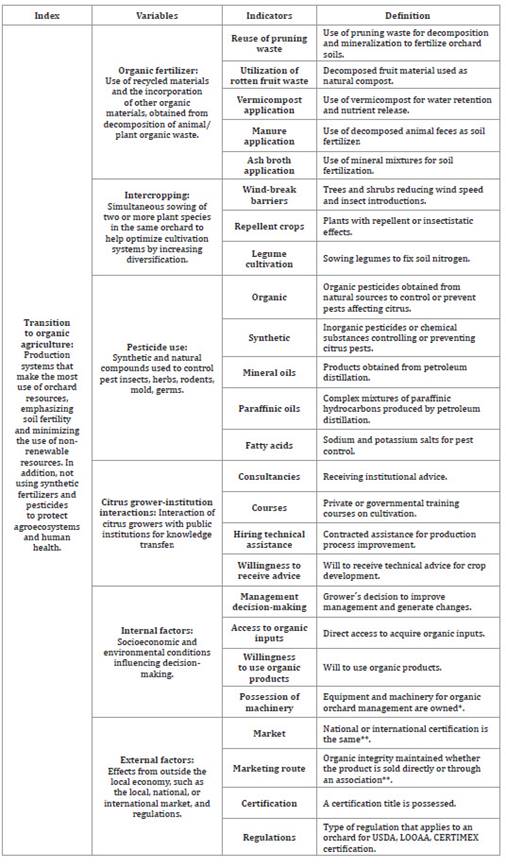
*According to the Guidelines for the
Organic Operation of agricultural activities (11), in the process and organic operation
towards general conversion, “the machinery has to be different from that of
conventional…”. ** The Organic integrity, that is, the
quality of an organic product obtained in accordance with the Law, which must
be maintained during production and handling until the final point of sale... (20).
* De
acuerdo con los Lineamientos para la Operación orgánica de las actividades
agropecuarias (11) en la operación orgánica y sus procesos hacia la conversión
general, “la herramienta y maquinaria utilizada en la operación orgánica deberá
diferenciarse de la utilizada en la actividad agropecuaria convencional…”. **La
integridad orgánica es la cualidad de un producto orgánico obtenido de acuerdo
con la Ley, la cual deberá ser mantenida durante la producción y manejo hasta
el punto final de venta… (20).
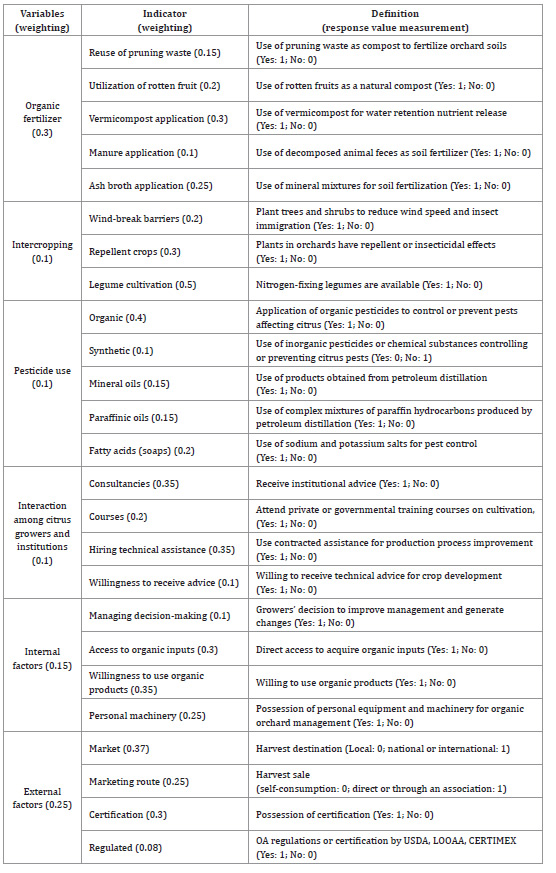
Based on the theoretical framework, the variables and
indicators were defined and operationalized. The questionnaire comprised
dichotomous answers. Variable and indicator weighting was carried out according
to the professional experience of the researchers (29). Relative weights were normalized by multiplying each
indicator in the questionnaire with the corresponding weighted value. Then
their sum was multiplied by the weighted value of each variable (29). The sum of the normalized relative weights for all
the indicators must equal 1 (Table 3).
Table 3: Operationalization and weighting of variables and indicators for
determining the Transition Index.
Tabla 3: Operacionalización y ponderación de variables e indicadores para
determinar el Índice de Transformación.
Therefore,
the transition index is the sum of the results of the weighted variables and
indicators. Coded and tabulated data in an Excel® spreadsheet allowed variables
and index calculation. Then, correlation analyses were carried out with all the
variables dedicated to OA practice using Statistica software (9). Statistically different variables were classified
into lower, intermediate, and upper by Line Plot. An ANOVA compared these
values with the transition index. Although surveys started in different years
with OA as an empirical division, they were divided into incipient,
intermediate, advanced, and organic, from 1 to 6 years, 7 to 12 years, 13 to 18
years, and 19 to 26 years, respectively. The years dedicated to OA were plotted
against the transition index.
Results and Discussion
Table 4 shows minimum and maximum
values for each indicator, meaning some growers are implementing more organic
management than others.
Table 4: Maximum, minimum, and mean values of variables A to F, and the
transition index.
Tabla 4: Valores máximos, mínimos y media de las variables e índice de
transformación. Cada una de las letras identifica las distintas variables.
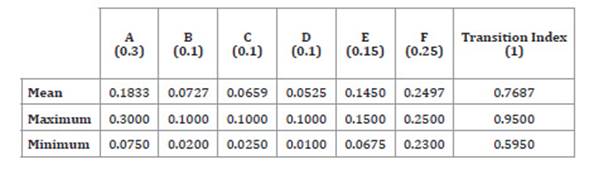
A: organic fertilizer. B: intercropping. C: pesticide use. D: interaction between citrus
growers and institutions, E: internal factors, F: external factors.
A: fertilizante orgánico. B: intercalado de
cultivo. C: uso de pesticidas. D: interacción citricultores-instituciones, E:
factores internos. F: factores externos.
The average transition index was 0.768, indicating an average value of
transition towards OA, consistent with the number of years dedicated to OA.
Figure 1 shows biplots and consequent
correlations between variables.
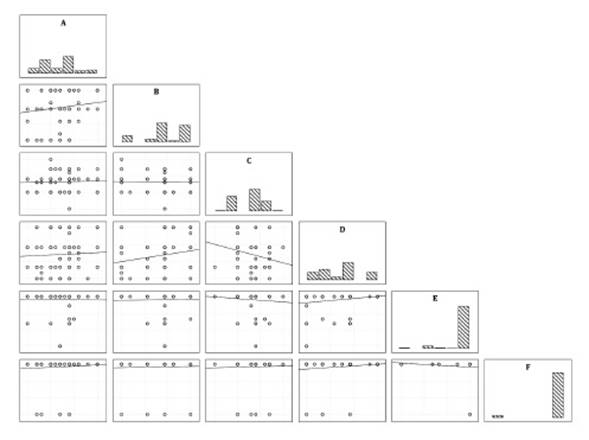
A: organic fertilizer. B: intercropping.
C: pesticide use. D: citrus grower institution interaction. E: internal factors. F: external factors.
A:
fertilizante orgánico. B: intercalado de cultivo. C: uso de pesticidas. D:
interacción citricultores-instituciones. E: factores internos. F: factores
externos.
Figure 1: Correlation matrix.
Figura 1: Matriz de correlación.
Significant positive correlations existed between the citrus
grower/institution interaction and intercropping (p = 0.0281; r = 0.2133), and
the citrus grower/institution interaction with internal factors (p = 0.0257; r
= 0.2167). A weak and negative correlation between pesticide use and citrus
grower/institution interaction (p = 0.0369; r = -0.2030) was given by producers
buying pesticides from agrochemical suppliers (based on seller recommendations)
without seeking advice from institutions. Thus, the citrus grower/ institution
interaction with intercropping constitutes a factor providing recent
information in Veracruz State. Production of organic C. sinensis is
gaining importance given a favourable international market demand and different
processing industries generating products such as orange juice, essential oils,
and cosmetics. The International Copper Chemistry (IQC), Cítricos ex S.A. of
C.V. (Citrex), Citrusper, and Procitris, S.A de C.V. industries are sought by
countries such as the United States, Canada, the European Union, and Asia (12). According to Bigaran and Ramos (2022), it is
also important to measure the logistical performance of distribution channels
of different lengths (km) based on criteria supported by the concept of food
miles and in the main logistical practices of distribution of fruits and
vegetables, contribute to the definition of strategies to mitigate food losses.
Figure 2 shows the categorized transition
index with the statistically different factors according to Line plot.
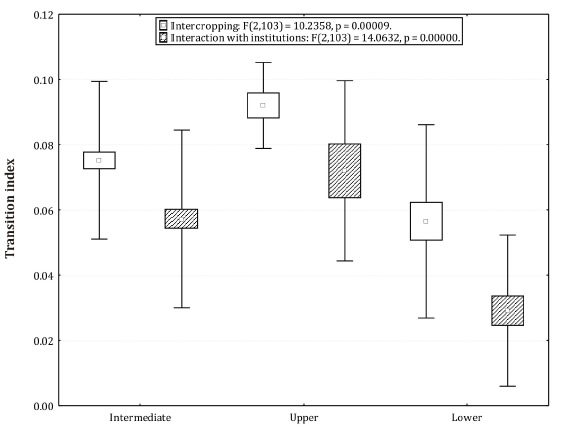
Figure 2: Analysis of the transition index and
variables with statistical differences, heuristically divided by Line plot.
Figura 2: Análisis del índice de transición con las variables divididas
heurísticamente por Line plot que presentaron diferencia estadística.
Growers with higher transition indices use
intercropping and have more interaction with institutions, while increased
activities help growers obtain certification for organic production. Yet, given
all growers applied organic fertilizers and organic pesticides, other variables
were not different within the categorized transition index. Plant nutrition
with organic fertilizers such as pruning residues, animal feces and mixtures of
mineral products promotes vigorous and healthy crops. Additionally, only organic
pesticides, and sodium/potassium salts are used to
control or prevent pests affecting citrus. In this sense, organic citriculture
results complex. Changes in scientific-technological paradigms are built in
constant association with social movements, where sustainable citriculture is
in constant transition and growers must interact with all agents related to
this industry. Thus, organic citriculture is an alternative for researchers,
producers and industrialists seeking less environmental impact and human
well-being (27).
Improving organic practices requires social, ecological, and technological
innovation in dynamic interaction among farmers and scientists strengthening
system resilience and exploiting research from diverse scientific disciplines (18).
The citrus grower/institution interaction evidences how OA is achieved
through a dynamic interaction among farmers and scientists promoting a
comprehensive culture including social, ecological, technological, and
environmental innovation (18). This is achieved because producers are willing to receive advice,
control, and supervision in different cultivation activities, while also
getting involved in training activities.
Figure 3, shows a highly
significant difference (p= 0.0000) between the transition index and the degree
of transition to OA, indicating that as conversion time increased, more
practices approved by the International Federation of Organic
Agriculture Movements (2005) were implemented.
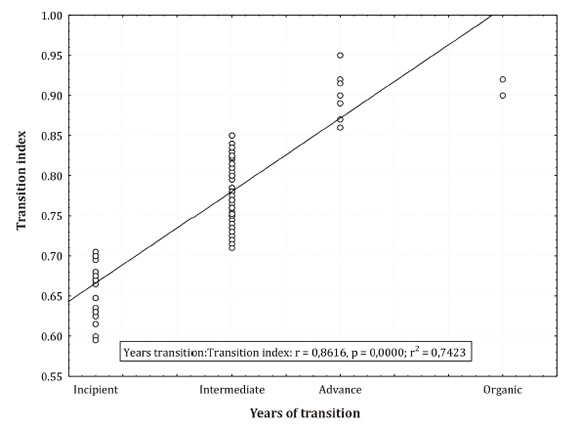
Figure 3: Relationship between the transition index
and years of conversion to organic agriculture.
Figura 3: Relación entre el índice de transformación y los años de
conversión hacia la agricultura orgánica.
Importantly, several growers with less time under OA
could apply all practices as advanced or organic according to the weighting of
variables and indicators, and all had their orchards certified as organic.
Current challenges should satisfy the production demand for Valencia orange
while reducing waste, improving the production of healthy oranges for
consumption, conserving natural resources, mitigating and adapting to climate
change and reducing social and cultural injustice and cultural erosion (i.e.
the loss of traditional knowledge). Improvement of most agricultural
activities is strongly needed (14).
Conclusions
Even considering all interviewed producers had orchards certified as
organic, Valencia orange producers in northern Veracruz State are still
transitioning to organic production above an average transition index (0.7687).
Producers with more years in organic production showed a higher transition
index. This transition degree is primarily influenced by the organic matter
recycling practices employed, the non-use of synthetic pesticides and
fertilizers, and the dynamic interactions between producers and institutions.
Yet, internal and external factors did not significantly influence the process
of transition towards an organic model for citrus production.
1. Beus, C.; Dunlap, R. 1991. Measuring adherence to alternative vs. conventional
agricultural paradigm: a proposed scale. Rural Sociology. 56(3): 432-60.
2.
Bigaran Aliotte, J. T.; Ramos de Oliveira, A. L. 2022. Multicriteria
decision analysis for fruits and vegetables routes based on the food miles
concept. Revista
de la Facultad de Ciencias Agrarias. Universidad Nacional de Cuyo. Mendoza.
Argentina. 54(1): 97-108.
3.
Boza, M. S. 2010. Desafío del desarrollo: la agricultura orgánica como parte de
una estrategia de mitigación de la pobreza rural en México. Revista de Ciencias
Sociales y Humanidades. Instituto de Ciencias Sociales y Administración. Ciudad
Juárez. México. 19(37): 92-111.
4.
Bustillo, G. L.; Martínez, D. J. P. 2008. Los enfoques del desarrollo
sustentable. Interciencia. 33(5): 389-395.
5.
Carlos, G. P.; Carlos, A. M. F. 2019. Estadística descriptiva y probabilidad.
Ed. Bonaventuriana. 38 p.
6.
Certificadora Mexicana de Productos y Procesos Ecológicos Sociedad Civil
(CERTIMEX). 2020. https://certimexsc.com/cmx/wp-content/uploads/2020/06/Libro_CertimeX.pdf
7.
Comisión Internacional de Agricultura Orgánica (CIAO). 2019. Obtenido de
Informe de la comisión. Interamericana de agricultura orgánica 2018-2019. https://www.ciaorganico.net/documypublic/762_Informe_CIAO_2018-19_extendido_(2).pdf
8.
Consejo de productores y exportadores de limón Persa (COPELP A.C.). 2017. http://www.copelp.org.mx/Buenas_practicas_agricolas/index.html
9. Data analysis software system. 2007.
Statistica (STATSOFT, Inc.). Versión 8.0. https://www.statsoft.com
10.
Departamento de Agricultura de los Estados Unidos (USDA). 2020. https://downloads.usda.library.cornell.edu/usdaesmis/files/w66343603/gf06gq220/rx914c158/citrus.pdf
11.
Diario Oficial de la federación. 2013. Acuerdo por el que se dan a conocer los
Lineamientos para la Operación Orgánica de las actividades agropecuarias. https://dof.gob.mx/nota_detalle.php?codigo=5319831&fecha=29/10/2013#gsc.tab=0. 62 p.
12.
Gómez, C. M. Á.; Schwentesius de R., R.; Rodríguez, N. O. 2019. Propuesta de políticas
públicas para el apoyo y fomento de la producción de naranja orgánica,
ecológica y para el comercio junto al norte de Veracruz. Memoria de Congreso
Anual del Instituto de Investigaciones Socioambientales, Educativas y
Humanísticas para el Medio Rural (IISEHMER). Colofón S.A. de C.V. 492 p.
13.
Federación Internacional de Movimientos de Agricultura Orgánica (IFOAM). 2005.
Definition of organic agriculture. Obtenido de Federación Internacional de
Movimiento de Agricultura Orgánica. https://www.ifoam.bio/why-organic/organic-landmarks/definition-organic
14. Kodirekkala, K. R. 2017. Internal and
external factors affecting loss of traditional knowledge: evidence from a
horticultural society in South India. Journal of Physiological Anthropology. 1(22): 22-42.
15.
Ley de Productos Orgánicos. 2006. Cámara de Diputados del H. Congreso de la
Unión. https://www.diputados.gob.mx/LeyesBiblio/pdf/LPO.pdf. 12p.
16. Mannion, A. M. 1995. Agriculture and environmental change. Temporal
and spatial dimensions. Journal of Economics &
Management Strategy. 14: 323-336.
17. Migliorini, P.; Wezel, A. 2017.
Converging and diverging principles and practices of organic agriculture
regulations and agroecology. A review. Agronomy for Sustainable Development. 37(6): 1-18.
18. Niggli, U. 2015. Incorporating
Agroecology into Organic Research-an Ongoing Challenge. Sustainable Agriculture Research. Published
by Canadian Center of Science and Education. 4(3): 149-157.
19.
Organización de las Naciones Unidas para la Alimentación y la Agricultura
(FAO). 1991. The Den Bosch Declaration and Agenda for
action on sustainable agriculture and rural development: Report of the
Conference, FAO/Netherlands Conference on Agriculture and the Environment. Rome: SHertogenbosch, the
Netherlands. 15-19.
20.
Reglamento de la Ley de Productos Orgánicos. 2010. Cámara de Diputados del H.
Congreso de la Unión. Reglamento de la Ley de Productos Orgánicos.
https://www.diputados.gob.mx›regley›Reg_LPO . 17 p.
21. Research Institute of Organic
Agriculture (FiBL). 2001. http://www.fibl.org.
22. Rigby, D.; Cáceres, D. 1997. The sustainability of agricultural systems. Institute for
Development Policy and Management. Working Papers. 10: 1-38.
23.
Secretaría de Agricultura y Desarrollo Rural. 2019. Productos orgánicos
naturalmente importantes. https://www.gob.mx/agricultura/articulos/productos-organicos-naturalmenteimportantes
24. Servicio de Información Agroalimentaria y Pesquera (SIAP).
2018. Agroalimentario: https://nube.siap.gob.mx/gobmx_publicaciones_siap/pag/2018/AtlasAgroalimentario-2018 .
25.
Servicio de Información Agroalimentaria y Pesquera (SIAP). 2019. http://infosiap.siap.gob.mx:8080/agricola_siap_gobmx/AvanceNacionalSinPrograma
26.
Servicio Nacional de Sanidad, Inocuidad y Calidad Agroalimentaria (SENASICA).
2019. Obtenido de Primer informe mensual de HLB:///C:/Users/shere/Desktop/Bibliografia_Proyectos_%20citriculturaorganica_%20productosquimicos/MARCO%20
T%C3%89ORICO_CITRICULTURA/Primer_informe_mensual_HLB_2019%20SENASICA. pdf
27.
Toledo, V. 2012. La agroecología en Latinoamérica: tres revoluciones, una misma
transformación. Agroecología. 6: 37-46.
28.
Tonolli, A.; Sarandón, S.; Greco, S. 2019. Algunos aspectos emergentes y de importancia
para la construcción del enfoque agroecológico. Revista de la Facultad de
Ciencias Agrarias .
Universidad Nacional de Cuyo. Mendoza. Argentina. 51(1): 206-212.
Acquired May 23, 2022, from http://www.scielo.org.ar/scielo.php?script=sci_arttext&pid=S185386652019000100015&lng=es&tlng=es .
29.
Van, G. J. P. 2012. Teoría general de sistemas. Ed 3. Ed. Trillas. México. 607
p.
30. Vogt, G. 2007. Incorporating
Agroecology into Organic Research - an Ongoing Challenge. In W.
Lockeretz, Organic Farming: An International History. CAB International.
Wallingford. UK. 9-29.
31. Wynen, E. 1996. Research Implications
of a Paradigm Shift in Agriculture: The Case of Organic Farming. Resource and Environmental Studies. Centre for Resource and
Environmental Studies, Australian National University, Canberra. No. 12.
45 p.