Revista de la Facultad de Ciencias
Agrarias. Universidad Nacional de Cuyo. Tomo 55(1). ISSN (en línea) 1853-8665.
Año 2023.
Scientific note
Control
capacity of the LPSc 1067 strain of Beauveria bassiana (Ascomycota:
Hypocreales) on different species of grasshoppers (Orthoptera: Acrididae:
Melanoplinae), agricultural pests in Argentina
Capacidad de control de la cepa LPSc 1067de Beauveria bassiana (Ascomycota:
Hypocreales) sobre diferentes especies de tucuras (Orthoptera: Acrididae:
Melanoplinae), plagas del agro de Argentina
Micaela Mancini 2
Leticia Russo 1
Florencia Vianna 1
Ana Clara Scorsetti 1
1 Instituto de Botánica
Carlos Spegazzini (FCNyM-UNLP). Calle 53 # 477. La Plata (1900). Argentina.
2
Instituto Multidisciplinario de Ecosistemas y Desarrollo Sustentable (UNICEN). Paraje Arroyo Seco S/N. Tandil (7000).
Argentina.
*
sebastianpelizza@conicet.gov.ar
Abstract
Grasshoppers affect
agriculture worldwide, causing serious economic damage. Currently, the
application of chemical insecticides against grasshoppers is the only effective
strategy, even considering the significant environmental concern. This study
aimed to test the entomopathogenic fungi Beauveria bassiana (LPSc 1067)
as biocontrol agent on six harmful grasshopper species in Argentina.
Significant differences were observed (DF= 5; F= 9.93; P<0.0001) when
considering B. bassiana pathogenicity on third-instar nymphs of the
different grasshopper species. The highest mortality (100%) was registered on Trimerotropis
pallidipennis and Dichroplus maculipennis nymphs while the lowest
mortality (48.6 ±3.5%) was observed on Scotussa lemniscata nymphs. The
lowest mean survival time (MST) was recorded for T. pallidipennis (3.5
±0.15 days) and the highest MST was observed on Dichroplus pratensis nymphs
(7.48 ±0.28 days). Results suggest that B. bassiana LPSc 1067 may
constitute an excellent candidate to be further studied as biological control
agent of T. pallidipennis and D. maculipennis.
Keywords: Entomopathogenic fungi; Biocontrol; Insect pests.
Resumen
Las tucuras causan graves
pérdidas económicas en la agricultura a nivel mundial. En la actualidad, los
insecticidas químicos siguen siendo el único medio utilizado para el control de
acridios, pero los efectos de su utilización son ambientalmente preocupantes.
El objetivo de este trabajo fue probar la eficacia de la cepa Beauveria
bassiana (LPSc 1067) sobre seis especies de tucuras consideradas plagas de
Argentina. En cuanto a la patogenicidad de B. bassiana sobre ninfas de
tercer estadio de las diferentes especies tratadas, se encontraron diferencias
significativas (DF= 5; F= 9.93; P<0.0001). Los valores de mortalidad más
altos (100%) se registraron en ninfas de Trimerotropis pallidipennis y Dichroplus
maculipennis y la mortalidad más baja se observó en ninfas de Scotussa
lemniscata con una mortalidad de 48,6 +3,5%. El tiempo medio de
supervivencia (MST) más bajo se registró para T. pallidipennis (3,5 +0,15 días) y el MST más alto
se observó en ninfas de Dichroplus pratensis (7,48 +0,28
días). Los resultados sugieren que B. bassiana LPSc 1067 constituye un
excelente candidato para ser estudiado en profundidad como agente de control
biológico de T. pallidipennis y D. maculipennis.
Palabras clave: Hongos entomopatógenos; Biocontrol; Insectos plaga.
Originales: Recepción: 21/09/2022
Aceptación: 26/01/2023
Introduction
In Argentina, Melanoplinae
grasshoppers represent one of the most relevant (and numerous) subfamilies
within the Acrididae family (Insecta Orthoptera). Several species in this subfamily
are considered plagues (2, 12). These
species cause serious damage to grasslands and economically important crops
such as maize, soybean, and wheat, among others (1, 14).
Since the mid-nineteenth century, these insects have been reported in several
regions of Argentina, following the progressive agricultural development of the
country. So far, synthetic insecticides are still the only alternative against
grasshoppers, regardless of negative environmental consequences (5).
In this sense,
entomopathogens acting as biocontrol agents have been considered excellent
alternatives to chemical control. Fungi are among the most important
entomopathogens, naturally regulating insect populations widely found in
multiple types of environments (9, 23). More
than 700 species of entomopathogenic fungi have been described worldwide.
Nevertheless, only a few have been found to affect grasshoppers. Beauveria
bassiana (Balsamo) Vuillemin, Entomophaga grylli (Fresenius) Batko, Metarhizium
anisopliae (Metsch.) Sorokin and Metarhizium flavoviridae Gams &
Rozsypal are the most frequently observed fungal species infecting acrididae (10). Furthermore, B. bassiana has been reported to cause
natural epizootics in grasshoppers, in different geographical regions (4). However, in Argentina, only a few records mention acridids
naturally infected with B. bassiana (16). This work aimed to test the efficacy of the strain B.
bassiana (LPSc 1067) on six grasshopper species in Argentina.
Materials and Methods
Insect collecting
Dichroplus maculipennis (Blanchard
1851), Dichroplus elongatus (Giglio-Tos 1894), Dichroplus pratensis (Bruner
1900), Scotussa lemniscata (Stal 1861), Ronderosia bergi (Stal
1878) individuals were collected from the southern Pampas region (Laprida
county, Buenos Aires province, Argentina, 37°32’60’’ S, 60°49’00’’ W). Trimerotropis
pallidipennis (Burmeister 1838) individuals were sampled from the locality
of Salinas de Bustos, in La Rioja province. The insects were kept in a rearing
room under controlled conditions (30°C, photoperiod 14-10 h light-dark, 40% RH)
as previously described (13). Different bioassays used first
laboratory generations [F1].
Pathogenicity assays
B. bassiana strain LPSc 1067 (GeneBank
accession number KF500409) was isolated in 2008 from a katydid (Orthoptera:
Tettigoniidae), closely related to the long-horned grasshopper. The strain was
collected at Salinas de Bustos, (30°18’9.4” S, 67°34’40.6” W), La Rioja
province, Argentina, where high temperatures and low humidity are unfavourable
for fungal development (8, 23). After
isolation, the strain was deposited at the Spegazzini Institute culture
collection. Conidia were obtained from cultures on potato-dextrose-agar medium
after incubation for 10 days at 25°C in the dark (7). They were later harvested with disposable cell scrapers
(Fisherbrand®) and placed in test tubes containing 0.01% (v/v) Tween 80
(Merck). Suspensions were vortexed for 2 min, filtered through four layers of
sterile muslin, and concentration was adjusted to 1 x 10⁸ conidia/ml using a Neubauer
hemocytometer according to Prior et al. (1995).
Conidia viability was determined after 24 h, as described by Lane
et al. (1988). This germination test was repeated for each stock
suspension. Nine replicates (on different dates) of 10 third-instar nymphs of
each grasshopper species, were sprayed with about 1 ml of conidial suspension
using a 35-ml glass atomizer, according to Prior et al. (1995).
Three additional control replicates per species, each with 10 grasshoppers,
were sprayed with 1 ml 0.01% [v/v] Tween 20. Groups of 10 individuals were kept
in acetate tubes of 50 x 9 cm and fed with lettuce, cabbage leaves and wheat bran
(6). Treated and control
insects were kept at 30°C, 60% relative humidity, and 14:10 h light: dark
photoperiod. Cumulative mortality was recorded for 10 days. Dead grasshoppers
with no external mycelia were surface-sterilized by successive dipping in 70%
ethanol (10-15 s), 0.5% sodium hypochlorite solution (1 min), and sterile
distilled water (1 min, two consecutive baths) according to Vega
et al. (2012). Next, insects were placed in sterile culture chambers
consisting of a Petri dish (60 mm diameter) with a filter-paper disk
periodically moistened with sterile distilled water and incubated at 25°C in
the dark. Mycosis was confirmed by microscopic examination of dead
grasshoppers.
Statistical analysis
Mortality data were
subjected to one-way ANOVA, after checking assumptions were met. Mean
comparisons were assessed by the Tukey test (P = 0.05). Analyses were performed
with InfoStat 2011 software (3). For mortality equal to
or higher than 50%, median survival time (MST) was calculated based on the
Kaplan-Meier Survival distribution function (25). Pairwise comparisons between survival curves were made by
Long-rank Test (P<0.0001).
Results
Significant differences were
observed when assessing pathogenicity of B. bassiana (LPSc 1067) on
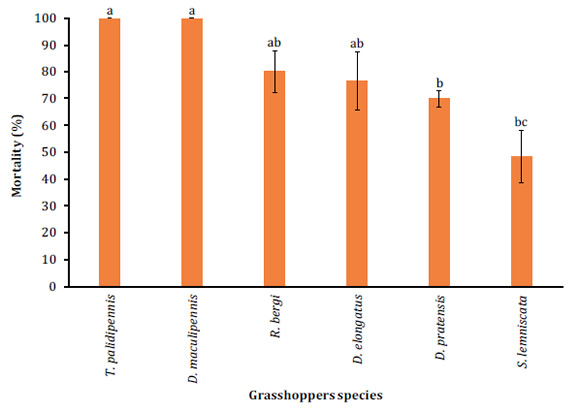
third-instar nymphs (DF= 5; F= 9.93; P<0.0001). The highest mortality (100%)
was registered in third-stage nymphs of T. pallidipennis and D.
maculipennis (Figure 1).
Different letters denote significant differences between
treatments according to the Tukey test (P<0.05).
Letras
distintas indican diferencias significativas entre tratamientos de acuerdo con
el test de Tukey (P<0,05).
Figure 1: Mean mortality (percent + SD) on third-instar nymphs of
different grasshopper species with 1x10⁸ conidia/ml
of B. bassiana (LPSc 1067) strain.
Figura 1: Porcentaje de mortalidad + DS
sobre ninfas de tercer estadio, de las diferentes especies de tucuras plagas
cuando sobre ellas fue aplicada una concentración de 1x10⁸
conidios/ml de la cepa (LPSc 1067) de B. bassiana.
The lowest mortality (50 + 3.5%) was observed in nymphs
of S. lemniscata (Figure 1). Further mortalities ranged
between 70 + 8.3% on D.
pratensis and 80 + 5.7%
on R. bergi (Figure 1).
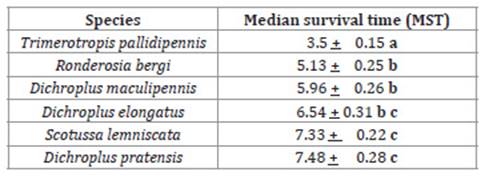
Controls recorded no mortality. Besides, significant differences in MST were
observed according to the log-rank test (P<0.0001). The lowest MST was
observed on T. pallidipennis nymphs at 3.5 +
0.15 days while the highest MST was observed on D. pratensis nymphs
with 7.48 + 0.28 days MST (Table 1).
Table 1: Median survival time (MST) expressed in days, on third-instar
nymphs for each evaluated grasshoppers species.
Tabla 1: Tiempo medio de supervivencia (MST) expresado en días, sobre
ninfas de tercer estadio de cada una de las especies de tucuras evaluadas.
Different letters indicate significant differences according to
the Long-rank Test (P<0.0001).
Letras
diferentes indican diferencias significativas según Long-rank Test
(P<0,0001).
Discussion
Entomopathogenic fungi
comprise important pathogens of insect pests. Some advantages to consider in
control programs consist of their high specificity, contact transmission,
natural dispersion, safety for non-target organisms and the ability to maintain
lasting control once established in the environment (24). The present study determined pathogenicity of B. bassiana (LPSc
1067) strain on six harmful grasshopper species in Argentina. T.
pallidipennis and D. maculipennis resulted the most susceptible,
exhibiting 100% mortality, while the least affected grasshopper species was S.
lemniscata, with 50% mortality. These results agree with those obtained by Pelizza et al. (2012a), who evaluated the
association between enzymatic activity and fungal virulence in 59
entomopathogenic fungal isolates native to Argentina. Isolate LPSc 1067 caused
the highest mortality on Tropidacris collaris nymphs (97.7 ± 1.22%),
nine isolates caused no mortality, while the remaining 49 caused mortalities
ranging between 6.6 ± 0.3% (LPSc 770) to 91.06 ± 1.51% (LPSc 906). Furthermore,
another study showed laboratory effectiveness of 26 fungal strains (isolated
from insects and soil in Argentina) against Schistocerca cancellata (Serville)
(Orthoptera: Acrididae) (18). These authors also
studied the association between chitinase, protease, and lipase levels in these
fungi and their insecticidal activities. They observed that B. bassiana (isolate
LPSc 1067) caused the highest mortality (90 ± 1.03 %) while exhibiting the
highest values of chitinolytic, proteolytic and lipolytic activity (6.13 +0.05; 2.56 +
0.11, and 2.33 + 0.47,
respectively) and the lowest median survival time (MST) (5.96 days).
The study by Schaefer et al. (1936) demonstrated that, in the
laboratory, B. bassiana infects grasshoppers and all locust nymphs and
adults sprayed with conidia. Mortalities caused by the fungi were registered
within 5-20 days. Regarding the MST, our results agree with those obtained by Roberts and Hajek (1992), who observed MST values between
4.1 and 7.9 days when applying B. bassiana conidia on Melanoplus
sanguinipes (Fabricius) adults. Also, results agree with those reported by Prior et al. (1995) who during various experiments
concerning inoculation protocols, observed 95% mortality within 4-5 days using
conidial suspension with 1 x 10⁷ and 1 x 10⁸ conidia/ml concentrations. On
the other hand, Uvarovistia zebra (Uvarov) (Orthoptera: Tettigoniidae)
treated with 5 × 10⁶ conidia/ ml of B. bassiana showed
a cumulative mortality of 57.7% (15), while other authors
evaluated the effect of B. bassiana (LPSc 1067) on nymphal developmental
time, fecundity, and survival of D. maculipennis and R. bergi under
laboratory conditions (19), and observed altered
adult survival after infection, with a fungal concentration of 1x10³
conidia/ml. Mortality of D. maculipennis during third
through sixth-instar (last) was significantly higher among treated nymphs (66 + 3.8%) than in controls (15 + 1.7%). Similarly, mortality
in R. bergi during third through fifth instar (last) was higher in
treated nymphs (71 + 2.8%)
than in controls (19 + 1.5%).
Conclusions
The fungal isolate LPSc
1067of B. bassiana, could act as a biological controller of grasshopper
pests T. pallidipennis and D. maculipennis in Argentina.
Nevertheless, a greater number of laboratory and, fundamentally, field studies
should confirm future investigations.
Acknowledgements
This study was partially
supported by Agencia Nacional de Promoción Científica y Tecnológica PICT Start
Up 2020-0008.Consejo Nacional de Investigaciones Científicas y Tecnológicas
(PIP 0018/ 0348) and Universidad Nacional de La Plata (UNLP, 11/N 903).
1.
Carbonell, C. S.; Cigliano, M. M.; Lange, C. E. 2006. Acridomorph (Orthoptera)
species of Argentina and Uruguay. Publication on Orthopteran diversity. The
“Orthopterists Society” and the Museo de la Plata, Argentina. La Plata.
2.
Cigliano, M. M.; Pocco, M. E.; Lange, C. E. 2014. Acridoideos (Orthoptera) de
importancia agroeconómica. In: Roig-Juñent, S.; Claps, L. E.; Morrone, J. J.
(Eds.). Biodiversidad de Artrópodos Argentinos. INSUE-UNT. 3: 11-36.
3.
Di Rienzo, J. A.; Casanoves, F.; Balzarini, M. G.; González, L.; Tablada, M.;
Robledo, Y. C. InfoStat Version 2011. Grupo InfoStat, FCA; Universidad Nacional
de Córdoba. p. 195-199. http://www.infostat.com.ar (accessed on 13
November 2021).
4.
Goettel, M. S.; Johnson, D. L.; Inglis, G. D. 1995. The role of fungi in the
control of grasshoppers. Canadian Journal of Botany. 73: 71-75.
5.
Gonzalez, M. K. S.; Miglioranza, J. E.; Aizpún, F. L; Peña, A. 2010. Assessing
pesticide leaching and desorption in soils with different agricultural
activities from Argentina (Pampa and Patagonia). Chemosphere. 81: 351-358.
6.
Henry, J. E. 1985. Melanoplus spp. In: Singh, P.; Moore, R. F. (Eds.). Handbook
of Insect Rearing. Amsterdam, Elsevier. 451-464.
7. Hernández-Eleria, G. del C.; Hernández-Garcia, V.;
Rios-Velasco, C.; Ruiz-Cisneros, M. F.; Rodriguez-Larramendi, L. A.;
Orantes-Garcia, C.; Espinoza-Medinilla, E. E.; Salas-Marina, M. Á. 2021. Salmea
scandens (Asteraceae) extracts inhibit Fusarium oxysporum and
Alternaria solani in tomato (Solanum lycopersicum L.). Revista de la
Facultad de Ciencias Agrarias. Universidad Nacional de Cuyo. Mendoza.
Argentina. 53(1): 262-273.
8.
Jaronski, S. T.; Goettel, S. M. 1997. Development of Beauveria bassiana for
control of grasshoppers and locusts. Memoirs of the Entomological Society of
Canada. 7: 225 231.
9.
Jaronski, S. T. 2010. Ecological factors in the inundative use of fungal
entomopathogens. BioControl. 55: 159-185.
10.
Lacey, L. A.; Brooks, W. M. 1997. Initial handling and diagnosis of diseased
insects. In: Lacey, L. A. (Ed.). Manual of techniques in Insect Pathology. USA.
Academic Press. 1-15.
11.
Lane, B. S.; Humphreys, B. S. A. M.; Thompson, K.; Trinci, A. P. J. 1988. ATP
content of stored spores of Paecilomyces farinosus and the use of ATP as
criterion of spore viability. Transactions of the British Mycological Society.
90: 109-111.
12.
Lange, C. E.; Cigliano, M. M.; De Wysiecki, M. L. 2005. Los acridoideos
(Orthoptera: Acridoidea) de importancia económica en la Argentina. In:
Barrientos-Lozano, L.; Almaguer-Sierra, P. (Eds.) Manejo integrado de la
langosta centroamericana (Schistocerca piceifrons piceifrons, Walker) y
acridoideos plaga en América Latina. México. Instituto Tecnológico de Ciudad
Victoria. 93-135.
13.
Mariottini, Y.; De Wysiecki, M. L.; Lange, C. E. 2011. Postembryonic
development and consumption of the melanoplines Dichroplus elongatus Giglio-Tos
and Dichroplus maculipennis (Blanchard) (Orhtoptera: Acrididae:
Melanoplinae) under laboratory conditions. Neotropical Entomology. 40: 190-196.
14.
Mariottini, Y.; De Wysiecki, M. L.; Lange C. E. 2013. Diversidad y distribución
de acridios (Orthoptera: Acridoidea) en pastizales del sur de la región
Pampeana, Argentina. Revista de Biología Tropical. 61: 111-124.
15.
Mohammadbeigi, A.; Port, G. 2015. Effect of infection by Beauveria bassiana and
Metarhizium anisopliae on the Feeding of Uvarovistia zebra.
Journal of Insect Science. 15(1): 88. DOI: 10.1093/jisesa/iev033.
16.
Pelizza, S. A.; Cabello, M. N.; Lange, C. E. 2010. Nuevos registros de hongos
entomopatógenos en acridios (Orthoptera: Acridoidea) de la República Argentina.
Revista de la Sociedad Entomológica Argentina. 69(3-4): 287-291.
17.
Pelizza, S. A.; Eliades, L. A.; Saparrat, M. N. C.; Cabello, M. N.; Scorsetti,
A. C.; Lange, C. E. 2012a. Screening of Argentine native fungal strains for
biocontrol of the grasshopper Tropidacris collaris: relationship between
fungal pathogenicity and chitinolytic enzyme activity. World Journal of
Microbiology and Biotechnology. 28: 1359-1366.
18.
Pelizza, S. A.; Eliades, L. A.; Scorsetti, A. C.; Cabello, M. N.; Lange, C. E.
2012b. Entomopathogenic fungi from Argentina for the control of Schistocerca
cancellata (Orthoptera: Acrididae) nymphs: fungal pathogenicity and enzyme
activity. Bicontrol Science and Technology. 22(10): 1119-1129.
19.
Pelizza, S. A.; Mariottini, Y.; Russo, M. L.; Cabello, M. N.; Lange, C. E.
2013. Survival and fecundity of Dichroplus maculipennis and Ronderosia
bergi (Orthoptera: Acrididae: Melanoplinae) following infection by Beauveria
bassiana (Ascomycota: Hypocreales) under laboratory conditions. Bicontrol
Science and Technology. 23(6): 701-710.
20.
Prior, C.; Carey, M.; Abraham, Y. J.; Moore, D.; Bateman, R. P. 1995.
Development of a bioassay method for the selection of entomopathogenic fungi
virulent to the desert locust, Schistocerca gregaria (Forskal). Journal
of Applied Entomology. 119: 567-573.
21.
Roberts, D. W.; Hajek, A. E. 1992. Entomopathogenic fungi as bioinsecticides.
In: Leatham, G. F. (Ed.) Frontiers in industrial mycology. USA. New York
Chapman and Hall. 144-159.
22.
Schaefer, E. E. 1936. The white fungus disease (Beauveria bassiana’)
among red locusts in South Africa, and some observations on the grey fungus
disease (Eizpasa grylli). Scientific Bulletin of the Department of
Agriculture & Forest. 160: 28.
23.
Sivasankaran, P.; Eswaramoorthy, S.; David, H. 1998. Influence of temperature
and relative humidity on the growth, sporulation and pathogenecity of Beauveria
bassiana. Biological Control. 12: 71-75.
24.
Vega, F. E.; Meyling, N. V.; Luangsa-ard, J. J.; Blackwell, M. 2012. Fungal
Entomopathogens. In: Vega, F.; Kaya, H. K. (Eds.). Insect Pathology. USA. San
Diego Academic Press. 171-220.
25.
Xlstat life software. 2013. Addinsoft SARL. France. http://www.xlstat.com