Farmers’ Fertilizer Use Behaviour: Evidence from Western Part of Türkiye
DOI:
https://doi.org/10.48162/rev.39.194Keywords:
cluster, farmer decisions, factor analysis, fertilizer , input choicesAbstract
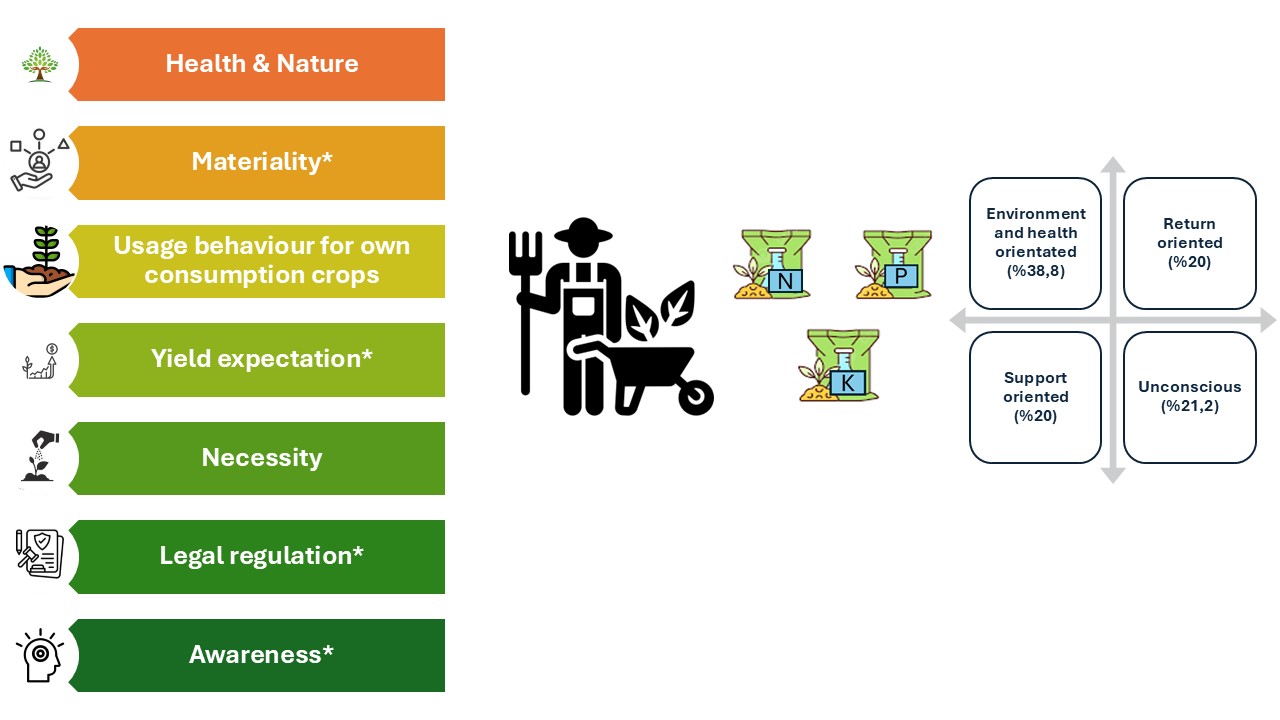
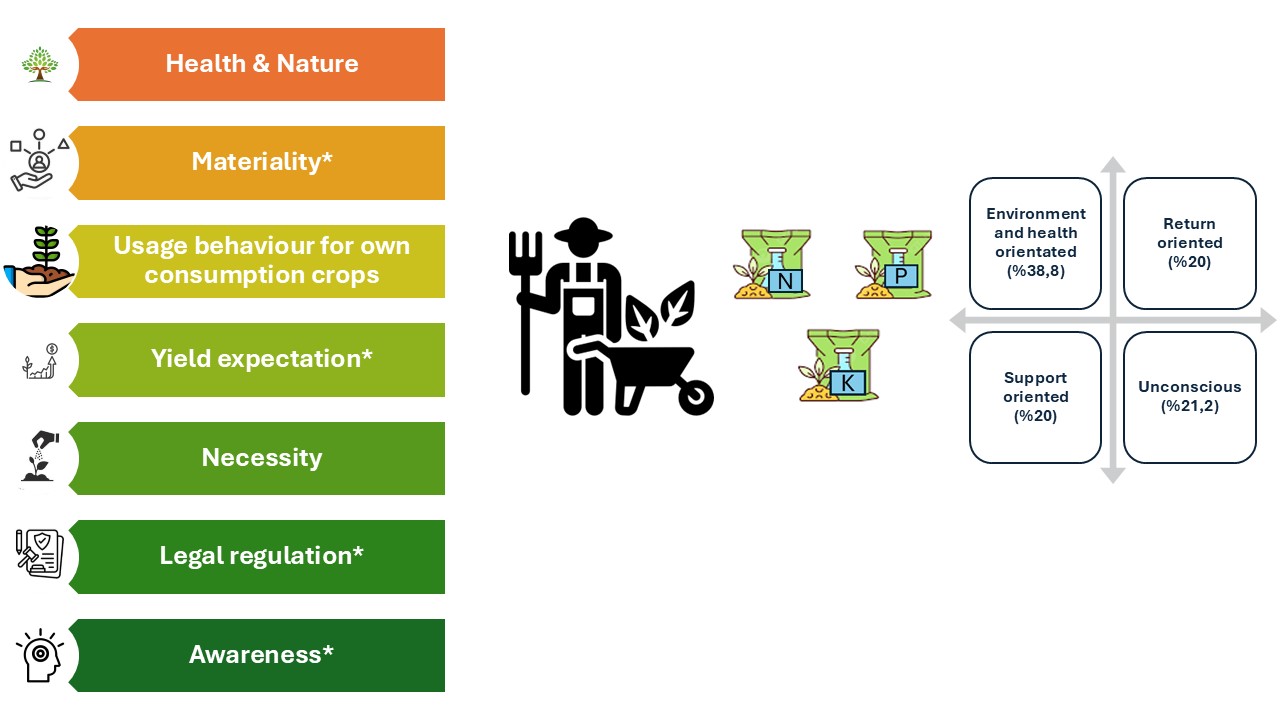
Fertilizer use has been important for decades. Recent records show significant increases in their usage. Excessive and unconscious applications threaten human and environmental health and cause economic losses. This study aims to identify farmers’ fertilizer use behaviour in Izmir province. In 2016, survey data were collected using a structured questionnaire concerning farmers’ views and attitudes regarding fertilizer use. Seven factors were identified, explaining 80.34% of total variability, determining farmers’ behaviour in the study area by cluster analysis. Farmers in the region were classified into four groups. The largest group, “environment and health-oriented”, comprised 38.8% of the farmers. We concluded that farmers consider environmental sensitivity regarding fertilizer applications; however, environmental awareness should be further developed.
Highlights:
- Seven key factors explaining 80.3 % of the variability in farmers’ fertilizer use behaviour were identified through factor analysis.
- Cluster analysis classified farmers into four groups: unconscious, support-oriented, environment & health-oriented, and return-oriented.
- The largest group (38.8 %) showed strong environmental and health awareness regarding fertilizer use.
- Economic incentives and expectations of crop price or fertilizer price changes significantly influenced fertilizer use decisions.
- Results highlight the need for extension services and policy measures to raise environmental awareness and promote sustainable fertilizer management.
Downloads
References
Aydin, B.; Ozkan, E.; Kayali, E.; Atav, V.; Gurbuz, M. A.; Kursun, I.; Kayhan, I. E. 2022. Comparative analysis of the opinions of the producers regarding fertilization practices and subsidies in Edirne and Tekirdağ Provinces. Journal of Agriculture Engineering. 374: 43-55.
Bynen, E. J. 1973. Cluster Analysis: Survey and Evaluation of Techniques. Tilburg University Press. 112p.
Cuhadar, M.; Atis, E. 2021. The analysis underlying factors affecting farmers’ attitudes towards drought. Turkish Journal of Agriculture and Natural Sciences. 8(1): 1-7.
Eraslan, F.; Nal, A.; Gunes, A.; Erdal, I.; Coskan, A. 2010. Chemical fertilizer production and consumption status, problems, solution suggestions and innovations in Türkiye, Proceedings of Turkish Chamber of Agricultural Engineers; Agricultural Engineering VII. Technical Congress. Ankara. 955-972.
Etumnu, C.; Gray, A. W. 2020. A clustering approach to understanding farmers’ success strategies. Journal of Agricultural and Applied Economics. 52(3): 335-351.
Gozener, B.; Sayili, M.; Yurdabakan, M. 2016. Fertilizer use condition in important products: Tokat city Kazova district example. Journal of Agricultural Faculty of Gaziosmanpasa University. 33(2): 41-47.
Hyland, J. J.; Jones, D. L.; Parkhill, K. A.; Barnes, A. P.; Williams, A. P. 2016. Farmers’ perceptions of climate change: identifying types. Agriculture and Human Values. 33(2): 323-339.
Kadioglu, B. 2021. Investigation of possible links between soil pollution and chemical fertilizer use. Journal of Mus Alparslan University Agricultural Production and Technologies. 1(2): 26-38.
Kilic, O.; Eryilmaz, G. A.; Cakır, S. 2021. Environmental sensitivity of fruit producers toward chemical fertilizer and pesticide use in Zonguldak Province. Anadolu J Agr Sci. 36(1): 113-121.
Kiziloglu, R.; Kizilaslan, N. 2017. Fertilizer use the condition of cultivator province center in Kahramanmaras, Turkish Journal of Agriculture-Food Science and Technology. 5(1): 18-23.
Newbold, P. 1995. Statistics for business and economics. Prentice-Hall International, Upper Saddle River.
Nguyen, L. L. H.; Khuu, D. T.; Halibas, A.; Nguyen, T. Q. 2024. Factors that influence the intention of smallholder rice farmers to adopt cleaner production practices: An empirical study of precision agriculture adoption. Evaluation Review. 48(4): 692-735.
Ozalp, B.; Guldal, H. T. 2017. Sensitiveness of maize producers on to environmental and human health in terms of hybrid seed, chemical fertilizer and pesticide: case of Adana. Turkish Journal of Agricultural Economics. 23(1): 13-24.
Ozturk, M.; Altay, V.; Gonenç, T. M.; Unal, B. T.; Efe, R.; Akcicek, E.; Bukhari, A. 2021. An overview of olive cultivation in Turkey: botanical features, eco-physiology and phytochemical aspects. Agronomy. 11(2): 295.
Sipahi, C.; Kizilaslan, H. 2003. The study of acquire and apply chemical fertilizer on Artova area of Tokat province. Journal of Agricultural Faculty of Gaziosmanpasa University (JAFAG). 20(1): 17-25.
Turkes, M.; Sahin, S. 2024. Will olive groves have a future under climate change conditions in the North Aegean sub-region, a Mediterranean agricultural environment of Turkey? Turkish Journal of Agriculture-Food Science and Technology. 13(1): 43-58.
Wagan, S. A.; Memon, Q. U. A.; Chunyu, D.; Jingdong, L.; 2018. A comparative study on agricultural production efficiency between China and Pakistan using data envelopment analysis (DEA). Custos e Agronegocio on Line. 14: 169-190.
Wawire, A. W.; Csorba, Á.; Tóth, J. A.; Michéli, E.; Szalai, M.; Mutuma, E.; Kovács, E. 2021. Soil fertility management among smallholder farmers in Mount Kenya East region. Heliyon. 7(3).
Welte, E. 1973. Profitability and optimal use of mineral fertilizer in forms of different cropping potential. Pontificiae Academial Screntiarum Scripta Varia. 38: 403-426.
Yilmaz, H.; Demircan, V.; Gul, M. 2009. Determination of information sources of producers on chemical fertilizer use and evaluation in terms of agricultural extension. Journal of Suleyman Demirel University Faculty of Agriculture. 4(1): 31-44.
Published
How to Cite
Issue
Section
License

This work is licensed under a Creative Commons Attribution-NonCommercial-ShareAlike 3.0 Unported License.
Authors who publish with this journal accept the Editorial Policies.
 RevFCAUNCuyo






.jpg)