Epiphytic Microorganisms Associated with Banana Phyllosphere with Potential Antagonism to Black Sigatoka (Pseudocercospora fijiensis) in Los Ríos, Ecuador
DOI:
https://doi.org/10.48162/rev.39.198Keywords:
microorganisms, fungi, bacteria, Musa spp.Abstract
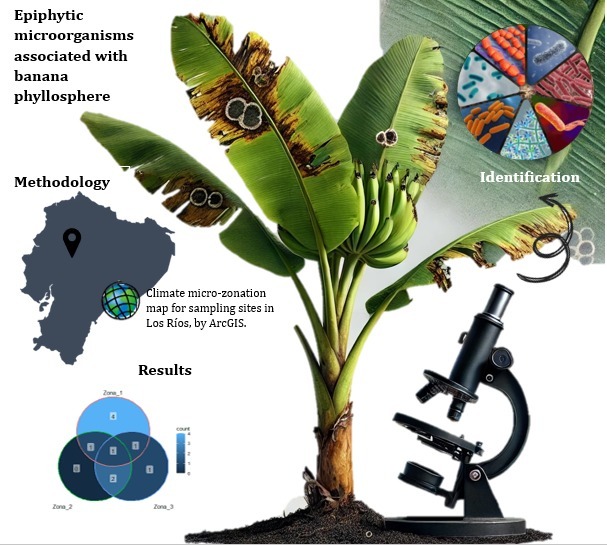
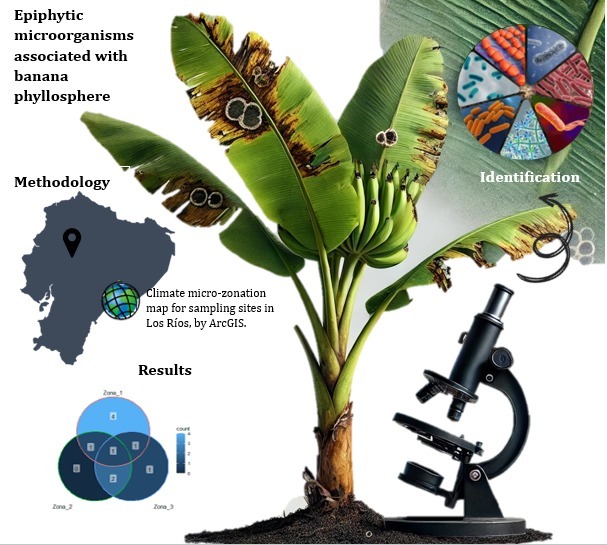
Black Sigatoka (Pseudocercospora fijiensis) is the most important leaf spot disease of bananas worldwide, particularly affecting Cavendish banana, the most exported variety. Additionally, this pathogen has developed resistance to some effective fungicides, making its management increasingly difficult. Epiphytic microorganisms with potential antagonism to P. fijiensis were identified in conventional banana farms in the province of Los Ríos. Sampling areas were determined through zoning processes and selecting the cantons of Mocache, Valencia, Baba and Pueblo Viejo. Leaf tissue samples were collected from three farms per zone. Microorganisms were isolated and morphologically and molecularly characterised in nine farms in the cantons of Valencia (63 bacteria), Baba (39 bacteria), Pueblo Viejo (8 bacteria) and 8 genera of fungi including 15 species. The isolated bacteria presented macroscopic and microscopic characteristics with different shapes, elevations, edges, consistencies and pigmentations. Taxonomically, they belonged to the genera Bacillus and Cocos, 81% Gram-negative and 19% Gram-positive. The analysis conducted for sampling-site selection allowed the identification of different microbial behaviours.
Highlights:
- Biological control offers a viable strategy to reduce reliance on agrochemicals in agricultural practices.
- The isolation and characterization of microorganisms are essential for researching and developing biological solutions applicable to banana cultivation.
- The data obtained provide crucial insights for formulating and developing bioinoculants.
Downloads
References
Agudelo, M. B.; Calderón, M.; Betancourt, O.; Gallejo, Á. S. 2007. Hongos Macromycetes en dos rellictos de bosque húmedo tropical montano bajo de la vereda La Cuchilla. Marmato, Caldas. Museo de História Natural. 11: 19-31.
Alfaro, F. 2013. Aislamiento y cuantificación de bacterias epífitas del filoplano de banano (Musa AAA cv. Grande Naine) y selección de cepas quitinolíticas y glucanolíticas como potenciales antagonistas de Mycosphaerella fijiensis, agente causal de la Sigatoka negra.
Ayala, D.; Acevedo, C.; Enrique, B.; Aguilar, F.; Orlandoni, G. 2018. Seguimiento de la actividad PGPR de microorganismos inoculados en plantas de Sacha inchi (Plukenetia volubilis) bajo condiciones de vivero. Archivo digital de prácticas, Microbiología Industrial. Universidad de Santander UDES. 1-14. https://doi.org/10.13140/RG.2.2.25676.36489
Barrera, S.; Sarango, S.; Montenegro, S. 2019. The phyllosphere microbiome and its potential application in horticultural crops. A review. Revista Colombiana de Ciencias Hortícolas. https://revistas.uptc.edu.co/index.php/ciencias_horticolas/article/view/8405
Benavides-López, L. 2019. Cuantificación temprana de Pseudocercospora fijiensis por medio de qPCR en modelos predictivos de Sigatoka negra en plantas de banano (Musa AAA). 9-162.
Bensch, K.; Braun, U.; Groenewald, J. Z.; Crous, P. W. 2012. The genus Cladosporium. Studies in Mycology. 72(1): 1. https://doi.org/10.3114/SIM0003
Brown, K.; Hyde, K.; Guest, D. 1998. Preliminary studies on endophytic fungal communities of Musa acuminata species complex in Hong Kong and Australia. https://www. fungaldiversity.org/fdp/sfdp/FD_1_27-51.pdf
Carrión Abad, B. A. C. 2015. Análisis microbiológico del complejo orgánico activfol para determinar la efectividad en el control del hongo (Mycosphaerella fijiensis) causante de la Sigatoka negra en el banano.
Carrion Ramon, J. J. C. 2020. Monitoreo y control especial de la Sigatoka negra (Mycosphaerella Fijiensis M), en el cultivo de banano. UTMACH. Unidad Académica de Ciencias Agropecuarias. Machala. Ecuador. http://repositorio.utmachala.edu.ec/handle/48000/16135
Casas, J.; López, M.; Salinas, M.; Gisbert, J.; Giménez, E.; García, F.; Sánchez, S.; Lacalle, A.; Cortés, A.; Moyano, F. 2017. Guía para la realización de un estudio ambiental: El caso de la cuenca del río Adra (J. Casas, Ed.; Vol. 11). Universidad de Almería. 3qk3vTP
Ceballos, I.; Mosquera, S.; Angulo, M.; Mira, J.; Argel, L.; Uribe-Velez, D.; Romero-Tabarez, M.; Orduz-Peralta, S.; Villegas, V. 2012. Cultivable bacteria populations associated with leaves of banana and plantain plants and their antagonistic activity against Mycosphaerella fijiensis. Microbial Ecology. 64(3): 641-653. https://doi.org/10.1007/s00248-012-0052-8
Cruz-Martín, M.; Acosta-Suárez, M.; Roque, B.; Pichardo, T.; Castro, R. 2016. Diversidad de cepas bacterianas de la filosfera de Musa spp. con actividad antifúngica frente a Mycosphaerella fijiensis Morelet. Biotecnología Vegetal. 16(1): 53-60.
Cruz-Martín, M.; Alvarado, Y.; Mena, E.; Acosta, M.; Roque, B.; Pichardo, T. 2018. Cepas bacterianas con potencial para el manejo de la Sigatoka negra. Anales de la Academia de Ciencias de Cuba. 8(1). http://www.revistaccuba.sld.cu/index.php/revacc/article/view/374/373
Dissanayake, L. S.; Wijayawardene, N. N.; Dayarathne, M. C.; Samarakoon, M. C.; Dai, D. Q.; Hyde, K. D.; Kang, J. C. 2021. Paraeutypella guizhouensis gen. et sp. nov. and Diatrypella longiasca sp. nov. (Diatrypaceae) from China. Biodiversity Data Journal 9: e63864. https:// doi.org/10.3897/BDJ.9.E63864
Doyle, J. J.; Doyle, J. L. 1987. A rapid DNA isolation procedure for samal quantities of fresh leaf tissue. Phytochemical Bulletin. 19: 11-15.
Ecuador, M. de C. E. del. 2017. Informe Sector Bananero Ecuatoriano. Ministerio de Comercio Exterior. 53(9): 1689-1699. https://doi.org/10.1017/CBO9781107415324.004
Etebu, E.; Young-Harry, W. 2011. Control of black Sigatoka disease: Challenges and prospects. African Journal of Agricultural Research. 6(3): 508-514. https://doi.org/10.5897/ AJAR10.223
Faleiro, F. G.; Santos, I. S.; Bahía, R.; Santos, R. F.; Anhert, D. 2002. Otimização da extração e amplificação de DNA de Theobroma cacao L. visando obtenção de marcadores RAPD. 31-34.
Fravel, D.; Olivain, C.; Alabouvette, C. 2003. Fusarium oxysporum and its biocontrol. New Phytologist. 157(3): 493-502. https://doi.org/10.1046/J.1469-8137.2003.00700.X
García, F.; Pachacama, S.; Jarrín, D.; Iza, M. 2020. Guía andina para el diagnóstico de Fusarium Raza 4 Tropical (R4T) Fusarium oxysporum f.sp. Cubense (syn. Fusarium odoratissimum) agente causal de la marchitez por Fusarium en musáceas (plátanos y bananos). www. comunidadandina.org
Gauhl, F. 1994. Epidemiology and ecology of Black Sigatoka on plantain and banana (Musa spp.) in Costa Rica, Centro América. Ph.D. Thesis of the Systematisch Geobotanische-Institut der Georg-August-Universität Göttingen and Institut für Pflanzenpathologie und Pflanzenchutz der Georg-August-Universität Göttingen. INIBAP.
Guzmán, M. 2012. Control biológico y cultural de la sigatoka-negra. Tropical Plant Pathology. 37 (Suplemento). Agosto. https://doi.org/10.13140/2.1.2927.7442
Hao, Y.; Aluthmuhandiram, J. V. S.; Chethana, K. W. T.; Manawasinghe, I. S.; Li, X.; Liu, M.; Hyde, K. D.; Phillips, A. J. L.; Zhang, W. 2020. Nigrospora species associated with various hosts from Shandong Peninsula, China. Mycobiology. 48(3): 169-183. https://doi.org/10.1080/1229 8093.2020.1761747
Hernández-Montiel, L. G.; Larralde-Corona, C. P.; Vero, S.; López-Aburto, M. G.; Ochoa, J. L.; Ascencio-Valle, F. 2010. Caracterización de levaduras Debaryomyces hansenii para el control biológico de la podredumbre azul del limón mexicano. CYTA-Journal of Food. 8(1): 49-56. https://doi.org/10.1080/19476330903080592
Horra, M. L. P. 2014. Evaluación in vitro de la capacidad de extractos orgánicos de biodiversidad ecuatoriana para inhibir al patógeno Mycosphaerella fijiensis (Morelet) causante de la Sigatoka Negra en banano. http://repositorio.puce.edu.ec/bitstream/handle/22000/10936/4.42.000892.pdf?sequence=4
Intriago Mendoza, L. 2010. Identificación y evolución en laboratorio e invernadero de microorganismos antagonistas de Sigatoka negra (Mycosphaerella fijiensis Morelet) en musáceas en el Litoral Ecuatoriano. Tesis de Grado. Universidad Técnica de Manabí. Ecuador. 95 p.
Israeli, Y.; Lahav, E. 2016. Banana. In Encyclopedia of Applied Plant Sciences. Elsevier. 3: 363-381. https://doi.org/10.1016/B978-0-12-394807-6.00072-1
Izzeddin, A. N.; Medina, T. L. 2011. Efecto del control biológico por antagonistas sobre fitopatógenos en vegetales de consumo humano. Salus. 15(3): 8-18.
Lima, N. B.; Marcus, M. V.; Morais, M. A. D.; Barbosa, M. A. G.; Michereff, S. J.; Hyde, K. D.; Câmara, M. P. S. 2013. Five Colletotrichum species are responsible for mango anthracnose in northeastern Brazil. Fungal Diversity. 61(1): 75-88. https://doi.org/10.1007/s13225- 013-0237-6
López, S. 2019. Bacillus un género que alberga especies que cumplen diversos roles biológicos. Infive-Conicet UNLP. 1-26.
Martínez, G.; Pargas, R.; Manzanilla, E. 2012. Orden Zingiberales: Las musáceas y su relación con plantas afines. Scielo. http://ve.scielo.org/scielo.php?script=sci_arttext&pid=S0002- 192X2012000100014
Morillo, E.; Miño, G. 2011. Marcadores moleculares en biotecnología agrícola: manual de técnicas y procedimientos en INIAP. https://repositorio.iniap.gob.ec/bitstream/41000/848/4/ iniapscm91.pdf
Moubasher, A. H.; Moharram, A. M.; Ismail, M. A.; Abdel-Hafeez, M. H. 2016. Aeromycobiota over banana plantations in Assiut Governorate and enzymatic producing potential of the most common species. Journal of Basic & Applied Mycology (Egypt). 7: 9-18.
Muimba-Kankolongo, A. 2018. Fruit Production. In Food crop production by smallholder farmers in Southern Africa (p. 275-312). Elsevier. https://doi.org/10.1016/B978-0-12-814383- 4.00012-8
Nam, M. H.; Park, M. S.; Kim, H. S.; Kim, T. I.; Kim, H. G. 2015. Cladosporium cladosporioides and C. tenuissimum cause blossom blight in strawberry in Korea. Mycobiology. 43(3): 354. https://doi.org/10.5941/MYCO.2015.43.3.354
Novák, P.; Hřibová, E.; Neumann, P.; Koblížková, A.; Doležel, J.; Macas, J. 2014. Genome-wide analysis of repeat diversity across the family musaceae. PLoS ONE. 9(6). https://doi.org/10.1371/journal.pone.0098918
Nuangmek, W.; McKenzie, E. H. C.; Lumyong, S. 2008. Endophytic fungi from wild banana (Musa acuminata Colla) works against anthracnose disease caused by Colletotrichum musae. Research Journal of Microbiology. 3(5): 368-374. https://doi. org/10.3923/JM.2008.368.374
Photita, W.; Lumyong, S.; Lumyong, P.; Mckenzie, E. H. C.; Hyde, K. D.; Photita, W.; Lumyong, S.; Lumyong, P.; Hyde, M. E. H. C. 2004. Fungal diversity are some endophytes of Musa acuminata latent pathogens? Fungal Diversity. 16: 131-140.
Pinheiro da Costa, S.; Schuenck-Rodrigues, R.; da Silva Cardoso, V.; Valverde, S.; Vermelho, A.; Ricci-Júnior, E. 2021. Actividad antimicrobiana de hongos endofíticos aislados de Brugmansia suaveolens Bercht.; Presl, J. Research, Society and Development. 10(14): e113101421646. https://doi. org/10.33448/rsd-v10i14.21646
Pitt, W. M.; Trouillas, F. P.; Gubler, W. D.; Savocchia, S.; Sosnowski, M. R. 2013. Pathogenicity of Diatrypaceous Fungi on grapevines in Australia. Plant disease. 97(6): 749-756. https:// doi.org/10.1094/PDIS-10-12-0954-RE
Poveda, I.; Cruz-Martín, M.; Sánchez-García, C.; Acosta-Suárez, M.; Leiva-Mora, M.; Roque, B.; Alvarado-Capó, Y. 2010. Caracterización de cepas bacterianas aisladas de la filosfera de Musa spp. con actividad antifúngica in vitro frente a Mycosphaerella fijiensis. Biotecnología Vegetal. 10(1): 57-61.
Ramírez, M.; Rodriguez, T.; Peniche, C.; Alfonso, L. 2010. Chitin and its derivatives as biopolymers with potential agricultural applications. Biotecnología Aplicada. 27: 270-276.
Riera, N. J. 2015. Caracterización molecular y de patogenicidad de Colletotrichum spp, en bananas var Cavendish y pruebas de antagonismo con Trichoderma spp., recolectadas en fincas bananeras de la región costa del Ecuador. Universidad San Francisco de Quito. 98.
Ruiz-Boyer, A.; Rodríguez-González, A. 2020. Preliminary list of fungi (Ascomycota and basidiomycota) and myxomycetes (myxomycota) of Isla del Coco, Puntarenas, Costa Rica. Revista de Biología Tropical. 68(S1): S33-S56. https://doi.org/10.15517/RBT. V68IS1.41165
SIPA. 2021. Ficha del cultivo de banano (Musa paradisiaca AAA). https://sipa.agricultura.gob.ec/ index.php/bananos
Šišić, A.; Baćanović-Šišić, J.; Al-Hatmi, A. M. S.; Karlovsky, P.; Ahmed, S. A.; Maier, W.; Hoog, G. S. D.; Finckh, M. R. 2018. The ‘forma specialis’ issue in Fusarium: A case study in Fusarium solani f. Sp. Pisi. Scientific Reports 2018 8:1, 8(1), 1-17. https://doi.org/10.1038/s41598-018- 19779-z
Sun, X.; Guo, L. D. 2012. Endophytic fungal diversity: Review of traditional and molecular techniques. Mycology. 3(1): 65-76. https://doi.org/10.1080/21501203.2012.656724
Suwannarach, N.; Kumla, J.; Bussaban, B.; Nuangmek, W.; Matsui, K.; Lumyong, S. 2013. Biofumigation with the endophytic fungus Nodulisporium spp. CMU-UPE34 to control postharvest decay of citrus fruit. Crop Protection. 45: 63-70. https://doi.org/10.1016/J. CROPRO.2012.11.015
Toju, H.; Tanabe, A. S.; Yamamoto, S.; Sato, H. 2012. High-Coverage ITS Primers for the DNA-Based Identification of Ascomycetes and Basidiomycetes in Environmental Samples. PLoS ONE. 7(7): 40863. https://doi.org/10.1371/JOURNAL.PONE.0040863
Trouillas, F. P.; Úrbez-Torres, J. R.; Gubler, W. D. 2017. Diversity of diatrypaceous fungi associated with grapevine canker diseases in California. 102(2): 319-336. https://doi.org/10.3852/08-185
Vázquez, J.; González, J.; Castillo, J.; Álvarez, M. 2019. Microorganismos benéficos MOBs obtenidos de plantas, como promotores en la germinación de semillas. Dominio de Las Ciencias. 5: 615-628. http://dx.doi.org/10.23857/dc.v5i1.1064 Cie
Velasco, R.; Tapia, R. 2014. Curso práctico de Microbiología. Universidad Autónoma Metropolitana.
Vilgalys, R. 2003. Taxonomic misidentification in public DNA databases. New Phytologist. 160(1): 4-5. https://doi.org/10.1046/J.1469-8137.2003.00894.X
Villamil Carvajal, J. E. V.; Viteri Rosero, S. E. V.; Villegas Orozco, W. L. V. 2015. Aplicación de antagonistas microbianos para el control biológico de Moniliophthora roreri Cif & Par en Theobroma cacao L. bajo condiciones de campo. Revista Facultad Nacional de Agronomía Medellín. 68(1): 7441-7450. https://doi.org/10.15446/rfnam.v68n1.47830
Villegas-Escobar, V.; Ceballos, I.; Mira, J. J.; Argel, L. E.; Peralta, S. O.; Romero-Tabarez, M. 2013. Fengycin C produced by Bacillus subtilis EA-CB0015. Journal of Natural Products. 76(4): 503-509. https://doi.org/10.1021/np300574v
Walker, C.; Muniz, M. F. B.; Rolim, J. M.; Martins, R. R. O.; Rosenthal, V. C.; Maciel, C. G.; Mezzomo, R.; Reiniger, L. R. S. 2016. Morphological and molecular characterization of Cladosporium cladosporioides species complex causing pecan tree leaf spot. Genetics and molecular research: GMR. 15(3). https://doi.org/10.4238/GMR.15038714
Wang, M.; Liu, F.; Crous, P. W.; Cai, L. 2017. Phylogenetic reassessment of Nigrospora: Ubiquitous endophytes, plant and human pathogens. Persoonia: Molecular Phylogeny and Evolution of Fungi. 39(December). 118-142. https://doi.org/10.3767/persoonia.2017.39.06
Zakaria, L.; Aziz, W. N. W. 2018. Molecular Identification of endophytic fungi from banana leaves (Musa spp.). Tropical Life Sciences Research. 29(2): 201. https://doi.org/10.21315/ TLSR2018.29.2.14
Published
How to Cite
Issue
Section
License

This work is licensed under a Creative Commons Attribution-NonCommercial-ShareAlike 3.0 Unported License.
Aquellos autores/as que tengan publicaciones con esta revista, aceptan las Políticas Editoriales.

 RevFCAUNCuyo







.jpg)