Synergistic Action of the Essential Oils of Elionorus muticus and Lippia junelliana Against the Causative Agent of Chalkbrood in Bees (Ascosphaera apis)
DOI:
https://doi.org/10.48162/rev.39.213Palabras clave:
biocontrol , pathogenic fungi , natural products, apicultureResumen
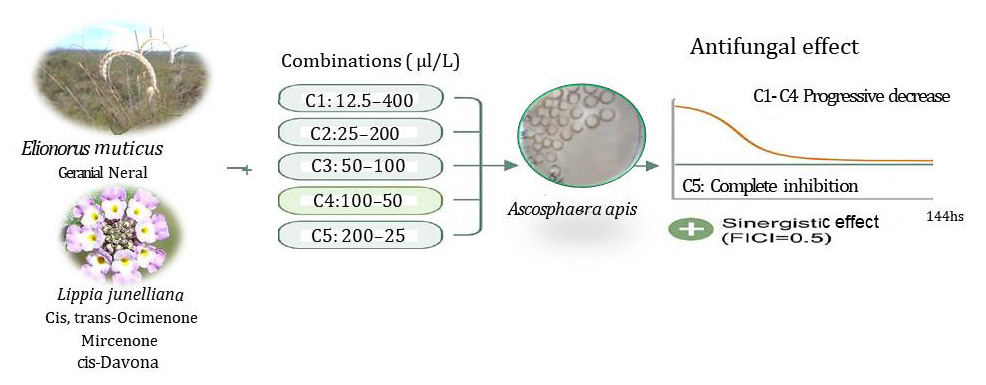
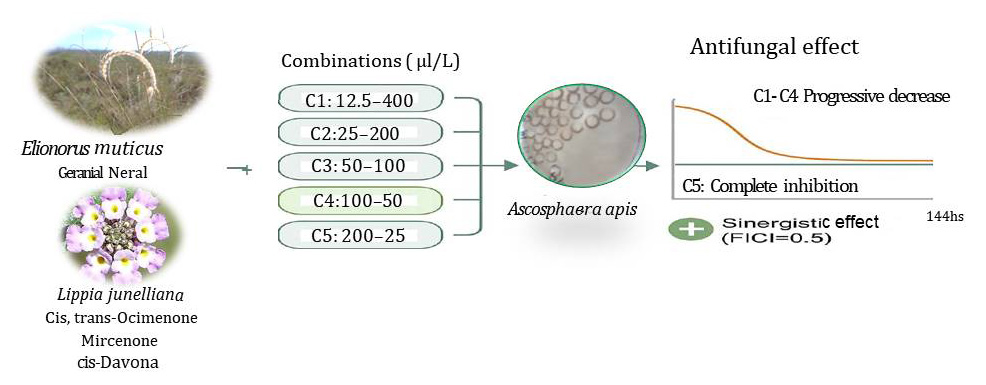
Ascosphaera apis is the fungus that causes chalkbrood in Apis mellifera. Traditionally, its control has relied on synthetic fungicides, which can be harmful to bees and ecosystems. An alternative treatment has explored safer alternatives, such as the antimicrobial properties of plant-based essential oils. This study evaluated the combined effect of the essential oils of Elionorus muticus and Lippia junelliana on 10 isolates of A. apis using a “chessboard” experimental design. Minimum inhibitory concentrations, fungal growth rates and inhibition percentages were determined. Analyses were performed with ANOVA and post-hoc tests. The results showed that the combination of 200 µL/L of E. muticus and 25 µL/L of L. junelliana (C5) completely inhibited fungal growth after 144 h, with MIC50 significantly more effective than controls. The combined use of E. muticus and L. junelliana shows synergistic activity (FICI ≤0.5) in controlling A. apis and achieves full inhibition of the fungus under controlled conditions. These findings suggest that essential oils may be a viable alternative for the sustainable management of bee diseases.
Highlights:
- The fractional inhibitory concentration index (FICI) for combination C5 was 0.5, demonstrating a significant synergistic interaction between both essential oils.
- The combining of junelliana(25 µL/L) and E. muticus (200 µL/L) inhibited A. apis growth.
- Combinations C1 (12.5–400 µL/L), C2 (25–200 µL/L), C3 (50–100 µL/L), and C4 (200–25 µL/L) of the Eos showed a progressive decrease in inhibitory capacity over time, whereas combination C5 maintained a consistent inhibition above 50% throughout the study period, indicating greater temporal stability.
Descargas
Citas
Albo, G. N.; Reynaldi, F. J.; Elder, H.; Juárez, M. A.; Córdoba, S. B. 2014. Control in vitro de Ascosphaera apis con Schinus molle y Lippia junelliana. Efectos tóxicos potenciales en abeja melífera. XI Congreso Latinoamericano de Apicultura FILAPI.
Albo, G. N.; Altamirano, R.; Henning, C.; Della Vedova, R.; Córdoba, S. B. 2015. Inhibición in vitro de Ascosphaera apis con aceites esenciales de gramíneas nativas e introducidas. III Congreso Argentino de Microbiología Agrícola y Ambiental. Ciudad Autónoma de Buenos Aires. Argentina.
Albo, G., Reynaldi, F., Córdoba, S., & Malbrán, C. 2016. Evaluación de la actividad inhibitoria, in vivo e in vitro, del aceite esencial de Cymbopogon citratus y cinco diluyentes sobre cultivos de Ascosphaera apis. Analecta veterinaria. 36: 5-11.
Amassmoud, O.; Abbad, I.; Iriti, M.; Hassani, L.; Mezrioui, N.; Abbad, A. 2023. Antibacterial activity of essential oils combinations based on Thymus broussonnetii, and their synergism with some antibiotics. Current Microbiology. 80(12): 398.
Ansari, M. J.; Al-Ghamdi, A.; Usmani, S.; Khan, K. A.; Alqarni, A. S.; Kaur, M.; Al-Waili, N. 2017. In vitro evaluation of the effects of some plant essential oils on Ascosphaera apis, the causative agent of Chalkbrood disease. Saudi Journal of Biological Sciences. 24(5): 1001-1006. https://doi.org/10.1016/j.sjbs.2016.04.016
Aziz, M. A.; Alam, S. 2024. Diseases of Honeybee (Apis mellifera). In Melittology-New Advances. IntechOpen.
Capetti, F.; Tacchini, M.; Marengo, A.; Cagliero, C.; Bicchi, C.; Rubiolo, P.; Sgorbini, B. 2021. Citral-containing essential oils as potential tyrosinase inhibitors: A bio-guided fractionation approach. Plants. 10(5): 969.
Celaya, L. S.; Le Vraux, M. A.; Heit, C. I.; Viturro, C. I.; Martina, P. F. 2023. Phytochemical and Biological Profile of Essential Oils of Elionurus muticus (Spreng.) Growing in Northeastern Argentina. Chemistry & Biodiversity. 20(6), e202201105. https://doi.org/10.1002/cbdv.202201105
Chagonda, L. S.; Fungirayi, B. 2016. Antifungal activity of the essential oil of Elionurus muticus (Spreng) Kunth from Zimbabwe against Candida albicans, C. krusei and Cryptococcus neoformans. J Multidiscip Eng Sci Technol. 3: 5331-5335.
Chen, C. J.; Li, Q. Q.; Ma, Y. N.; Wang, W.; Cheng, Y. X.; Xu, F. R.; Dong, X. 2019. Antifungal effect of essential oils from five kinds of Rutaceae plants-avoiding pesticide residue and resistance. Chemistry & Biodiversity. 16(4): e1800688.
Clinical and Laboratory Standards Institute (CLSI). 2008. Reference method for broth dilution antifungal susceptibility testing of filamentous fungi. Approved Standard CLSI. Doc. M 38-A2. 2° Ed. Wayne.
Comelli, N. C.; Diez, P. A.; Rodríguez, M. R.; Denett, G. O.; López, T. E.; Bracamonte, D. M.; Ortiz, E. V.; Sampietro, D. A.; Duchowicz, P. R. 2023. Excito-repellent and Pesticide-Likeness Properties of Essential Oils on Carpophilus dimidiatus (Fabricius) (Nitidulidae) and Oryzaephilus mercator (L.) (Silvanidae). Journal of Chemical Information and Modeling. https://doi.org/10.1021/acs.jcim.3c01198
Córdoba, S.; Vivot, W.; Szusz, W.; Albo, G. 2019. Antifungal Activity of Essential Oils Against Candida Species Isolated from Clinical Samples. Mycopathologia. 184(5): 615-623. https://doi. org/10.1007/s11046-019-00364-5
Davis, C.; Ward, W. 2003. Control of chalkbrood disease with natural products: a report for the RIRDC. Publication N° 03/107. Kingston. ACT. AU. p. 1-23.
Dellacasa, A. D.; Bailac, P. N.; Ponzi, M. I.; Ruffinengo, S. R.; Eguaras, M. J. 2003. In vitro activity of essential oils from San Luis-Argentina against Ascosphaera apis. Journal of Essential Oil Research. 15(4): 282-285.
El Youssfi, C.; Dadou, S.; Loukili, E. H.; El Hammoudani, Y.; Soujaa, H.; Rejdali, M.; Zerrouk Mohammed, H.; Mourabit, N.; Aarab, S. 2024. Biological activities of essential oils: A mini-review. BIO Web of Conferences, 109, 01031. EDP Sciences.
Hauschild, R.; Ott, A.; da Silva, M. A. S. 2020. Ação fumigante de óleos essenciais de Baccharis dracunculifolia e Elionurus muticus contra o Ácaro rajado (Tetranychus urticae, Koch 1836) em morangueiro. Cadernos de Agroecologia. 15(2).
Juárez, M. A.; Elechosa, M. A.; Molina, A. M.; Viturro, C. I.; Molina, A. C.; Heit, C. I. 2007. Estudio del aceite esencial de Lippia junelliana (Mold) Tronc. Obtenido de colectas en Tucumán, Argentina. Boletín Latinoamericano y del Caribe de Plantas Medicinales y Aromáticas. 6(5): 254-255.
Krutmuang, P.; Rajula, J.; Pittarate, S.; Chatima, C.; Thungrabeab, M.; Mekchay, S.; Senthil-Nathan, S. 2022. The inhibitory action of plant extracts on the mycelial growth of Ascosphaera apis, the causative agent of chalkbrood disease in Honey bee. Toxicology Reports. 9: 713-719.
Lameck, S.; Chagonda, L.; Fungirayi, B. 2016. Antifungal Activity of the Essential Oil of Elionurus muticus (Spreng) Kunth from Zimbabwe against Candida albicans, C. krusei and Cryptococcus neoformans. Journal of Multidisciplinary Engineering Science and Technology. 3: 2458-9403.
Lazăr, R. N.; Pătruică, S. 2020. Use of Essential Oils in Bees. Scientific Papers Animal Science and Biotechnologies. 53(1): 74-74.
Lopes, L. Q. S.; Quatrin, P. M.; De Souza, M. E.; De Almeida Vaucher, R.; Vianna Santos, R. C. 2015. Fungal infections in honey bees. Fungal Genomics. Biol. 5: 1-4.
Mohamed, A. A.; Alotaibi, B. M. 2023. Essential oils of some medicinal plants and their biological activities: a mini review. Journal of Umm Al-Qura University for Applied Sciences. 9(1): 40-49.
Moreno, E. M.; Almirón, N. E. A.; Peichoto, M. C.; Solís Neffa, V. G. 2018. Variabilidad genética en poblaciones de Elionurus muticus (Poaceae) de Corrientes, Argentina, a partir de marcadores moleculares de ADN nuclear y cloroplástico. Boletín de La Sociedad Argentina de Botánica. 53(2): 1-10. https://www.scielo.org.ar/scielo.php?script=sci_abstract&pid=S1851-3722018000200012&lng=es&nrm=iso&tlng=en
Mráz, P.; Žabka, M.; Hoštičková, I.; Kopecký, M.; Bohatá, A.; Tomčala, A.; Hýbl, M. 2023. Effect of selected botanical compounds on Ascosphaera apis and Apis mellifera. Industrial Crops and Products. 197: 116649. https://doi.org/10.1016/j.indcrop.2023.116649
Nardoni, S.; D’Ascenzi, C.; Rocchigiani, G.; Papini, R.; Pistelli, L.; Formato, G.; Najar, B.; Mancianti, F. 2017. Stonebrood and chalkbrood in Apis mellifera causing fungi: In vitro sensitivity to some essential oils. Natural Product Research. 32: 1-6. https://doi.org/10.1 080/14786419.2017.1306703
Pérez Panti, O.; García de la Cruz, R.; González Hernández, H.; Sánchez Soto, S.; Moscoso Ramírez, P. A.; Izquierdo Reyes, F. 2024. Bio-efficacy of entomopathogenic fungi and vegetable oils against the pink pineapple mealybug: Dysmicoccus brevipes (Cockerell). Revista de la Facultad de Ciencias Agrarias. Universidad Nacional de Cuyo. Mendoza. Argentina. 56(1): 83-93. DOI: https://doi.org/10.48162/rev.39.125
Puppin, D. de G. P. B. 2018. Ação antifúngica e toxicidade do óleo essencial de Elionurus muticus (capim-limão brasileiro). http://repositorio.unicamp.br/jspui/handle/REPOSIP/333555
Pusceddu, M.; Floris, I.; Mangia, N. P.; Angioni, A.; Satta, A. 2021. In vitro activity of several essential oils extracted from aromatic plants against Ascosphaera apis. Veterinary sciences. 8(5): 80.
Reynaldi, F. J.; López, A. C.; Albo, G. N.; Alippi, A. M. 2003. Differentiation of Ascosphaera apis isolates by rep-PCR fingerprinting and determination of chalkbrood incidence in Argentinean honey samples. Journal of Apicultural Research. 42(4): 68-76.
Spiltoir, C. F.; Olive, L. S. 1955. A reclassification of the genus Pericystis Betts. Mycologia. 47(2): 238-244.
Tapia-González, J. M.; Alcazar-Oceguera, G.; Macías-Macías, J. O.; Contreras-Escareño, F.; Tapia- Rivera, J. C.; Petukhova, T.; Guzmán-Novoa, E. 2020. Ascosferosis en abejas melíferas y su relación con factores ambientales en Jalisco, México. Revista mexicana de ciencias pecuarias. 11(2): 468-478.
Vega, M.; Reynaldi, F. J.; Altamirano, R.; Marcos, D.; Juárez, M. A. 2022. Preliminary report on the toxicity of Lippia junelliana (Lamiales: Verbenaceae) and Elionorus muticus (Poales: Poaceae) on Apis mellifera (Hymenoptera: Apidae). Revista de la Sociedad Entomológica Argentina. 81(1).
Yoder, J. A.; Jajack, A. J.; Rosselot, A. E.; Smith, T. J.; Yerke, M. C.; Sammataro, D. 2013. Fungicide contamination reduces beneficial fungi in bee bread based on an area-wide field study in honey bee, Apis mellifera, colonies. Journal of Toxicology and Environmental Health. Part A. 76(10): 587-600. https://doi.org/10.1080/15287394.2013.798846
Yuan, X.; Cao, D.; Xiang, Y.; Jiang, X.; Liu, J.; Bi, K.; Dong, X.; Wu, T.; Zhang, Y. 2024. Antifungal activity of essential oils and their potential synergistic effect with amphotericin B. Scientific Reports. 14(1): 31125. https://doi.org/10.1038/s41598-024-82380-0
Zeng, Z. Y.; Li, Q. Q.; Huo, Y. Y.; Chen, C. J.; Duan, S. S.; Xu, F. R.; Cheng Y. X.; Dong, X. 2021. Inhibitory effects of essential oils from Asteraceae plant against pathogenic fungi of Panax notoginseng. Journal of Applied Microbiology. 130(2): 592-603.
Descargas
Publicado
Cómo citar
Número
Sección
Licencia

Esta obra está bajo una licencia internacional Creative Commons Reconocimiento-NoComercial-CompartirIgual 3.0.
Aquellos autores/as que tengan publicaciones con esta revista, aceptan las Políticas Editoriales.
 RevFCAUNCuyo





.jpg)