Social Welfare Effects of Water Security Improvements in Arid Regions: The Case of Mendoza, Argentina
DOI:
https://doi.org/10.48162/rev.39.195Keywords:
water security, social welfare, benefit transfer method, water footprint, water reallocation, arid regions, mendocinian northern oasisAbstract
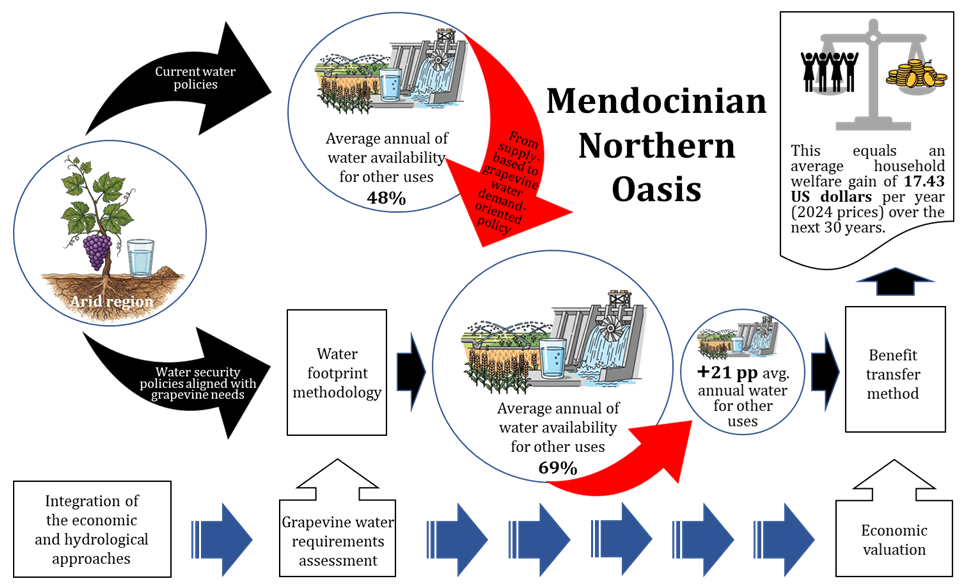
Water security is a critical challenge in Mendoza, Argentina, an arid region that faces rising water demand and uncertainty caused by climate change. Agriculture consumes 90% of the fresh water in the region, while vineyards occupy just over 60% of the cultivated area. This study estimates the social welfare effects of an improvement in water security achieved by reallocating water from vineyards to other uses. We used a multidisciplinary approach, applying benefit transfer to estimate social welfare changes and water footprint to quantify shifts in water availability. Our findings suggest that a water security policy in the Mendocinian Northern Oasis can result in an average 21-percentage-point increase in annual water availability for other uses. This equals an average household welfare gain of 17.43 US dollars per year (95% CI: 8.40-35.64) at 2024 prices over the next 30 years. This study offers a framework for regions worldwide facing similar challenges of water scarcity, increasing water demand, and climate change. Moreover, it can support the design of more informed water management strategies to ensure long-term water security.
Highlights:
- A framework is proposed for evaluating water security improvements in arid regions.
- Aligning water distribution with crop water needs enables efficient water allocation.
- Water security improvement policies increase social welfare for Mendocinian citizens.
- A multidisciplinary approach is developed using benefit transfer and water footprint.
- Water security improvement equals an annual welfare gain of 17.43 US dollars per household.
Downloads
References
Allen, R. G., Pereira, L. S., Raes, D. & Smith, M. (1998). Crop evapotranspiration: Guidelines for computing crop water requirements (FAO Irrigation and Drainage Paper N° 56). Food and Agriculture Organization of the United Nations.
Bennett, J. & Blamey, R. (2001). The choice modelling approach to environmental valuation (p. 269). Edward Elgar Publishing.
Boutwell, J. L. & Westra, J. V. (2013). Benefit transfer: A review of methodologies and challenges. Resources, 2(4), 517-527. https://doi.org/10.3390/resources2040517
Carson, R. T., Carson, N., Alberini, A., Flores, N. & Wright, J. (1993). A bibliography of contingent valuation studies and papers. Natural Resources Damage Assessment.
Castex, V., Morán, E. & Beniston, M. (2015). Water availability, use and governance in the wine producing region of Mendoza, Argentina. Environmental Science & Policy, 48, 1-8. https:// doi.org/10.1016/j.envsci.2014.12.008
Civit, B., Piastrellini, R., Curadelli, S. & Arena, A. P. (2018). The water consumed in the production of grapes for vinification (Vitis vinifera): Mapping the blue and green water footprint. Ecological Indicators, 85, 236-243.
Dirección de Agricultura y Contingencias Climáticas. (2021). Informe técnico [Dataset].
Departamento General de Irrigación. (1999). Plan hídrico para la provincia de Mendoza. Bases y propuestas para el consenso de una política de estado. Gobierno de Mendoza.
Departamento General de Irrigación. (2015). Balance hídrico río Tunuyán Inferior (Cap. 5, p. 129).
Departamento General de Irrigación. (2016a). Balance hídrico río Mendoza (Cap. 4, p. 128).
Departamento General de Irrigación. (2016b). Aquabook. http://aquabook.agua.gob.ar/
Duek, A. E. (2018). Escenarios de uso sostenible del recurso hídrico en el sector agrícola de Mendoza. 4° Encuentro de Investigadores en Formación en Recursos Hídricos, 11. https://www.ina.gov.ar/ifrh-2018/pdf/IFRH_2018_paper_4.pdf
Farreras, V., Riera, P., & Salvador, P. F. (2017). Environmental valuation with periodical payments in high-inflation economies: An Argentinean case study. Ecological Economics, 138, 56-63. https://doi.org/10.1016/j.ecolecon.2017.03.028
Farreras, V., & Abraham, L. (2020). Valuation of viticultural adaptation to climate change in vineyards: A discrete choice experiment to prioritize trade-offs perceived by citizens. Wine Economics and Policy, 9(2), 99-112.
Food and Agriculture Organization of the United Nations. (2024). CROPWAT 8.0 for Windows [Computer software]. https://www.fao.org/land-water/databases-and-software/cropwat/en/
Grafton, R. Q., Williams, J., Perry, C. J., Molle, F., Ringler, C., Steduto, P., Udall, B., Wheeler, S. A., Wang, Y., Garrick, D., & Allen, R. G. (2018). The paradox of irrigation efficiency. Science, 351, 748-750.
Hanley, N., Wright, R. E., & Adamowicz, V. (1998). Using choice experiments to value the environment. Environmental and Resource Economics, 11: 413-428. https://doi. org/10.1023/A:1008287310583
Herath, I., Green, S., Singh, R., Horne, D., van der Zijpp, S., & Clothier, B. (2013). Water footprinting of agricultural products: A hydrological assessment for the water footprint of New Zealand’s wines. Journal of Cleaner Production, 41, 232-243.
Hoekstra, A. Y., Chapagain, A. K., Aldaya, M. M., & Mekonnen, M. M. (2011). The water footprint assessment manual: Setting the global standard. Routledge. https://waterfootprint.org/ resources/TheWaterFootprintAssessmentManual_English.pdf
Instituto Nacional de Estadísticas y Censo. (2018). Censo Nacional Agropecuario 2018. Cuadros estadísticos. https://www.indec.gob.ar/indec/web/Nivel4-Tema-3-8-87
Instituto Nacional de Estadísticas y Censo. (2024). [Dataset]. https://www.indec.gob.ar/ftp/cuadros/ economia/sh_ipc_12_24.xls
Instituto Nacional de Tecnología Agropecuaria. (1990). Atlas de Suelos de la República Argentina.
Instituto Nacional de Vitivinicultura. (2020). Relevamiento Vitivinícola Argentino-Sector Primario. https://www.argentina.gob.ar/inv/vinos/estadisticas/regiones-vitivinicolas
Johnston, R. J., Boyle, K. J., Loureiro, M. L., Navrud, S., & Rolfe, J. (2021). Guidance to enhance the validity and credibility of environmental benefit transfers. Environmental and Resource Economics, 79, 575-624. https://doi.org/10.1007/s10640-021-00574-w
Katz, D. (2016). Undermining demand management with supply management: Moral hazard in Israeli water policies. Water, 8(4), 159. https://doi.org/10.3390/w8040159
Konapala, G., Mishra, A. K., Wada, Y., & Mann, M. E. (2020). Climate change will affect global water availability through compounding changes in seasonal precipitation and evaporation. Nature Communications, 11, 3044. https://doi.org/10.1038/s41467-020-16757-w
Lauro, C., Vich, A. I. J., Otta, S., Moreiras, S. M., Vaccarino, E., & Bastidas, L. (2021). Recursos hídricos superficiales de la vertiente oriental de los Andes Centrales (28°-37°S) en contexto de variabilidad hidroclimática. Boletín de Estudios Geográficos, 116, 45-71.
Lauro, C., Vich, A. I. J., Rivera, A., Otta, S., Moreiras, S. M., Bastidas, L., & Vaccarino, E. (2022). Patrones de variabilidad hidroclimática en los Andes Centrales (30-37°S) de Argentina. Geoacta, 44(1), 1-22.
Mekonnen, M., & Hoekstra, A. Y. (2011). The green, blue and grey water footprint of crops and derived crop products. Hydrology and Earth System Sciences, 15(5), 1577-1600. https://doi. org/10.5194/hess-15-1577-2011
Monnet, M., Vignola, R., & Aliotta, Y. (2022). Smallholders’ water management decisions in the face of water scarcity from a socio-cognitive perspective: Case study of viticulture in Mendoza. Agronomy, 12(11), 2868. https://doi.org/10.3390/agronomy12112868
Morábito, J., Mirábile, C., Salatino, S., Pizzuolo, P., Chambouleyron, J., & Fasciolo, G. (2005). Eficiencia de riego actual y potencial en el área regadía del río Mendoza. https://repositorio.ina.gob.ar/items/cd398433-7fa6-4b9c-adb9-0b7ebc2dcb97
Morábito, J., Mirábile, C., & Salatino, S. (2007). Eficiencia del riego superficial, actual y potencial, en el área de regadío del río Mendoza (Argentina). Ingeniería del Agua, 14, 199-214. https:// doi.org/10.4995/ia.2007.2912
Pellegrini, E., Dalmazzone, S., Fasolino, N. G., Frontuto, V., Gizzi, P., Luppi, F., Moroni, F., Raggi, M., Zanni, G., & Viaggi, D. (2023). Economic analysis under the Water Framework Directive: The state of the art and way forward. Water, 15(23), 4128. https://doi.org/10.3390/w15234128
Pérez Blanco, C. D., Hrast Essenfelder, A., & Perry, C. (2020). Irrigation technology and water conservation: A review of the theory and evidence. Review of Environmental Economics and Policy, 14(2).
Rivera, J. A., Naranjo Tamayo, E., & Viale, M. (2020). Water resources change in Central-Western Argentina under the Paris Agreement warming targets. Frontiers in Climate, 2, 587126. https://doi.org/10.3389/fclim.2020.587126
Rivera, J., Lauro, C., & Otta, S. (2021). Cuantificación del déficit hidrológico reciente en la región de Cuyo a partir de indicadores de caudales bajos. Boletín de Estudios Geográficos, 116, 23-44.
Rodríguez, J., De la Iglesia, F., & Ocvirk, M. (2000). Fenología de cultivares de vid (Vitis vinífera L.) en Luján de Cuyo. Revista de la Facultad de Ciencias Agrarias, Universidad Nacional de Cuyo, 32(2), 15-24. http://bdigital. uncu.edu.ar/11001
Rolfe, J., Windle, J., & Johnston, R. J. (2015). Applying benefit transfer with limited data: Unit value transfers in practice. In R. J. Johnston, J. Rolfe, R. S. Rosenberger, & R. Brouwer (Eds.), Benefit transfer of environmental and resource values: A guide for researchers and practitioners (p. 381-398). Springer.
Rosenberger, R., & Loomis, J. (2003). Benefit transfer. In P. Champ, K. Boyle, & T. Brown (Eds.), A primer on nonmarket valuation (p. 445-482). Kluwer Academic Publishers.
Servicio Meteorológico Nacional. (2024). Estadísticas climatológicas normales período 1991-2020. https://www.smn.gob.ar/descarga-de-datos
United States Department of Agriculture. (2024). Soil water characteristics (Version 6.02.72) [Computer software]. https://www.ars.usda.gov/research/software/ download/?softwareid=492&modecode=80-42-05-10
Villodas, R., Andino, M., Baduí, M. T., & Marinelli, S. (2023). Distribución de riego en función de la demanda-cuenta de agua. XXVII Congreso Nacional del Agua, Buenos Aires, Argentina.
Zetland, D. (2021). The role of prices in managing water scarcity. Water Security, 12, 100081. https:// doi.org/10.1016/j.wasec.2020.100081
Published
How to Cite
Issue
Section
License

This work is licensed under a Creative Commons Attribution-NonCommercial-ShareAlike 3.0 Unported License.
Authors who publish with this journal accept the Editorial Policies.
 RevFCAUNCuyo






.jpg)