Statistical Optimization of Seed Coating in Arid-Zone Grass Species Used as Cover Crops in Woody Agroecosystems
DOI:
https://doi.org/10.48162/rev.39.189Keywords:
Native seeds, Leptochloa crinita, Pappophorum caespitosum, Digitaria californicaAbstract
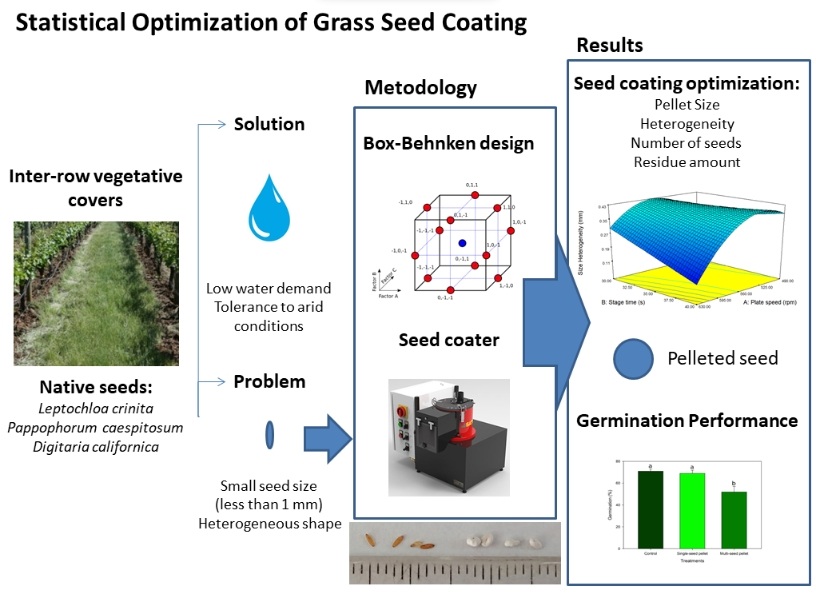
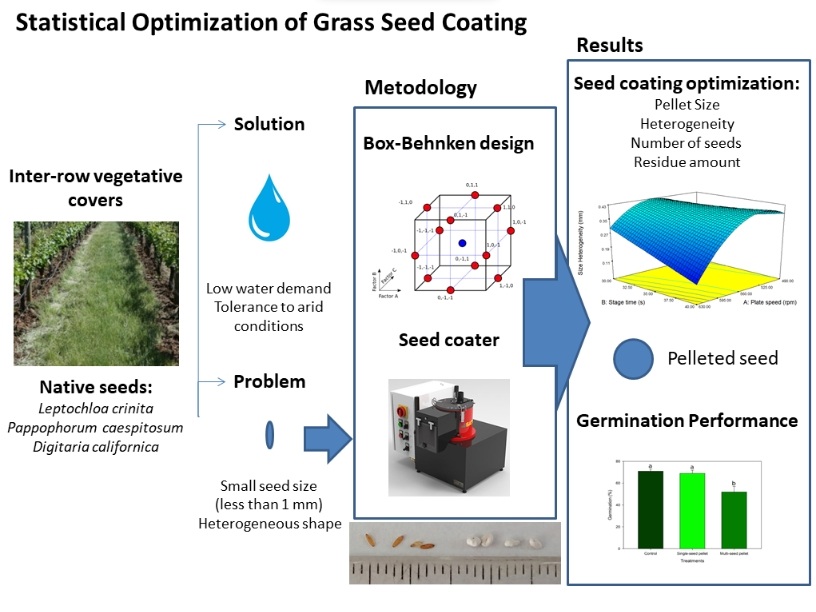
Inter-row vegetative cover improves soil physicochemical properties and biodiversity but should not compete with main crop for water. Native grass species such as Leptochloa crinita (Lag.) P. M. Peterson & N. W. Snow, Pappophorum caespitosum R. E. Fr. and Digitaria californica (Benth.) Henrard var. californica provide forage value, require less water than conventional cover crops, and exhibit high tolerance to the edaphoclimatic conditions of arid regions. However, their small seed size hinders efficient handling and sowing. Seed coating increases seed size and weight, forming a pellet that improves handling, distribution, and protection. Nevertheless, limited information is available on coating techniques for small-seeded species. This study aims to optimize the coating process through a statistically designed experiment to evaluate key morphological and physiological seed traits. A Box-Behnken design was applied to optimize one compositional factor of the pellet and two operational parameters. Pellet traits such as size, heterogeneity, seed number, and residue were analyzed alongside germination and seedling development. Optimization was first carried out using edible amaranth seeds as a model organism and then validated with native grasses. The resulting models were statistically significant and allowed the identification of an optimal operational range. Germination was unaffected in single-seed pellets, and root growth was enhanced by the coating process. Overall, the proposed statistical methodology proved effective and broadly applicable for optimizing small-seed coating processes.
Highlights:
- The Box–Behnken design enabled the identification of an optimal and reproducible operating range, proving to be an effective tool for seed coating process optimization while requiring a limited number of experiments and maximizing informational output.
- Coating small seeds significantly improved handling, overcoming the operational limitations associated with the small size of native grass seeds.
- Germination was not affected in single-seed pellets, and early root growth was enhanced, indicating a positive effect of seed coating on early seedling establishment.
Downloads
References
Afzal, I., Javed, T., Amirkhani, M., Taylor, A. G. (2020). Modern Seed Technology: Seed Coating Delivery Systems for Enhancing Seed and Crop Performance. Agriculture, 10, 526. https://doi. org/10.3390/agriculture10110526
Bartlett, M. S. (1947). The Use of Transformations. Biometrics, 3(1): 39-52. https://doi. org/10.2307/3001536
Bauer, P., Elbaum, R., Weiss, I. M. (2011). Calcium and silicon mineralization in land plants: transport, structure and function. Plant Science, 180(6), 746-756. https://doi.org/10.1016/j. plantsci.2011.01.019
Carballo, D. J., Matus, M., Betancourt, M., Ruiz, C. (2005). Manejo de Pasto I. Facultad de Ciencia Animal. Universidad Nacional Agraria. https://repositorio.una.edu.ni/id/ eprint/2425
Chen, D., Suter, H. C., Islam, A., & Edis, R. (2010). Influence of nitrification inhibitors on nitrification and nitrous oxide (N2O) emission from a clay loam soil fertilized with urea. Soil Biology Biochem, 42(4): 660-664. https://doi.org/10.1016/j.soilbio.2009.12.014
Ferrari, F. N., & Parera, C. A. (2015). Germination of six native perennial grasses that can be used as potential soil cover crops in drip-irrigated vineyards in semiarid environs of Argentina. Journal of Arid Environments, 113, 1-5. https://doi.org/10.1016/j.jaridenv.2014.09.002
Hoose, B. W., Call, R. S., Bates, T. H., Anderson, R. M., Roundy, B. A., Madsen, M. D. (2019). Seed conglomeration: a disruptive innovation to address restoration challenges associated with small-seeded species. Restoration Ecology, 27(5): 959-965. https://doi.org/10.1111/rec.12947
Iparraguirre, L. M. (2009). Mecánica Básica: fuerza y movimiento. Instituto Nacional de Educación Tecnológica. http://www.bnm.me.gov.ar/giga1/ documentos/EL001845.pdf
Jalal, A., da Silva Oliveira, C. E., Galindo, F. S., Rosa, P. A. L., Gato, I. M. B., de Lima, B. H., Teixeira Filho, M. C. M. (2023). Regulatory Mechanisms of Plant Growth-Promoting Rhizobacteria and Plant Nutrition against Abiotic Stresses in Brassicaceae Family. Life, 13, 211. https://doi.org/10.3390/ life13010211
Johansen, A., Schæfer, T. (2001). Effects of interactions between powder particle size and binder viscosity on agglomerate growth mechanisms in a high shear mixer. European Journal of Pharmaceutical Sciences, 12(3), 297-309. https://doi.org/10.1016/S0928- 0987(00)00182-2
Just, S., Toschkoff, G., Funke, A., Djuric, D., Scharrer, G., Khinast, J., Knop, K., Kleinebudde, P. (2013). Optimization of the inter-tablet coating uniformity for an active coating process at lab and pilot scale. International journal of pharmaceutics, 457(1), 1-8. http://dx.doi.org/10.1016/j. ijpharm.2013.09.010
Kangsopa, J., Hynes, R. K., Siri, B. (2018). Lettuce seeds pelleting: A new bilayer matrix for lettuce (Lactuca sativa) seeds. Seed Science and Technology, 46(3), 521-531. https://doi.org/10.15258/ sst.2018.46.3.09
Keningley, S. T., Knight, P. C., Marson, A. D. (1997). An investigation into the effects of binder viscosity on agglomeration behaviour. Powder Technology, 91(2), 95-103. https://doi.org/10.1016/ S0032-5910(96)03230-5
Kozub, P. C., Cavagnaro, J. B., Cavagnaro, P. F. (2018). Exploiting genetic and physiological variation of the native forage grass Trichloris crinita for revegetation in arid and semi‐arid regions: An integrative review. Grass and Forage Science, 73(2), 257-271. https://doi.org/10.1111/ gfs.12337
Lavanya, K., Senthil, V., Rathi, V. (2011). Pelletization technology: a quick review. International Journal of Pharmaceutical Sciences and Research, 2(6), 1337. http://dx.doi.org/10.13040/ IJPSR.0975-8232.2(6).1337-55
Leardi, R. (2009). Experimental design in chemistry: A tutorial. Analytica Chimica Acta, 652(1-2), 161-172. https://doi.org/10.1016/j.aca.2009.06.015
Madsen, M. D., Davies, K. W., Jason Williams, C. & Svejcar, T. J. (2012). Agglomerating seeds to enhance native seedling emergence and growth. Journal of Applied Ecology, 49, 431-438 https:// doi.org/10.1111/j.1365-2664.2012.02118.x
Marinoni, L. D. R., Zabala, J. M., Taleisnik, E. L., Schrauf, G. E., Richard, G. A., Tomas, P. A., Giavedoni, J. A. & Pensiero, J. F. (2019). Wild halophytic species as forage sources: Key aspects for plant breeding. Grass and Forage Science, 74(3), 321-344. https://doi.org/10.1111/gfs.12410
Massa Decon, A. M.; Pérez, S. 2025. Nursery Production of Neltuma Genus in Arid and Semiarid Regions of Argentine: a Review. Revista de la Facultad de Ciencias Agrarias. Universidad Nacional de Cuyo. Mendoza. Argentina. 57(2): 211-223. DOI: https://doi.org/10.48162/rev.39.184
Meglioli, C., Scaglia, J. A., Parera, C. A. (2024). Factores que afectan la germinación de tres pastos de zonas áridas: Leptochloa crinita, Pappophorum caespitosum y Digitaria californica (Poaceae). Acta Botanica Mexicana, (131). https://doi.org/10.21829/abm131.2024.2329
Möhler, H., Diekötter, T., Herrmann, J. D., & Donath, T. W. (2018). Allelopathic vs. autotoxic potential of a grassland weed-evidence from a seed germination experiment. Plant Ecology & Diversity, 11(4), 539–549. https://doi.org/10.1080/17550874.2018.1541487
Pasha, M., Hare, C., Ghadiri, M., Gunadi, A., Piccione, P. M. (2016). Effect of particle shape on flow in discrete element method simulation of a rotary batch seed coater. Powder Technology, 296, 29-36. http://dx.doi.org/10.1016/j.powtec.2015.10.055
Pedrini, S., Merritt, D. J., Stevens, J., Dixon, K. (2017). Seed Coating: Science or Marketing Spin? Trends in Plant Science, 22(2): 106-116. https://doi.org/10.1016/j.tplants.2016.11.002
Pedrozo, L. P., Kuchen, B., Flores, C. B., Rodríguez, L. A., Pesce, V. M., Maturano, Y. P., Nally, M. C., Vazquez, F. (2024). Optimization of sustainable control strategies against blue rot in table grapes under cold storage conditions. Postharvest Biology and Technology, 213, 112946. https://doi. org/10.1016/j.postharvbio.2024.112946
Pornaro, C., Meggio, F., Tonon, F., Mazzon, L., Sartori, L., Berti, A., Macolino, S. (2022). Selection of inter-row herbaceous covers in a sloping, organic, non-irrigated vineyard. PLoS ONE, 17(12): e0279759. https://doi.org/10.1371/journal.pone.0279759
Rajeshwari, M., Renganayaki, P. R., Vanitha, C., Ravikesavan, R. (2020). Standardization of Pellet size for Mechanized Sowing in Foxtail Millet (Setaria italica). Madras Agricultural Journal. https:// doi.org/10.29321/MAJ.2020.000370
Ramírez-Segura, E., Maldonado-Jaquez, J. A., Torres-Salas, I., Quero-Carrillo, A. R. (2022). Atributos físicos y fisiológicos de semilla de pastos nativos del México árido. Revista fitotecnia mexicana, 45(4): 453-460. https://doi.org/10.35196/rfm.2022.4.453
Romo Campos, R. de L., & Guzmán Valle, J. F. G. (2019). Recubrimiento de semillas como técnica para la restauración de suelos degradados. e-CUCBA 11: 46-53. https://doi.org/10.32870/e-cucba.v0i11.128
Rubio-Asensio, J. S., Abbatantuono, F., Ramírez-Cuesta, J. M., Hortelano, D., Ruíz, J. L, Parra, M., Martínez-Meroño, R. M., Intrigliolo, D. S., Buesa, I. (2022). Effects of cover crops and drip fertigation regime in a young almond agroecosystem. Agronomy, 12(11), 2606. https://doi.org/10.3390/ agronomy12112606
Sprey, L. M., Ferreira, S. A. D. N., Sprey, M. M. (2019). Physiological quality of pelleted Cubiu (Solanum sessiliflorum Dunal) seeds. Revista Brasileira de Fruticultura, 41, e-075. https://doi. org/10.1590/0100-29452019075
Thies, R., Kleinebudde, P. (1999). Melt pelletisation of a hygroscopic drug in a high shear mixer: Part 1. Influence of process variables. International journal of pharmaceutics, 188(2), 131-143. https://doi.org/10.1016/S0378-5173(99)00214-8
Thioye, B., Legras, M., Castel, L., Hirissou, F., Chaftar, N., Trinsoutrot-Gattin, I. (2021). Understanding arbuscular mycorrhizal colonization in walnut plantations: The contribution of cover crops and soil microbial communities. Agriculture, 12(1), 1. https://doi.org/10.3390/ agriculture12010001
Tomaz, A., Coleto Martínez, J., Arruda Pacheco, C. (2021). Effects of cover crops and irrigation on ‘Tempranillo’ grapevine and berry physiology: an experiment under the Mediterranean conditions of Southern Portugal. OENO One, 55(3), 191-208. https://doi.org/10.20870/ oeno-one.2021.55.3.4629
Trod, M. A., Tomas, P. A., Cervigni, G. D., Zabala, J. M., Marinoni, L. D., Giavedoni, J. A. (2018). Análisis de la distribución y densidad estomática en Trichloris (Chloridoideae, Poaceae), bajo diferentes regímenes hídricos. Boletín de la Sociedad Argentina de Botánica, 53(4): 1-10. http:// dx.doi.org/10.31055/1851.2372.v53.n4.21979
Vega Riveros, C., Villagra, P. E., & Greco, S. A. (2020). Different root strategies of perennial native grasses under two contrasting water availability conditions: implications for their spatial distribution in desert dunes. Plant Ecology, 221(7), 633-646
Villagra, P. E., Giordano, C., Alvarez, J. A., Cavagnaro, J. B., Guevara, A., Sartor, C., Passera, C. B., Greco, S. (2011). Ser planta en el desierto: estrategias de uso de agua y resistencia al estrés hídrico en el Monte Central de Argentina. Ecología Austral, 21(1), 029–042. https://ojs.ecologiaaustral.com. ar/index.php/Ecologia_Austral/article/view/1294
Xavier, J. B., Andrade, D. B. D., Souza, D. C. D., Guimarães, G. C., Resende, L. V., & Guimarães, R. M. (2019). Morphological, chemical and physiological characterization of Amaranthus spp. Seeds. Journal of Seed Science, 41(4), 478-487. https://doi.org/10.1590/2317- 1545v41n4226286
Zubillaga, M. F.; Repupilli, J. A.; Boeri, P.; Servera, J. A.; Gallego, J. J.; Piñuel, L. (2024). Nutritional quality of amaranth (Amaranthus) silage in response to forage airing and addition of lactic bacteria. Revista de la Facultad de Ciencias Agrarias. Universidad Nacional de Cuyo. Mendoza. Argentina. 56(1): 117-126. DOI: https://doi.org/10.48162/rev.39.128
Published
How to Cite
Issue
Section
License

This work is licensed under a Creative Commons Attribution-NonCommercial-ShareAlike 3.0 Unported License.
Authors who publish with this journal accept the Editorial Policies.
 RevFCAUNCuyo






.jpg)