
Translocation and Experimental Adaptation of Distichia muscoides Cushions in a Wetland Impacted by Acid Rock Drainage, Ancash, Peru
DOI:
https://doi.org/10.48162/rev.39.190Palabras clave:
Biorremediación, bofedales, drenaje ácido de roca, Distichia muscoides, metales pesadosResumen
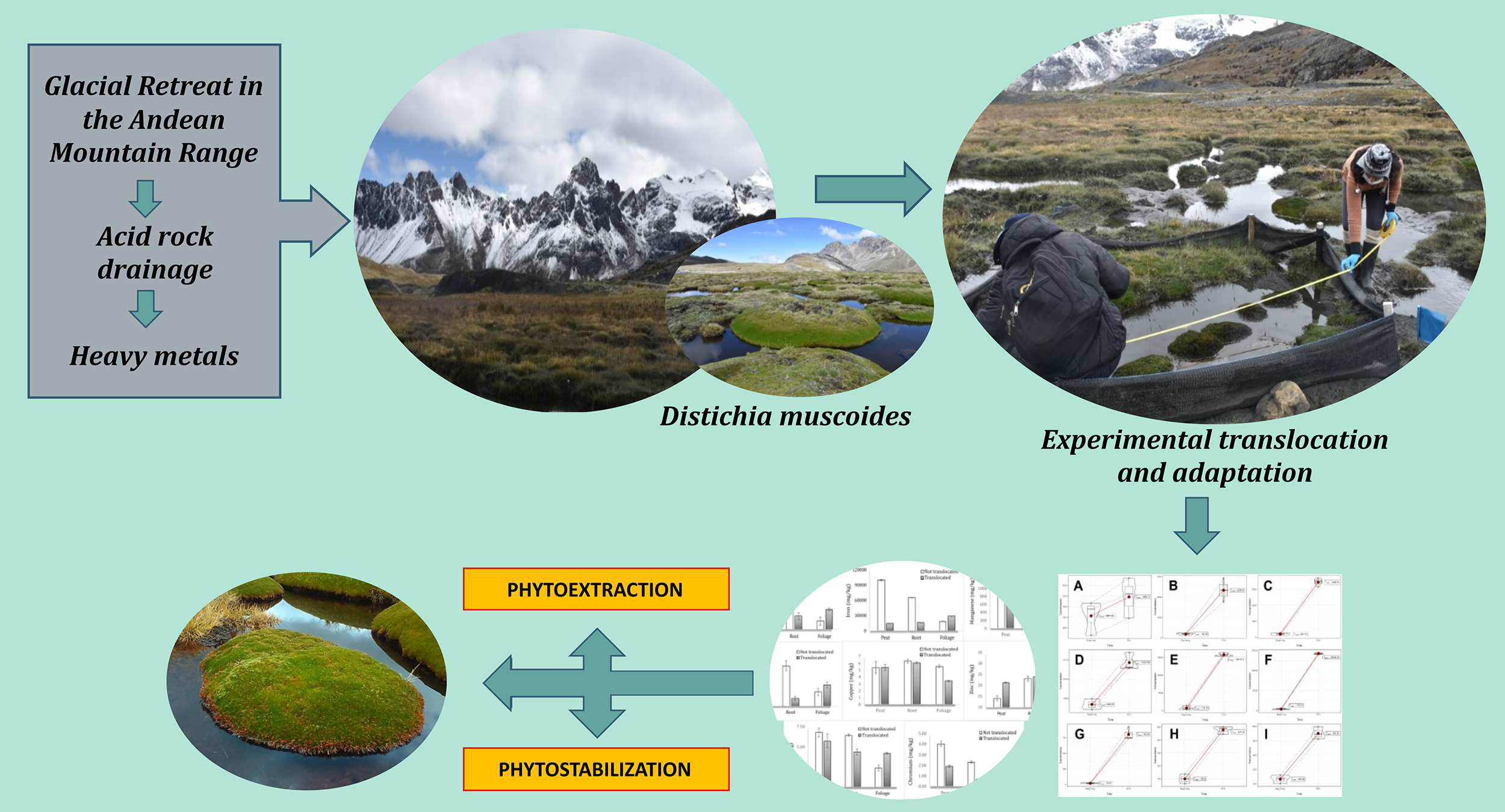
The deglaciation of the Andean mountain range negatively impacts ecosystems and water bodies, primarily increasing the concentration of heavy metals. However, their concentration can be reduced by applying bioremediation techniques. The objective of this study was to evaluate the effect of the translocation and adaptation of Distichia muscoides cushions in a wetland impacted by acid rock drainage in a high Andean region. For this purpose, the characteristics of water, peat, and D. muscoides tissue were compared in two wetlands, and the behavior of translocated D. muscoides was evaluated based on the bioaccumulation and translocation factors of metals. The quantification of Al, Fe, and Mn in peat, root, and aerial tissue of D. muscoides showed higher concentration values after the translocation of the cushions. Additionally, the bioaccumulation factor classified the transplanted cushions as accumulators of Al, Cu, As, Fe, Mn, and Zn, while the translocation factor classified the cushions as phytoextractors of Al, As, Cr, Fe, Mn, and Zn, and phytostabilizers of Pb and Cu. It is concluded that translocated and adapted D. muscoides cushions have potential for the bioremediation of wetlands contaminated with acid rock drainage.
Hightlights:
- Two wetlands in the Andean mountains were characterized, one with apparent DAR impact and one without.
- muscoides was successfully translocated and adapted to a DAR-impacted wetland.
- The concentrations of heavy metals such as Al, Fe, and Mn increased after translocation in the peat, aerial tissues, and roots of muscoides.
- muscoides demonstrated its potential as a phytoextractor and phytostabilizer of heavy metals.
- The translocated cushions of muscoides show promise for the bioremediation of heavy metals.
Descargas
Citas
Alcalá Jáuregui, J. A.; Rodríguez Ortiz, J. C.; Filippini, M. F.; Martínez Carretero, E.; Hernández Montoya, A.; Rojas Velázquez, A. N.; Méndez Cortés, H.; Beltrán Morales, F. A. 2022. Metallic elements in foliar material and fruits of three tree species as bioindicators. Revista de la Facultad de Ciencias Agrarias. Universidad Nacional de Cuyo. Mendoza. Argentina. 54(2): 61-72. DOI: https://doi.org/10.48162/rev.39.083
Arsenic, A. M.; Beryllium, A. M.; Chromium, B. N.; Cobalt, C. P.; Iron, C. S.; Lead, C. S.; Thallium, I. Z. 1996. Method 3050B acid digestion of sediments, sludges, and soils 1.0 scope and application. United States Environmental Protection Agency (EPA). Washington. DC. USA. 1-12.
Autoridad Nacional del Agua (ANA). 2011. Protocolo Nacional de Monitoreo de la calidad en cuerpos naturales de agua superficial. Ministerio de Agricultura. Perú. https://hdl. handle.net/20.500.12543/215 (Accessed May, 2023).
Awa, S.; Hadibarata, T. 2020. Removal of heavy metals in contaminated soil by phytoremediation mechanism: A Review. Water, air, Soil Pollut. 231-47. https://doi.org/10.1007/s11270- 020-4426-0
Benfield, A.; Yu, Z.; Benavides, J. 2021. Environmental controls over Holocene carbon accumulation in Distichia muscoides-dominated peatlands in the eastern Andes of Colombia. Quaternary Science Reviews. 251: 106687. https://doi.org/10.1016/j.quascirev.2020.106687
Chávez, J.; Gonzales, J.; Iparraguirre, J. 2023. El impacto del cambio climático en la evolución glaciar desde la pequeña edad de hielo, en la vertiente occidental de la subcuenca Ranrahirca (Cordillera Blanca, Ancash). Tesis de grado en Ingeniería Ambiental y Recursos Naturales. Facultad de Ingeniería Ambiental y Recursos Naturales. Universidad Nacional del Callao. Perú. 156 p.
Cooper, D.; Kaczynski, K.; Slayback, D.; Yager, K. 2015. Growth and organic carbon production in peatlands dominated by Distichia muscoides, Bolivia, South America. Artic, Antarctic, and Alpine Research. 47(3): 505-510. https://doi.org/10.1657/AAAR0014-060
Ding, X.; Qian, L.; Juang, W.; Liu, H.; Yiming, A.; Zha, M.; Qu, J.; Jiang, Z. 2024. Review of bacterial sulfate reduction in lacustrine deposition and its identification in the Jimsar Sag, Junggar Basin. Marine and Petroleum Geology. 163: 106801. https://doi.org/10.1016/j. marpetgeo.2024.106801
Haghnazar, H.; Sabbagh, K.; Johannesson, K.; Pourakbar, M.; Aghayani, E. 2023. Phytoremediation capability of Typha latifolia L. to uptake sediment toxic elements in the largest coastal wetland of the Persian Gulf. Marine Pollution Bulletin. 188: 114699. https://doi. org/10.1016/j.marpolbul.2023.114699
Heisi, H.; Awosusi, A.; Nkuna, R.; Matambo, T. 2023. Phytoextraction of anthropogenic heavy metal contamination of the Blesbokspruit wetland: Potential of wetland macrophytes. Journal of Contaminant Hydrology. 253: 104101. https://doi.org/10.1016/j.jconhyd.2022.104101
Hirsh, M. 2016. Compilación sistemática de la situación actual en bofedales, bosques, paisajes, calidad de agua y praderas en la reserva de biósfera Huascarán, región Áncash. USAID, Instituto de montaña conservación, cultura, comunidad AID-527-A-14-00001. 39 p.
Hussein, S.; Qurbani, K.; Ahmed, S.; Tawfeeq, W.; Hassan, M. 2024. Bioremediation of heavy metals in contaminated environments using Comamonas species: A narrative review. Bioresource Technology Reports. 25: 101711. https://doi.org/10.1016/j.biteb.2023.101711
Janaki, M.; Kirupanantha, P.; Senthil, S.; Stanley, V.; Al Farraj, D.; Aljeidi, R.; Arokiyaraj. S. 2024. Beneficial role of Burkholderia cepacia in heavy metal bioremediation in metal-polluted soils and enhance the tomato plant growth. Biocatalysis and Agricultural Biotechnology. 57: 103032. https://doi.org/10.1016/j.bcab.2024.103032
Jara-Peña, E.; Gómez, J.; Montoya, H.; Sánchez, T.; Tapia, L.; Cano, N.; Dextre, A. 2017. Acumulación de metales pesados en Calamagrostis rigida (Kunth) Trin ex Steud. (Poaceae) y Myriophyllum quitense Kunth (Haloragaceae) evaluadas en cuatro humedales altoandinos del Perú. Arnaldoa. 24(2): 583-598. http://dx.doi.org/10.22497/arnaldoa.242.24210
La Matta, F. 2020. Influencia del drenaje ácido de roca en la comunidad de macroinvertebrados bentónicos, índices bióticos de calidad de agua y grupos funcionales alimenticios en ríos y cabeceras de La Cordillera Blanca (Subcuenca de Quillcay, Áncash). Tesis de grado en Biología. Facultad de Ciencias y Filosofía. Universidad Peruana Cayetano Heredia. Lima. Perú. 118 p.
López, M.; Morales, O. 2022. Fitorremediación de suelos contaminados por metales pesados: una revisión. Revista de Ciencia y Tecnología El Higo. 12(2): 15-28. https://doi.org/10.5377/ elhigo.v12i2.15197
Luna, E. 2018. Biorremediación utilizando Distichia muscoides y Calamagrostis glacialis del drenaje ácido de roca proveniente del nevado de Pastoruri-2015. Tesis de grado en Ingeniería Ambiental. Facultad de Ciencias del Ambiente. Universidad Nacional Santiago Antúnez de Mayolo. Ancash. Perú. 103 p.
Magnússon, R.; Cammeraat, E.; Lücke, A.; Jansen, B.; Zimmer, A.; Recharte, J. 2020. Influence of glacial sediments on the chemical quality of surface water in the Ulta valley, Cordillera Blanca, Perú. Journal of Hydrology. 587: 125027. https://doi.org/10.1016/j.jhydrol.2020.125027
Martín, T. D.; Brockhoff, C. A.; Creed, J. T.; EMMC Methods Work Group. 1994. Methods EMW 200.7: Methods for the determination of metals in environmental samples. U.S. Environmental Protection Agency Cincinnati, Ohio. Methods Work Group. Revision 4.4. 1-58.
Martínez, V.; Benavides, J. 2023. Carbon balance shift in mountain peatlands along a gradient of grazing disturbance in the tropical Andes (Colombia). Plant Ecology. 224: 1049-1058. https://doi.org/10.1007/s11258-023-01356-8
Ministerio del Ambiente (MINAM). 2016. El Perú y el cambio climático, tercera comunicación nacional del Perú a la Convención Marco de las Naciones Unidas sobre cambio climático. https://www.gob.pe/institucion/minam/informes-publicaciones/2653-el-peru-y-el-cambio-climatico-tercera-comunicacion-nacional-del-peru (Accessed March, 2023).
Ministerio del Ambiente (MINAM). 2017. Decreto Supremo N° 004-2017. Estándares de Calidad Ambiental (ECA) para Agua y establecen Disposiciones Complementarias. https://www.gob.pe/institucion/minam/normas-legales/3671-004-2017- minam (Accessed March, 2023).
Narváez, C.; Kalinhoff, C.; Sánchez, A. 2024. Potencial del arbusto Lantana camara L. (Verbenaceae) para la fitoestabilización y volatilización de mercurio. Revista Internacional de Contaminación Ambiental. 40: 95-103. https://doi.org/10.20937/RICA.54790
Oggero, A.; Nakayama, H.; Ávalos, C.; Garcia, I.; Benítez, J.; Ayala, J.; Elkhalili, R., Peralta, I. 2021. Eficiencia de la absorción de cobre (Cu) y cromo (Cr), una propuesta de fitorremediación de efluentes mediada por Typha domingensis. Revista de la Sociedad Científica del Paraguay. 26(2): 100-113. https://doi.org/10.32480/rscp.2021.26.2.100
Orrego, S. 2019. Eficiencia de consorcios de bacterias sulfato reductoras en la degradación anaerobia de hidrocarburos aromáticos del petróleo en microcosmos, junio-octubre de 2018. Tesis de maestría en Ciencias en Ingeniería Ambiental. Universidad Nacional Pedro Ruiz Gallo. Lambayeque. Perú. 83 p.
Oyague, E.; Cooper, D.; Ingol, E. 2022. Effects of land use on the hydrologic regime, vegetation, and hydraulic conductivity of peatlands in the central Peruvian Andes. Journal of Hydrology. 609: 127687. https://doi.org/10.1016/j.jhydrol.2022.127687
Pabón, S.; Benítez, R.; Sarria, R.; Gallo, J. 2020. Contaminación del agua por metales pesados, métodos de análisis y tecnologías de remoción. Una revisión. Entre Ciencia e Ingeniería. 14(27): 9-18. https://doi.org/10.31908/19098367.1734
Pedraza, M. 2021. Fitorremediación en cuerpos de agua contaminados por metales pesados. Revista Científica de Biología y Conservación. 1(1): 61-78. https://doi.org/10.58720/ibs. v1i1.6
Rascón, J.; Corroto, F. 2020. Evolución fisicoquímica y de las bacterias de azufre en microcosmos de diferentes sistemas acuáticos de la Región Amazonas. Revista de Investigación Científica Tayacaja. 3(1). https://doi.org/10.46908/rict.v3i1.68
Reyna, D.; Cortés, L.; Sandino, G.; Martínez, M.; Rodríguez, L. 2022. Estudio del comportamiento de especies vegetales en un proceso de fitoestabilización para remediación de suelo contaminado por jal minero abandonado. Ciencia, Tecnología y Salud. 16(32): 52-57. https://doi.org/10.36790/epistemus.v16i32.197
Ruthsatz, B. 2022. Vegetación y ecología de los bofedales tropicales altoandinos en el norte de Chile. Chloris Chilensis. 25(1): 165-214.
Suárez, E.; Chimbolema, S.; Chimner, R.; Lilleskov, E. 2021. Root biomass and production by two cushion plant species of tropical high-elevation peatlands in the andean paramo. Mires and Peat. 27. https://doi.org/10.19189/MaP.2020.OMB.StA.2131
Wang, H.; Wang, X.; Zhang, Y.; Wang, D.; Long, X.; Chai, G.; Wang, Z.; Meng, H.; Jiang, C.; Dong, W.; Guo, Y.; Li, J.; Xu, Z.; Lin, Y. 2023. Sulfate-reducing bacteria-based bioelectrochemical system for heavy metal wastewater treatment: Mechanisms, operating factors, and future challenges. Journal of Electroanalytical Chemistry. 915 (15): 117945. https://doi.org/10.1016/j. jelechem.2023.117945
Wanner, C.; Moradi, H.; Ingold, P.; Cardenas, M.; Mercurio, R.; Furrer, G. 2023. Rock glaciers in the Central Eastern Alps-How permafrost degradation can cause acid rock drainage, mobilization of toxic elements and formation of basaluminite. Global and Planetary Change. 227: 104180. https://doi.org/10.1016/j.gloplacha.2023.104180
Yan, A.; Wang, Y.; Tan, S.; Yusof, M.; Ghosh, S.; Chen, Z. 2020. Phytoremediation: a promising approach for revegetation of heavy metal-polluted land. Frontiers in Plant Science. 30(11): 359. https://doi.org/10.3389/fpls.2020.00359
Yaranga, R. 2020. Humedal Altoandino del Perú: Diversidad florística, productividad primaria neta aérea, condición ecológica y capacidad de carga. Scientia Agropecuaria. 11(2): 213-221. https://doi.org/10.17268/sci.agropecu.2020.02.08
Zheng, H.; Bingjie, L.; Guocheng, L.; Zhaohui, C.; Chenchen, Z. 2019. Potential toxic compounds in biochar: Knowledge gaps between biochar research and safety, biochar from biomass and waste. Biochar from Biomass and Waste. 349-384. https://doi.org/10.1016/B978-0- 12-811729-3.00019-4
Zimmer, A.; Brito, M.; Alegre, C.; Sánchez, J.; Recharte, J. 2018. Implementación de dos sistemas de biorremediación como estrategia para la prevención y mitigación de los efectos del drenaje ácido de roca en la Cordillera Blanca, Perú. Revista de Glaciares y Ecosistemas de Montaña. 4(3): 57-76.
Zimmer, A.; Beach, T.; Luzzadder, S.; Rabatel, A.; Lopez, J.; Cruz, R.; Temme, A. 2024. Physico-chemical properties and toxicity of young proglacial soils in the Tropical Andes and Alps. Catena. 237: 107748. https://doi.org/10.1016/j.catena.2023.107748

Descargas
Publicado
Cómo citar
Número
Sección
Licencia

Esta obra está bajo una licencia internacional Creative Commons Reconocimiento-NoComercial-CompartirIgual 3.0.
Aquellos autores/as que tengan publicaciones con esta revista, aceptan las Políticas Editoriales.
 RevFCAUNCuyo






.jpg)