
Yield and Development of Winter and Spring Rapeseed (Brassica napus L.) at Different Sowing Dates in Temperate Environments
DOI:
https://doi.org/10.48162/rev.39.186Palabras clave:
fecha de siembra otoñal, fecha de siembra invernal, vernalización, heladasResumen

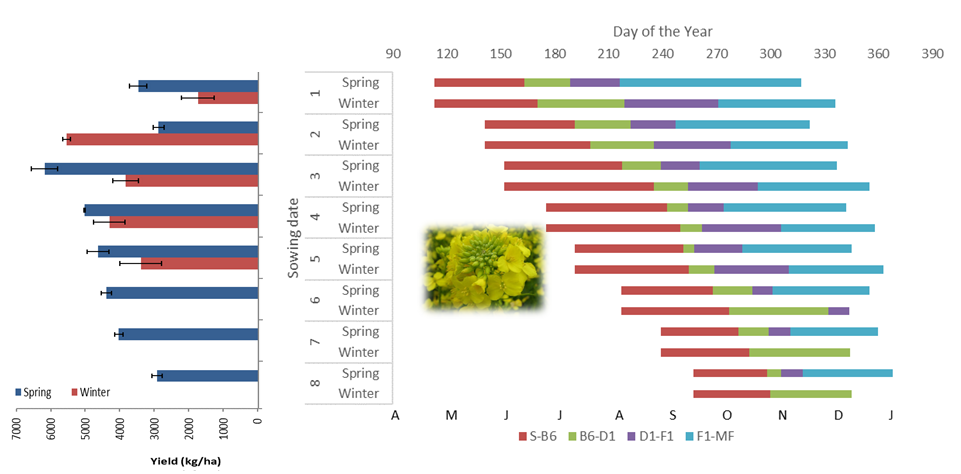
Optimal sowing dates should match the crop-critical period with favorable conditions. In rapeseed, growth stages change among spring and winter cultivars. This study characterized changes in rapeseed phenology with varying sowing dates to determine critical periods in both winter and spring cultivars. The trial took place in Balcarce, Argentina, where a winter-type variety and a spring-type were sown on eight different dates in a randomized complete block design with three replicates. Phenology was monitored weekly, and yield was evaluated at the end of the season. Changes in sowing dates and cultivars led to variations in the timing of critical periods. Considering the experimental conditions, the optimal sowing window was between April and July for sowing either rapeseed cultivar. However, the winter variety did not bloom for sowing dates after July, while the spring variety showed yield reductions due to frosts for sowing dates before the end of April. Changes in sowing date resulted in differences in timing and duration of vegetative and reproductive stages, generally leading to shorter crop cycles. However, in late sowing, winter cultivars lengthened their life cycle to the point of not reaching flowering during the growing season.
Highlights:
- Adjustments in sowing dates and cultivar types changed the timing and duration of vegetative and reproductive stages.
- Late sowing extended winter cultivar cycles, occasionally preventing flowering within the season.
- Winter cultivars failed to flower after July sowing, while spring cultivars faced yield reductions from frosts in early sowing.
Descargas
Citas
Agosti, M. B. 2011. Fertilización nitrógeno-azufrada y variabilidad genotípica en el rendimiento y la calidad del grano en colza-canola (Brassica napus L.). Tesis Magister. Universidad de Buenos Aires. 130 p.
Allen, R. G.; Pereira, L. S.; Raes, D.; Smith, M. 1998. Crop evapotranspiration: guidelines for computing crop water requirements. In: FAO Irrigation and Drainage Paper N° 56. FAO. Rome. Italy. 300 p.
Arisnabarreta, S.; Miralles, D. J. 2008. Critical period for grain number establishment of near isogenic lines of two- and six-rowed barley. Field Crops Research. 107: 196-202. https:// doi.org/10.1016/j.fcr.2008.02.009
Arnoud, F. 1989. Colza: selection, varietés. Cahier Technique. CETIOM. París, Francia. 28 p.
Bouché, F.; Woods, D. P.; Amasino, R. M. 2017. Winter memory throughout the plant kingdom: Different paths to flowering. Plant Physiology. 173(1): 27-35. https://doi.org/10.1104/ pp.16.01322
Cantagallo, J. E.; Chimenti, C. A.; Hall, A. J. 1997. Number of seed per unit area in sunflower correlates well with a phototermal quotient. Crop Science. 37: 1780- 1786. https://doi.org/10.2135/ cropsci1997.0011183X003700060020x
Coll, L.; Larrosa, L. M. 2010. Efecto de la fecha de siembra y el ciclo sobre el rendimiento de colza. Actualización Técnica N° 1. EEA INTA Paraná. 36 p.
Di Rienzo, J. A.; Casanoves, F.; Balzarini, M. G.; Gonzalez, L.; Tablada, M.; Robledo, C. W. 2008. InfoStat, Grupo InfoStat. FCA. Universidad Nacional de Córdoba. Argentina.
Fischer, R. A. 1985. Number of kernels in wheat crops and the influence of solar radiation and temperature. Journal of Agriculture Science. Cambridge. 105: 447-461. https://doi. org/10.1017/S0021859600056495
Gómez, N. V.; Miralles, D. J. 2011. Factors that modify early and late reproductive phases in oilseed rape (Brassica napus L.): Its impact on seed yield and oil content. Industrial Crops and Products. 34: 1277-1285. https://doi.org/10.1016/j.indcrop.2010.07.013
Gómez, N. V.; Miralles, D. J.; Mantese, A. I.; Menéndez, Y. C.; Rondanini, D. P. 2018. Colza: un cultivo con historia en la FAUBA. Universidad de Buenos Aires. Facultad de Agronomía; Agronomía & Ambiente. 38(1): 23-36.
Habekotté, B. 1997. Evaluation of seed yield determining factors of winter oilseed rape (Brassica napus L.) by means of crop growth modelling. Field Crops Research. 54: 137-151. https://doi.org/10.1016/S0378-4290(97)00044-0
Hocking, P. J.; Kirkegaard, J. A.; Angus, J. F.; Gibson, A. H.; Koetz, E. A. 1997. Comparison of canola, Indian mustard and Linola in two contrasting environments. I. Effects of nitrogen fertilizer on dry-matter production, seed yield and seed quality. Field Crops Research. 49: 107-125. https://doi.org/10.1016/S0378-4290(96)01063-5
Iriarte, L. B. 2014. Cultivo de colza: fecha de siembra, densidad y distancia entre surcos. INTA Barrow. 11 p.
Iriarte, L. B.; Valetti, O. 2008. Cultivo de Colza. INTA. Buenos Aires. 152 p.
Iriarte, L. B.; López, Z. B. 2014. El cultivo de colza en Argentina. Situación actual y perspectivas. 1° Simposio Latinoamericano de Canola. Passo Fundo. Brasil. 1-7.
Kirkegaard, J. A.; Lilley, J. M.; Berry, P. M.; Rondanini, D. P. 2021. Canola. In: Sadras VO and Calderini DF. Crop Physiology Case Histories for Major Crops, eds and (Academic Press). 518-549.
Lin, L.; Allemekinders, H.; Dansby, A.; Campbell, L.; Durance-Tod, S.; Berger, A.; Jones, P. J. 2013. Evidence of health benefits of canola oil. Nutr. Rev. 71: 370-385. https://doi.org/10.1111/ nure.12033
McWilliam, S. C.; Stafford, J. A.; Scott, R. K.; Norton, G.; Stokes, D. T. 1995. The relationship between canopy structure and yield in oilseed rape. In: Proceedings of the 9th International Rapeseed Congress. Cambridge. UK. 491-493.
Mendham, N. J.; Salisbury, P. A. 1995. Physiology: crop development, growth and yield. In: Kimber D.; McGregor, D. I. (Eds.), Brassica Oilseed, Production, Utilization, Camb. 11-64.
Michaels, S.; Amasino, R. 2000. Memories of winter: vernalization and the competence to flower. Plant Cell Environ. 23: 1145–1154. https://doi.org/10.1046/j.1365-3040.2000.00643.x
Mingeau, M. 1974. Comportement du colza e printemps a la sécheresse. Informations Techniques (Paris, France). 36: 1-11.
Miralles, D. J.; Ferro, B.; Slafer, G. 2001. Developmental responses to sowing date in wheat, barley and rapeseed. Field Crops Research. 71: 211-223. https://doi.org/10.1016/S0378- 4290(01)00161-7
Morrison, M. J.; Stewart, D. W. 2002. Heat stress during flowering in summer brassica. Crop Science. 42: 797-803. https://doi.org/10.2135/cropsci2002.7970
Murphy, L.; Scarth, R. 1991. Vernalization response of spring canola (Brassica napus L.) In: Mc Gregor DI (eds.). Proceedings of the Eight International Rapeseed Congress. Saskatoon, Saskatchewan. Canadá. 1764-1768.
Nanda, R.; Bhargava, S.; Tomar, D.; Rawson, H. M. 1996. Phenological development of Brassica campestris, B. juncea, B. napus and B. carinata grown in controlled environments and from 14 sowing dates in the field. Field Crops Res. 46: 93-103. https://doi. org/10.1016/0378-4290(95)00090-9
Permingeat, M. P. 2013. Rendimiento de colza 00: determinación del período crítico. Tesis de grado. Facultad de Ciencias Agrarias. Universidad de Mar del Plata. Argentina. 20 p.
Rondanini, D. P.; Menendez, Y. C.; Gomez, N. V.; Miralles, D. J.; Botto, J. F. 2017. Vegetative plasticity and floral branching compensate low plant density in modern spring rapeseed. Field Crops Research. 210: 104-113. https://doi.org/10.1016/j.fcr.2017.05.021
Secchi, M. A.; Fernandez, J. A.; Stamm, M. J.; Durrett, T.; Prasad, P. V. V.; Messina, C. D.; Ciampitti, I. A. 2023. Effects of heat and drought on canola (Brassica napus L.) yield, oil, and protein: a meta-analysis. Field Crops Res. 293. Article 108848. 10.1016/j. fcr.2023.108848
Silvester-Bradley, R.; Makepeace, R. J. 1984. A code for stages of development in oilseed rape (Brassica napus L.). Aspects of Applied Biology. 6: 399-419.
Takashima, N. E.; Rondanini, D. P.; Puhl, L. E.; Miralles, D. J. 2013. Environmental factors affecting yield variability in spring and winter rapeseed genotypes cultivated in the southeastern Argentine Pampas. European Journal of Agronomy. 48: 88-100. https://doi.org/10.1016/j. eja.2013.01.008
Tommey, A. M.; Evans, E. J. 1991. Temperature and daylength control of flower initiation in winter oilseed rape (Brassica napus L.). Annals of Applied Biology. 118: 201-208. https://doi. org/10.1111/j.1744-7348.1991.tb06098.x
Walton, G.; Si, P.; Bowden, B. 1999. Environmental impact on canola yield and oil. In: Proceedings of the 10th International Rapeseed Congress. Camberra, Australia. http://www. regional.org.au/au/gcirc/2/136.htm (Accessed: Sept 2023).
Weymann, W.; Bottcher, U.; Sieling, K.; Kage, H. 2015. Effects of weather conditions during different growth phases on yield formation of winter oilseed rape. Field Crops Res. 173: 41-48. https://doi.org/10.1016/j.fcr.2015.01.002
Woźniak, E.; Waszkowska, E.; Zimny, T.; Sowa, S.; Twardowski, T. 2019. The rapeseed potential in Poland and Germany in the context of production, legislation, and intellectual property rights. Front Plant Sci. 2019 Nov 5;10:1423. doi: 10.3389/fpls.2019.01423. PMID: 31749825; PMCID: PMC6848278.
Yaniv, Z.; Schafferman, D.; Zur, M. 1995. The effect of temperature on oil quality and yield parameters of high- and low-erucic acid Cruciferae seeds (rape and mustard). Industrial Crops and Products. 3: 247-251. https://doi.org/10.1016/0926-6690(94)00041-V
Zhang, Z.; Cong, R. H.; Ren, T.; Li, H.; Zhu, Y.; Lu, J. W. 2020. Optimizing agronomic practices for closing rapeseed yield gaps under intensive cropping systems in China. Journal of Integrative Agriculture. 19(2020): 1241-1249. https://doi.org/10.1016/S2095-3119(19)62748-6
Zheng, Q.; Liu, K. 2022. Worldwide rapeseed (Brassica napus L.) research: A bibliometric analysis during 2011-2021. Oil Crop Science. 7(4): 157-165. https://doi.org/10.1016/j.ocsci.2022.11.004.
Descargas
Publicado
Cómo citar
Número
Sección
Licencia

Esta obra está bajo una licencia internacional Creative Commons Reconocimiento-NoComercial-CompartirIgual 3.0.
Aquellos autores/as que tengan publicaciones con esta revista, aceptan las Políticas Editoriales.
 RevFCAUNCuyo






.jpg)