
Radial Growth Dynamics and Drought Resilience in Pinus pinea L. Plantations from Central-Western Argentina: Implications for Forestry Development
DOI:
https://doi.org/10.48162/rev.39.191Palabras clave:
cambio climático, manejo forestal, Mendoza, anillos de crecimiento de árbolesResumen
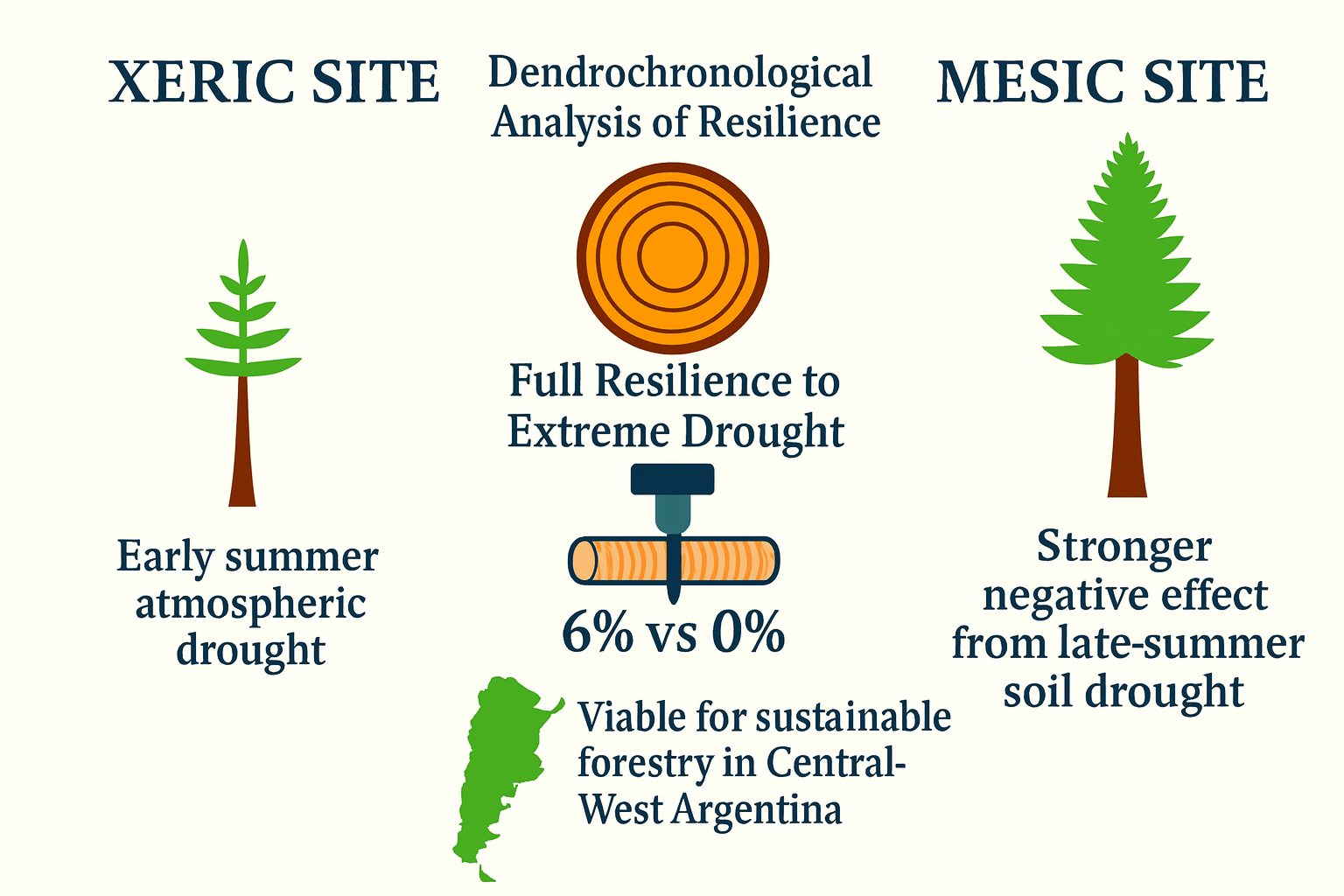
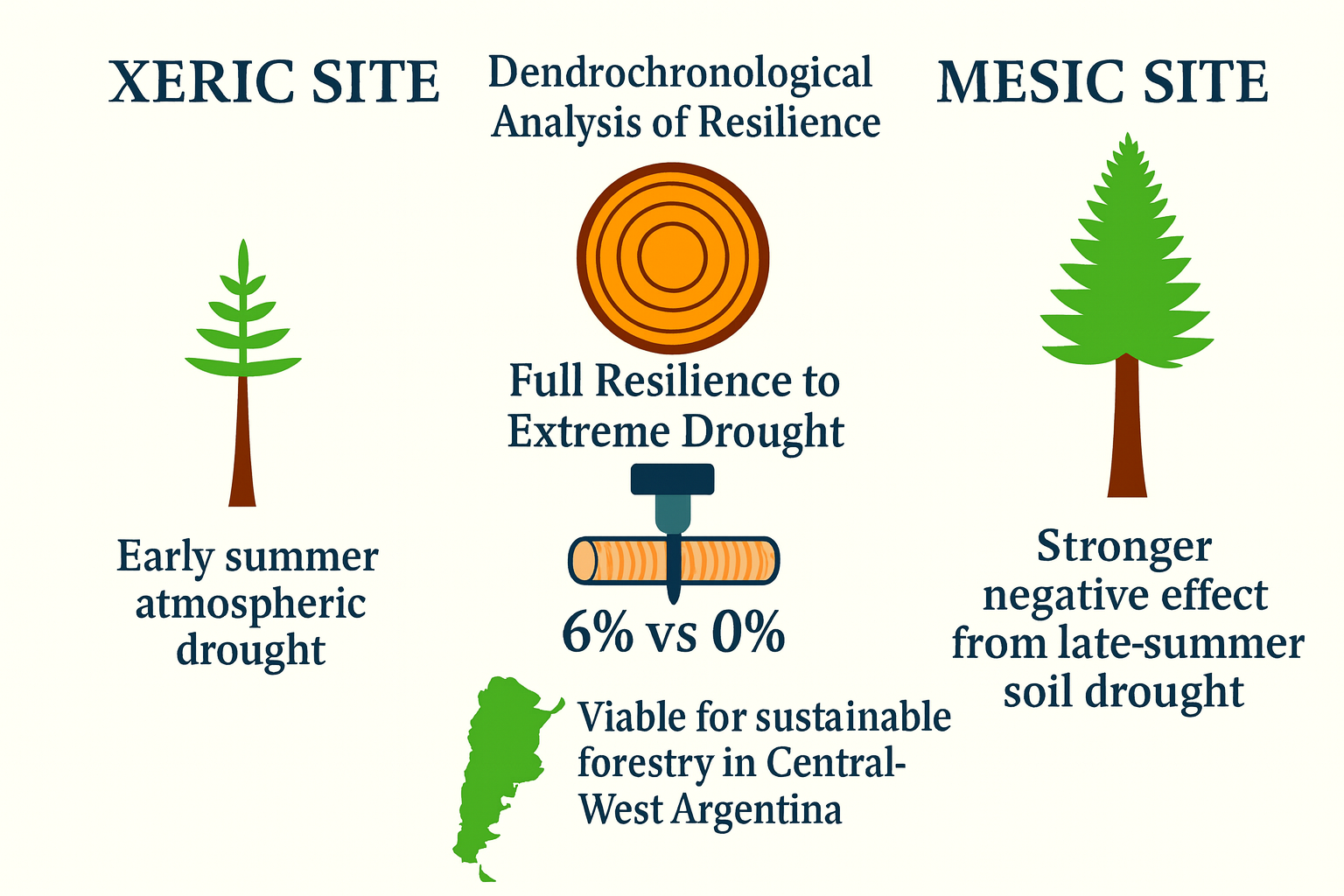
Forests play a crucial role in ecological stability, carbon sequestration, habitat provision and economy. As climate change intensifies, increasing drought frequency and severity challenge our understanding of forest resilience. Based on this premise, we examined radial growth dynamics and drought response of Pinus pinea L. in Mendoza Province in both mesic and xeric conditions. Using dendrochronological techniques, we assessed the long and short-term effects of soil and atmospheric drought on radial growth trends at two irrigated plantations with contrasting environments. Growth dynamics reflected differences in soil, climate, and irrigation. Growth rates were significantly higher at the mesic stand, which received nearly twice the precipitation and irrigation compared to xeric one. In contrast, growth at the xeric site was strongly limited by early-summer atmospheric drought, while late-growing season soil moisture and climatic conditions affected tree-ring development at the mesic site. Growth resilience to extreme events experienced site dependence, with edaphic drought exerting a stronger negative effect than atmospheric dry spells at the mesic stand. Our results underscore the importance of integrating short- and long-term drought assessment into P. pinea management strategies and support the potential of stone pine plantations in extra-Mediterranean South America for sustainable forestry under changing climatic conditions.
Highlights:
- First dendrochronological assessment of Pinus pinea in Central-Western Argentina.
- Radial growth shows site-specific sensitivity to drought types: limited by early-summer atmospheric drought at the xeric site and by late-season soil moisture deficit at the mesic site.
- Irrigation does not fully decouple tree growth from climate, underscoring the need for precise water management in future plantations under semi-arid climates.
- Full resilience to extreme drought is low (≤50%), with edaphic drought exerting a stronger negative impact than atmospheric drought, particularly at the mesic stand.
- pinea demonstrates high potential for forestry diversification in semi-arid regions of South America, offering an alternative for sustainable nut and wood production.
Descargas
Citas
Allen, C. D., Macalady, A. K., Chenchouni, H., Bachelet, D., McDowell, N., Vennetier, M., Kitzberger, T., Rigling , A., Breshears, D. D., Hogg, E. H., Gonzalez, P., Fensham, R., Zhang, Z., Castro, J., Demidova, N., Lim, J. N., Allard, G., S., Running S. W., Semerci, A., Cobb, N. (2010). A global overview of drought and heat-induced tree mortality reveals emerging climate change risks for forests. Forest ecology and management, 259(4), 660-684.
Bagnouls, F. (1953). Saison sèche et indice xérothermique. Bull Soc His nat Toulouse, 88, 193-239.
Barnes, B. V., Zak, D. R., Denton, S. R., & Spurr, S. H. (1997). IForest ecology (N° Ed. 4, p. xviii+-774).
Berauer, B. J., Steppuhn, A., & Schweiger, A. H. (2024). The multidimensionality of plant drought stress: The relative importance of edaphic and atmospheric drought. Plant, Cell & Environment, 47(9), 3528-3540.
Biondi, F., & Waikul, K. (2004). DENDROCLIM2002: A C++ program for statistical calibration of climate signals in tree-ring chronologies. Computers & geosciences, 30(3), 303-311.
Calama, R., Gordo, J., Mutke, S., Conde, M., Madrigal, G., Garriga, E., Arias, M. J., Piqué, M., Gandía, R., Monterno, G., Pardos, M. (2020). Decline in commercial pine nut and kernel yield in Mediterranean stone pine (Pinus pinea L.) in Spain. Forest-Biogeosciences and Forestry, 13(4), 251.
Calderón, A., Bustamante, J. A., Riu, N., Perez, S. (2008). Conifers behaviour under irrigation in the Yaucha dam. Mendoza, Argentina. Revista de la Facultad de Ciencias Agrarias. Universidad Nacional de Cuyo. 40(1): 67-72. https://bdigital.uncu.edu.ar/app/navegador/?idobjeto=2676
Camarero, J. J., Gazol, A., Linares, J. C., Fajardo, A., Colangelo, M., Valeriano, C., Sánchez-Salguero, R., Sangüesa-Barreda, G., Granda, E., Gimeno, T. E. (2021). Differences in temperature sensitivity and drought recovery between natural stands and plantations of conifers are species-specific. Science of the Total Environment, 796, 148930.
Cook, E. R., & Krusic, P. J. (2008). A tree-ring standardization program based on detrending and autoregressive time series modeling, with interactive graphics (ARSTAN). http://www. ldeo. columbia. edu/res/fac/trl/public/publicSoftware. html
Diaz Dentoni, L. (2024). Análisis de la dinámica de crecimiento de Pinus pinea l. en dos parcelas bajo riego en la provincia de Mendoza. Tesis de grado. FCA-UNCuyo. 34p.
Di Rienzo, J., Casanoves, F., Balzarini, M., Gonzalez, L., Tablada, M., Robledo, C. (2021). InfoStat version 2021.
FAO (Food and Agriculture Organization). (2020). Global Forest Resources Assessment 2020: Main report. FAO, Rome.
Feichtinger, L. M., Eilmann, B., Buchmann, N., & Rigling, A. (2014). Growth adjustments of conifers to drought and to century-long irrigation. Forest Ecology and Management, 334, 96-105.
Fritts, H. C., Smith, D. G., Cardis, J. W., & Budelsky, C. A. (1965). Tree‐ring characteristics along a vegetation gradient in northern Arizona. Ecology, 46(4), 393-401.
Holmes, R. L. (1983). Computer-assisted quality control in tree-ring dating and measurement. Tree-Ring Bulletin, Vol. 43. 1-10.
IPCC (2023). Sections. In: Climate Change 2023: Synthesis Report. Contribution of Working Groups I, II and III to the Sixth Assessment Report of the Intergovernmental Panel on Climate Change [Core Writing Team, H. Lee and J. Romero (eds.)]. IPCC. p. 35-115.
Johnstone, J. F., Allen, C. D., Franklin, J. F., Frelich, L. E., Harvey, B. J., Higuera, P. E., Mack, M. C., Meentemeyer, R. K., Metz, M. R., Perry, G. L. W., Schoennagel, T., Turner, M. G. (2016). Changing disturbance regimes, ecological memory, and forest resilience. Frontiers in Ecology and the Environment, 14(7), 369-378.
Knutzen, F., Dulamsuren, C., Meier, I. C., & Leuschner, C. (2017). Recent climate warming-related growth decline impairs European beech in the center of its distribution range. Ecosystems, 20, 1494- 1511.
Lloret, F., Keeling, E. G., & Sala, A. (2011). Components of tree resilience: effects of successive low‐growth episodes in old ponderosa pine forests. Oikos, 120(12), 1909-1920.
Loewe Muñoz, V., Delard, C., González González, M., Mutke, S., Fuentes Díaz, V. (2012). Introducción del pino piñonero (Pinus pinea L.) en Chile. Ciencia & Investigación Forestal,18(2), 39-52.
Loewe-Muñoz, V., Del Río, R., Delard, C., Balzarini, M. (2022). A detailed time series of hourly circumference variations in Pinus pinea L. in Chile. Annals of Forest Science. 79(1): 4.
Loewe-Muñoz, V., Del Río, R., Delard, C., Cachinero-Vivar, A. M., Camarero, J. J., Navarro-Cerrillo, R., & Balzarini, M. (2024a). Resilience of Pinus pinea L. trees to drought in Central Chile based on tree radial growth methods. Forests, 15(10), 1775.
Loewe-Muñoz, V., Cachinero-Vivar, A. M., Camarero, J. J., Río, R. D., Delard, C., & Navarro-Cerrillo, R. M. (2024b). Dendrochronological analysis of Pinus pinea in Central Chile and South Spain for sustainable forest management. Biology, 13(8), 628.
Maxwell, R. S., & Larsson, L. A. (2021). Measuring tree-ring widths using the CooRecorder software application. Dendrochronologia, 67, 125841.
Mechergui, K., Saleh Altamimi, A., Jaouadi, W., & Naghmouchi, S. (2021). Climate change impacts on spatial distribution, tree-ring growth, and water use of stone pine (Pinus pinea L.) forests in the Mediterranean region and silvicultural practices to limit those impacts. iForest- Biogeosciences and Forestry, 14(2), 104.
Mishra, A. K., & Singh, V. P. (2010). A review of drought concepts. Journal of hydrology, 391(1-2), 202- 216.
Muñoz, V. F. L., Delard, C., González, M. V. G., Mutke, S., & Díaz, V. C. F. (2012). Introducción del pino piñonero (Pinus pinea L.) en Chile. Ciencia & Investigación Forestal, 18(2), 39-52.
Mutke, S., Calama, R., González-Martínez, S. C., Montero, G., Javier Gordo, F., Bono, D., & Gil, L. (2012). Mediterranean stone pine: botany and horticulture. Horticultural reviews, 39(1), 153-201.
Natalini, F., Alejano, R., Vázquez-Piqué, J., Pardos, M., Calama, R., & Büntgen, U. (2016). Spatiotemporal variability of stone pine (Pinus pinea L.) growth response to climate across the Iberian Peninsula. Dendrochronologia, 40, 72-84.
Natalini, F., Alejano, R., Pardos, M., Calama, R., & Vázquez-Piqué, J. (2024). Declining trends in long-term Pinus pinea L. growth forecasts in Southwestern Spain. Dendrochronologia, 88, 126252.
Navarro-Cerrillo, R. M., Cachinero-Vivar, A. M., Pérez-Priego, Ó., Cantón, R. A., Begueria, S., & Camarero, J. J. (2023). Developing alternatives to adaptive silviculture: Thinning and tree growth resistance to drought in a Pinus species on an elevated gradient in Southern Spain. Forest Ecology and Management, 537, 120936.
Perulli, G. D., Peters, R. L., von Arx, G., Grappadelli, L. C., Manfrini, L., & Cherubini, P. (2019). Learning from the past to improve in the future: tree-ring wood anatomy as retrospective tool to help orchard irrigation management. In IX International Symposium on Irrigation of Horticultural Crops 1335 (p. 179-188).
Piraino, S. (2020). Assessing Pinus pinea L. resilience to three consecutive droughts in central-western Italian Peninsula. iForest-Biogeosciences and Forestry, 13(3), 246.
Piraino, S., Camiz, S., Di Filippo, A., Piovesan, G., & Spada, F. (2013). A dendrochronological analysis of Pinus pinea L. on the Italian mid-Tyrrhenian coast. Geochronometria, 40, 77-89.
Piraino, S., Cignoli, F. N., Robledo, S., & Pérez, S. (2021). Un pino mediterráneo en Sudamérica: situación actual y potencialidad de Pinus pinea L. en territorio argentino. Experticia, 12(1). 7-10. https://revistas.uncu.edu.ar/ojs3/index.php/experticia/article/view/5041
Piraino, S., Molina, J. A., Hadad, M. A., & Roig, F. A. (2022). Resilience capacity of Araucaria araucana to extreme drought events. Dendrochronologia, 75, 125996.
Piraino, S., Hadad, M. A., Ribas‑Fernández, Y. A., & Roig, F. A. (2024). Sex-dependent resilience to extreme drought events: implications for climate change adaptation of a South American endangered tree species. Ecological Processes, 13(1), 24.
Rigling, A., Brühlhart, H., Bräker, O. U., Forster, T., & Schweingruber, F. H. (2003). Effects of irrigation on diameter growth and vertical resin duct production in Pinus sylvestris L. on dry sites in the central Alps, Switzerland. Forest Ecology and Management, 175(1-3), 285-296.
Schulman, E. (1956). Dendroclimatic changes in semiarid America. University of Arizona.
Schwarz, J., Skiadaresis, G., Kohler, M., Kunz, J., Schnabel, F., Vitali, V., & Bauhus, J. (2020). Quantifying growth responses of trees to drought-A critique of commonly used resilience indices and recommendations for future studies. Current Forestry Reports, 6, 185-200.
Speer, J. H. (2010). Fundamentals of tree-ring research. University of Arizona Press.
Trouet, V., & Van Oldenborgh, G. J. (2013). KNMI Climate Explorer: a web-based research tool for high-resolution paleoclimatology. Tree-Ring Research, 69(1), 3-13.
Vicente-Serrano, S. M., Beguería, S., & López-Moreno, J. I. (2010). A multiscalar drought index sensitive to global warming: the standardized precipitation evapotranspiration index. Journal of climate, 23(7), 1696-1718.
Villalba, R., & Veblen, T. T. (1997). Spatial and temporal variation in Austrocedrus growth along the forest steppe ecotone in northern Patagonia. Canadian Journal of Forest Research, 27(4), 580-597.
Wigley, T. M., Briffa, K. R., & Jones, P. D. (1984). On the average value of correlated time series, with applications in dendroclimatology and hydrometeorology. Journal of Applied Meteorology and climatology, 23(2), 201-213.
Descargas
Publicado
Cómo citar
Número
Sección
Licencia

Esta obra está bajo una licencia internacional Creative Commons Reconocimiento-NoComercial-CompartirIgual 3.0.
Aquellos autores/as que tengan publicaciones con esta revista, aceptan las Políticas Editoriales.
 RevFCAUNCuyo






.jpg)