
Determinants of Agricultural Land Prices in the Mendoza River Basin: A Spatial Hedonic Analysis with Emphasis on Irrigation Water
DOI:
https://doi.org/10.48162/rev.39.205Palabras clave:
precio hedónico, valor de la tierra agrícola, agua de riego, características del terreno , geoestadística, regiones áridas, cuencas hidrográficasResumen
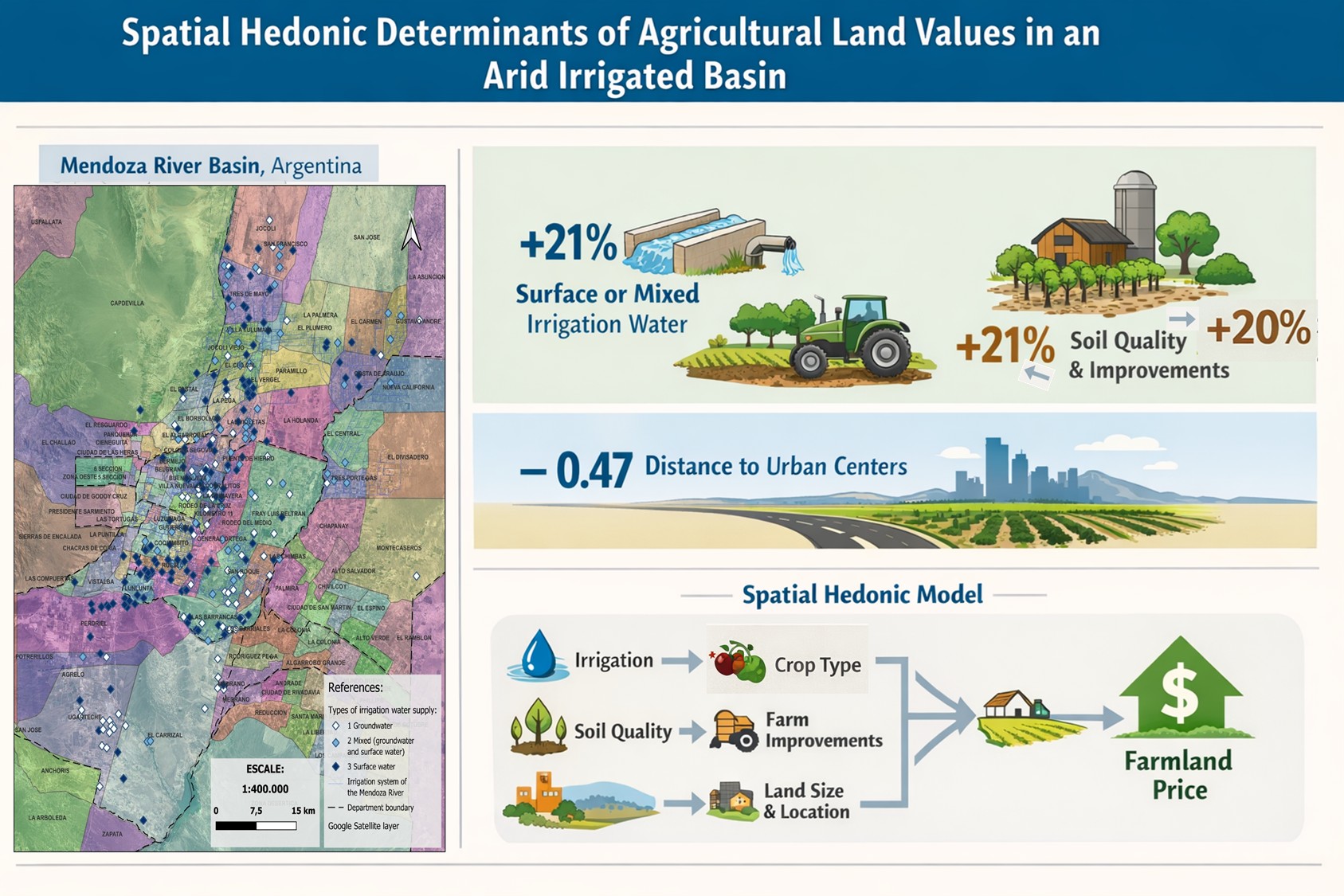
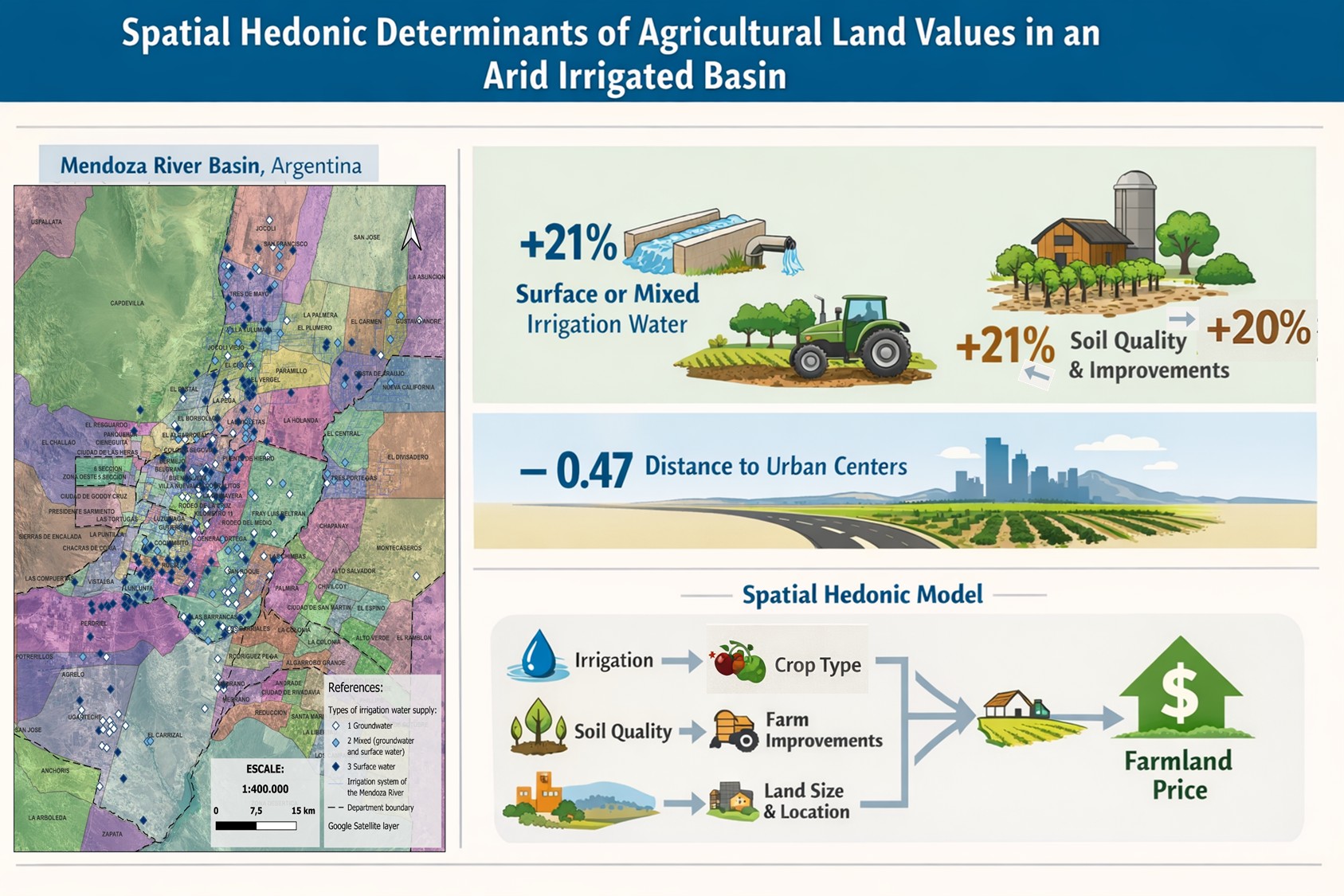
This research examines the determinants of agricultural land prices in the Mendoza River Basin, with emphasis on the marginal contribution of irrigation water as a strategic resource in an arid context. An original georeferenced database of 297 cultivated rural properties (2003-2024) was compiled, using advertised asking prices expressed in 2024 constant US dollars. A mixed spatial hedonic model with a log-log functional form was applied, incorporating hierarchical random effects (district nested within department), exponential spatial correlation, and heterogeneous variance across districts. The results indicate that properties with definitive surface irrigation rights command prices approximately 21% higher than comparable properties that rely exclusively on groundwater, confirming surface irrigation water as a pivotal economic asset. Soil quality and productive improvements increase land values by approximately 20% and 21%, respectively. In contrast, land size and distance to urban centres have significant negative effects (elasticities of -0.39 and -0.47). These findings highlight the central role of surface irrigation water as an economic asset and indicate a territorially segmented land market. The proposed methodology provides empirical evidence to support the design and implementation of water management and land-use planning policies in irrigated agricultural regions.
Highlights:
- A spatial mixed log–log hedonic model is estimated for 297 agricultural properties in an arid irrigated basin.
- Secure surface or mixed irrigation water increases farmland prices by approximately 21% relative to groundwater-only properties.
- Soil quality and productive improvements generate land value premiums of approximately 20% and 21%, respectively.
- Larger farms and greater distance to urban centres significantly reduce land values.
- Accounting for spatial dependence and territorial hierarchy improves inference and policy relevance.
Descargas
Citas
Bastian, C. T., McLeod, D. M., Germino, M. J., Reiners, W. A. & Blasko, B. J. (2002). Environmental amenities and agricultural land values: A hedonic model using geographic information systems data. Ecological Economics, 40(3), 337-349. https://doi.org/10.1016/S0921-8009(01)00278-6
Berbel, J., & Mesa, P. (2007). Valoración del agua de riego por el método de precios quasi-hedónicos: aplicación al Guadalquivir. Economía Agraria y Recursos Naturales, 7(14), 127-144.
Bolsa de Comercio de Mendoza. (2024). Estadística de los Mercados-Uva varietal. https://bcmdz.com. ar/servicios/tasa-estadistica#mercados
Caballer Mellado, V., & Guadalajara Olmeda, N. (2005). Modelos econométricos de valoración de la tierra de uso agrícola: Una aplicación al Estado español. Revista española de Estudios Agrosociales y Pesqueros, 205, 13-38.
Chicoine, D. L. (1981). Farmland values at the urban fringe: An analysis of sale prices. American Journal of Agricultural Economics, 63(3), 530–537.
Ciardullo, V. F., & Gennari, A. J. (2025). Agricultural Land Valuation-Hedonic Pricing and Geostatistical Advances: A State-of-the-Art Review. Revista de la Facultad de Ciencias Agrarias. Universidad Nacional de Cuyo. 57(2), 224-236. https://doi.org/10.48162/rev.39.185
Córdoba, M., Carranza, J. P., Piumetto, M., Monzani, F., & Balzarini, M. (2021). A spatially based quantile regression forest model for mapping rural land values. Journal of Environmental Management, 289, 112509.
Decimavilla, E., & Sperlich, S. (2008). Urban pressure and land value in Spain: A hedonic pricing approach. Agricultural Economics Review, 9(1), 22-33.
Demetriou, D. (2015). A GIS-based hedonic price model for agricultural land. In D. G. Hadjimitsis, K. Themistocleous, S. Michaelides, & G. Papadavid (Eds.), Proceedings of SPIE. The International Society for Optical Engineering, 9535, 95350B. https://doi. org/10.1117/12.2192498
Departamento General de Irrigación. (2016). Balance Hídrico Río Mendoza. DGI.
Departamento General de Irrigación, Mekorot Israel National Water Co., & Consejo Federal de Inversiones. (2023). Plan Maestro para el sector hídrico de la provincia de Mendoza: Informe 1. Estudio de la situación actual del sector hídrico. https://www.irrigacion.gov.ar/web/wp-content/uploads/2025/03/1-PLAN-MAESTRO-PARA-EL-SECTOR-H%C3%8DDRICO-Informe-1-MENDOZA.pdf
Dirección de Agricultura y Contingencias Climáticas. Gobierno de Mendoza. (2010). Índice de siniestralidad por granizo. https://www.mendoza.gov.ar/contingencias/
Dirección de Estadísticas e Investigaciones Económicas. Ministerio de Gobierno, Infraestructura y Desarrollo Territorial. Gobierno de Mendoza. (2024). Participación del Producto Bruto Geográfico por Departamento. https://deie.mendoza.gov.ar/
Donoso, G., Cancino, J., & Foster, W. (2013). Farmland values and agricultural growth: The case of Chile. Economía Agraria y Recursos Naturales, 13(2), 33-52. https://doi.org/10.7201/ earn.2013.02.02
Faux, J., & Perry, G. M. (1999). Estimating irrigation water value using hedonic price analysis: A case study in Malheur County, Oregon. Land Economics, 75(3), 440-452.
Federal Reserve Bank of Minneapolis. (2024). Consumer Price Index, 1913. https://www. minneapolisfed.org/about-us/monetary-policy/inflation-calculator
Fraser, I., & Hilder, C. (2007). Vineyard capitalisation: A hedonic analysis of wine grape growing properties. Australian Journal of Agricultural and Resource Economics, 51(1), 1-17.
Gracia, A., Pérez y Pérez, L., Sanjuán, A., & Barreiro Hurle, J. (2004). Análisis hedónico de los precios de la tierra en la provincia de Zaragoza. Estudios Agrosociales y Pesqueros, 202, 51-69.
Greene, W. H. (2011). Econometric Analysis (7th ed.). Pearson. (Note: the 7th edition was published in the United States in 2011, and in its international version in 2012; the content is identical.).
Guadalajara, H., García, L., & Rodríguez, J. (2019). Assessing the localization impact on land values: A spatial hedonic study. Spanish Journal of Agricultural Research, 17(3), e0110. https://doi. org/10.5424/sjar/2019173-14961
Guida-Johnson, B.; Vignoni, A. P.; Migale, G. M.; Aranda, M. A.; Magnano, A. (2024). Rural abandonment and its drivers in an irrigated area of Mendoza (Argentina). Revista de la Facultad de Ciencias Agrarias. Universidad Nacional de Cuyo. 56(1): 35-47. DOI: https://doi.org/10.48162/rev.39.121
Gujarati, D. N. (2003). Basic econometrics (4th ed.). McGraw-Hill.
Huang, H., Miller, G., Sherrick, B., Gómez, M. (2006). Factors influencing Illinois farmland values. American Journal of Agricultural Economics, 88(2), 458-470.
Instituto Geográfico Nacional. (2025). Información geoespacial. Capas SIG. https://www.ign.gob.ar/ NuestrasActividades/InformacionGeoespacial/CapasSIG
Instituto Nacional de Tecnología Agropecuaria & Departamento General de Irrigación. Gobierno de Mendoza. (2025). Clasificación de suelos y aptitud de riego de la Provincia de Mendoza.
Maddison, D. J. (2000). A hedonic analysis of agricultural land prices in England and Wales. European Review of Agricultural Economics, 27(4), 519-532. https://doi.org/10.1093/erae/27.4.519
Mallios, Z., Papageorgiou, A., Latinopoulos, D., & Latinopoulos, P. (2009). Spatial hedonic pricing models for the valuation of irrigation water. Global NEST Journal, 11(4), 575-582.
Marcolini Tulliani, S. B., Verón Medina, C. S., & Goytia García, M. D. (2015). Rentabilidad y precio de la tierra agrícola: un estudio sobre la región pampeana argentina. CAPIC Review, 13(1), 21-30.
Mukherjee, M., & Schwabe, K. A. (2014). Where’s the salt? A spatial hedonic analysis of the value of groundwater to irrigated agriculture. Agricultural Water Management, 145, 110-122.
Palmquist, R. B., & Danielson, L. E. (1989). A hedonic study of the effects of erosion control and drainage on farmland values. American Journal of Agricultural Economics, 71(1), 55-62.
Rosen, S. (1974). Hedonic prices and implicit markets: Product differentiation in pure competition. Journal of Political Economy, 82(1), 34-55. https://doi.org/10.1086/260169
Sardaro, R., La Sala, P., & Roselli, L. (2020). Land pricing in rural development: The role of irrigation and territorial policies. Land Use Policy, 94, 104531.
von Thünen, J. H. (1966). Isolated state: An English edition of Der isolierte Staat. (P. Hall, Ed. & Trans.). Pergamon Press. (Original work published 1826).
Descargas
Publicado
Cómo citar
Número
Sección
Licencia

Esta obra está bajo una licencia internacional Creative Commons Reconocimiento-NoComercial-CompartirIgual 3.0.
Aquellos autores/as que tengan publicaciones con esta revista, aceptan las Políticas Editoriales.
 RevFCAUNCuyo






.jpg)