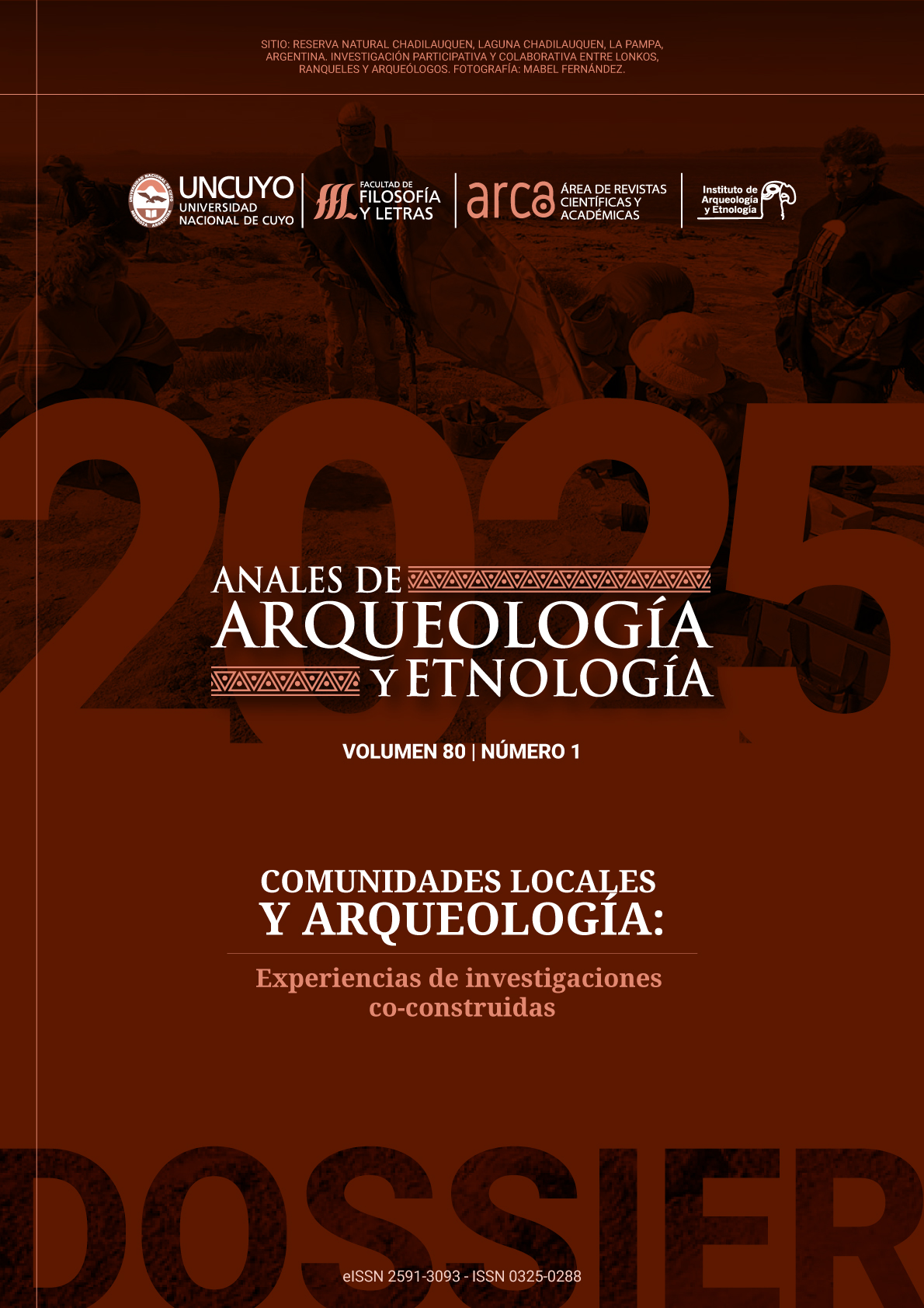
Introducción al Dossier: Comunidades locales y arqueología: experiencias de investigaciones co-construidas
Palabras clave:
co-construction of knowledgeResumen
En los últimos 20 años la Arqueología argentina vislumbró nuevas formas de construcción científica, resultantes de una mirada retrospectiva crítica de la disciplina (Curtoni, 2022; Endere, 2000; Flores y Acuto, 2014). Este giro se basó en el reconocimiento de la existencia de actores que, por fuera de la academia, reclamaban un lugar a la hora de estudiar, interpretar, conservar y resguardar los bienes arqueológicos. Si bien esto puede explicarse, en parte, por cambios de paradigma a escala global, cuando la academia se vio interpelada por los reclamos de movimientos sociales indígenas (Ferguson, 1996; McGuire, 1992; Ranjan, 2017, entre otros), fueron las legislaciones de nuestro país las que, gracias al reconocimiento constitucional de la pre-existencia de los pueblos originarios, abrieron una arena de franca disputa por el pasado (ver autores varios en Briones, 2008, Iturralde 1997; Gordillo y Hirsch, 2010).
Descargas
Citas
Argentina. Congreso de la Nación. (2003). Ley N.º 25.743: Protección del patrimonio arqueológico y paleontológico. Sancionada el 4 de junio de 2003, promulgada el 25 de junio de 2003. https://www.argentina.gob.ar/normativa/nacional/ley-25743-86356/texto
Atalay, S. (2012). Community-based archaeology: Research with, by, and for Indigenous and Local Communities. University of California Press. https://doi.org/10.1525/9780520953468
Batllori, M. D. G. (2019). Reflexión sobre la participación de la sociedad en la arqueología pública y una experiencia de esta realizada en Barrancas Maipú, Mendoza, Argentina. Arqueología y Patrimonio, 1(1), 87–93. https://doi.org/10.22380/26652773.2157
Briones, C. (Comp.). (2005). Cartografías argentinas: Políticas indigenistas y formaciones provinciales de alteridad. Antropofagia.
Curtoni, R. (2022). La restitución de cuerpos indígenas y la colonialidad de la ancestralidad. Revista Tefros, 20(1), 59–78.http://www2.hum.unrc.edu.ar/ojs3/index.php/tefros/article/view/1275
Declaración de Río Cuarto. (2005). Primer Foro Pueblos Originarios-Arqueólogos (Río Cuarto, 2005). Arqueología Suramericana, 1(2), 287–293.
Delfino, D., B. Manasse, R. A. Díaz y M.G. Pisani. (2016). La arqueología socialmente útil y la arqueología pública. Reflexiones desde la praxis. En Actas del XIX Congreso Nacional de Arqueología Argentina, Serie Monográfica y Didáctica (Vol. 54, pp. 2648–2653).
Endere, M. L. (2000). Patrimonios en disputa: Acervos nacionales, investigación arqueológica y reclamos étnicos sobre restos humanos. Trabajos de Prehistoria, 57(1), 5–17. https://doi.org/10.3989/tp.2000.v57.i1.258
Ferguson, T. J. (1996). Native Americans and the practice of archaeology. Annual Review of Anthropology, 25(1), 63–79.
Flores, C., y Acuto, F. (2014). Pueblos originarios y arqueología argentina. Construyendo un diálogo intercultural y reconstruyendo la arqueología. Intersecciones en Antropología, 16, 179–194. http://ref.scielo.org/3dyv29
Gordillo, G., y Hirsch, S. (2010). La presencia ausente: Invisibilizaciones, políticas estatales y emergencias indígenas en la Argentina. En G. Gordillo & S. Hirsch (Eds.), Movilizaciones indígenas e identidades en disputa (pp. 15–38). La Crujía.
Haber, A. (2010). Arqueología indígena y poder campesino. En Pueblos indígenas y arqueología en América Latina (pp. 51–61).
Iturralde, D. (1997). Demandas indígenas y reforma legal: retos y paradojas. Alteridades, 7(14), 81–98.
Mc Guire, R. H. (1992). Archeology and the first Americans. American Anthropologist, 94(4), 816–836. https://doi.org/10.1525/aa.1992.94.4.02a00030
Quijano, A. (2000). Colonialidad del poder, eurocentrismo y América Latina. En E. Lander (Ed.), La colonialidad del saber: Eurocentrismo y ciencias sociales. Perspectivas latinoamericanas (pp. 201–246). CLACSO.
Ranjan, D. (2017). Decolonizing both researcher and research and its effectiveness in Indigenous research. Research Ethics, 14(2), 1–24. https://doi.org/10.1177/1747016117733296
Salerno, V. M., Picoy, M. C., Tello, M., Pinochet, H. C., Lavecchia, C., y Moscovici Vernieri, G. (2016). Lo "público" en la arqueología argentina. Chungará (Arica), 48(3), 397–408. http://dx.doi.org/10.4067/S0717-73562016005000015
Descargas
Publicado
Cómo citar
Número
Sección
Licencia
Derechos de autor 2025 Violeta Anahí Killian Galván, Maria Soledad Gheggi

Esta obra está bajo una licencia internacional Creative Commons Atribución-NoComercial-CompartirIgual 4.0.
Esta obra está bajo licencia internacional Creative Commons Reconocimiento-NoComercial-CompartirIgual 4.0.
Quienes publiquen en Anales de Arqueología y Etnología aceptan las siguientes condiciones:
- Los/as autores/as conservan los derechos de autor y ceden a la revista el derecho de la primera publicación, el cual está sujeto a la licencia Creative Commons, que permite a terceros utilizar lo publicado siempre que mencionen la autoría del trabajo y a la primera publicación en esta revista.
- Los/as autores/as podrán realizar otros acuerdos contractuales no exclusivos para la distribución de la versión del artículo publicado (p. ej., incluirlo en un repositorio institucional o publicarlo en un libro o monografía) siempre que se indique expresamente que el trabajo se publicó por primera vez en esta revista.
Los artículos firmados son de responsabilidad exclusiva de sus autores.
Anales de Arqueología y Etnología garantiza el libre acceso y la gratuidad para autores/as y lectores/as.